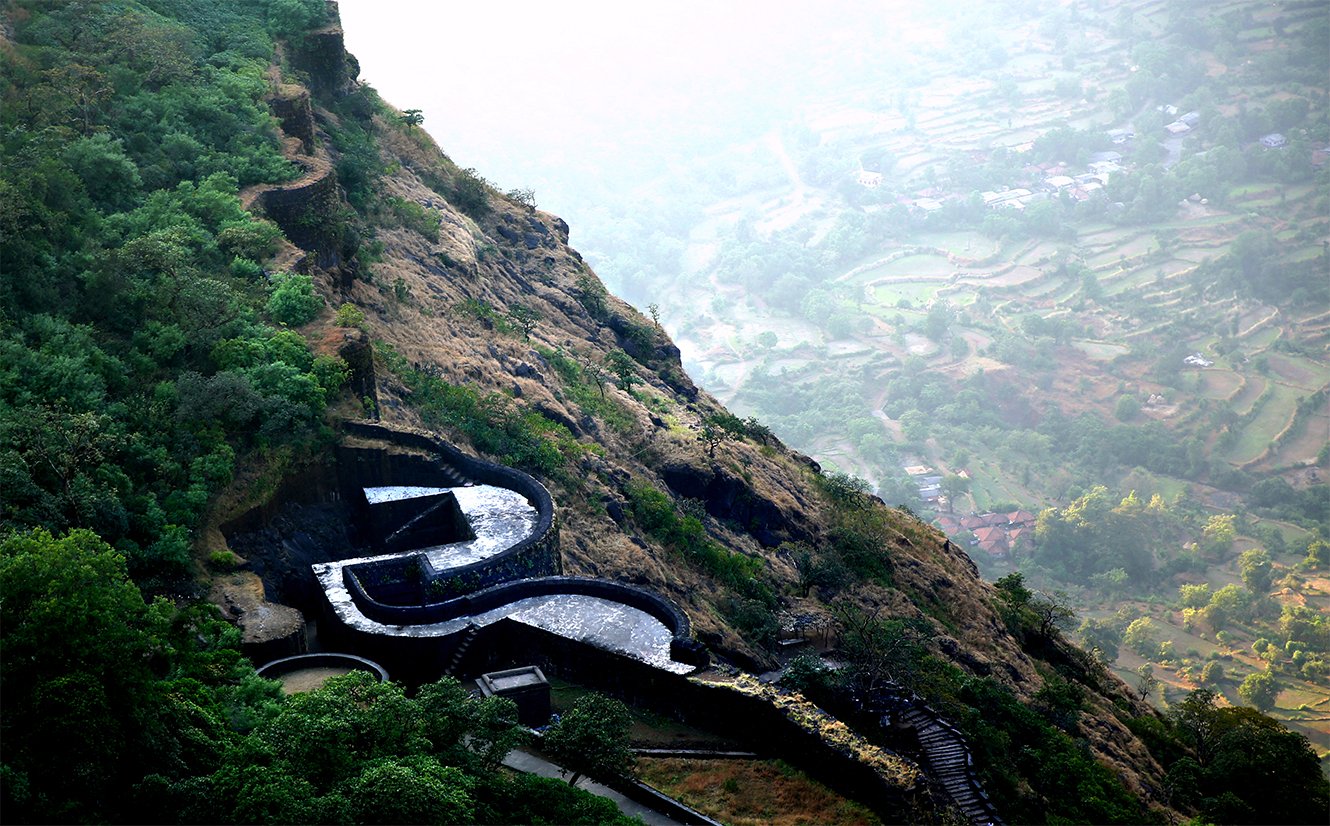
Maratha hill fort in the Western Ghats, where Shivaji was crowned and later buried.
Raigad Fort, in the Sahyadri ranges of the Western Ghats, was the capital of the Maratha warrior king Chhatrapati Shivaji Maharaj. Perched on a sheer-sided plateau roughly 820 m above the surrounding valley, it was one of the most formidable fortresses of 17th-century India. Shivaji was crowned here in 1674 and died here in 1680.
The fort is now largely ruined — the British destroyed much of it after the collapse of Maratha power — but the scale of the original construction remains impressive. The Raigad ropeway (cable car) connects the base to the top; the walk up takes about two hours through forest. The iconic equestrian statue of Shivaji, the ruins of the market area, the Maha Darwaja gate, the Jagdishwar Temple, and the tomb of Shivaji are all within the fort complex. The execution cliff at Takmak Tok commands the western edge.
The views of the Konkan coast and the surrounding Sahyadri ranges are spectacular on a clear day. Raigad is about 120 km from Mumbai and can be visited as a day trip.
Guide
Getting There
Raigad is roughly 170 km south of Mumbai by road and 130 km west of Pune, both reachable in 4–5 hours along the NH66 and the Mumbai-Goa highway. The nearest railway station of any size is Mahad, about 25 km away, but most travellers come on day trips by car or organised bus.
Public transport from Mumbai is awkward — buses go to Mahad, after which a local jeep or taxi is needed up to the base of the fort. Hiring a car for the day from Mumbai or Pune is far easier and lets you stop for views along the way.
Guide
When to Go
October to March is the season to climb. Skies are clear, the views down the Konkan are vast, and the temperature on the plateau stays comfortable. Monsoon (June to September) brings dense cloud, slippery rock, and frequent closure of the upper paths, though the green of the ranges is at its most extravagant. Locals make a pilgrimage to the fort on Shivaji's birthday (19 February) and on his coronation anniversary in early June, and the site can be crowded around both.
Aim to start the climb (or the ropeway) before mid-morning — by midday the upper plateau can be hot and the haze hides the long views.