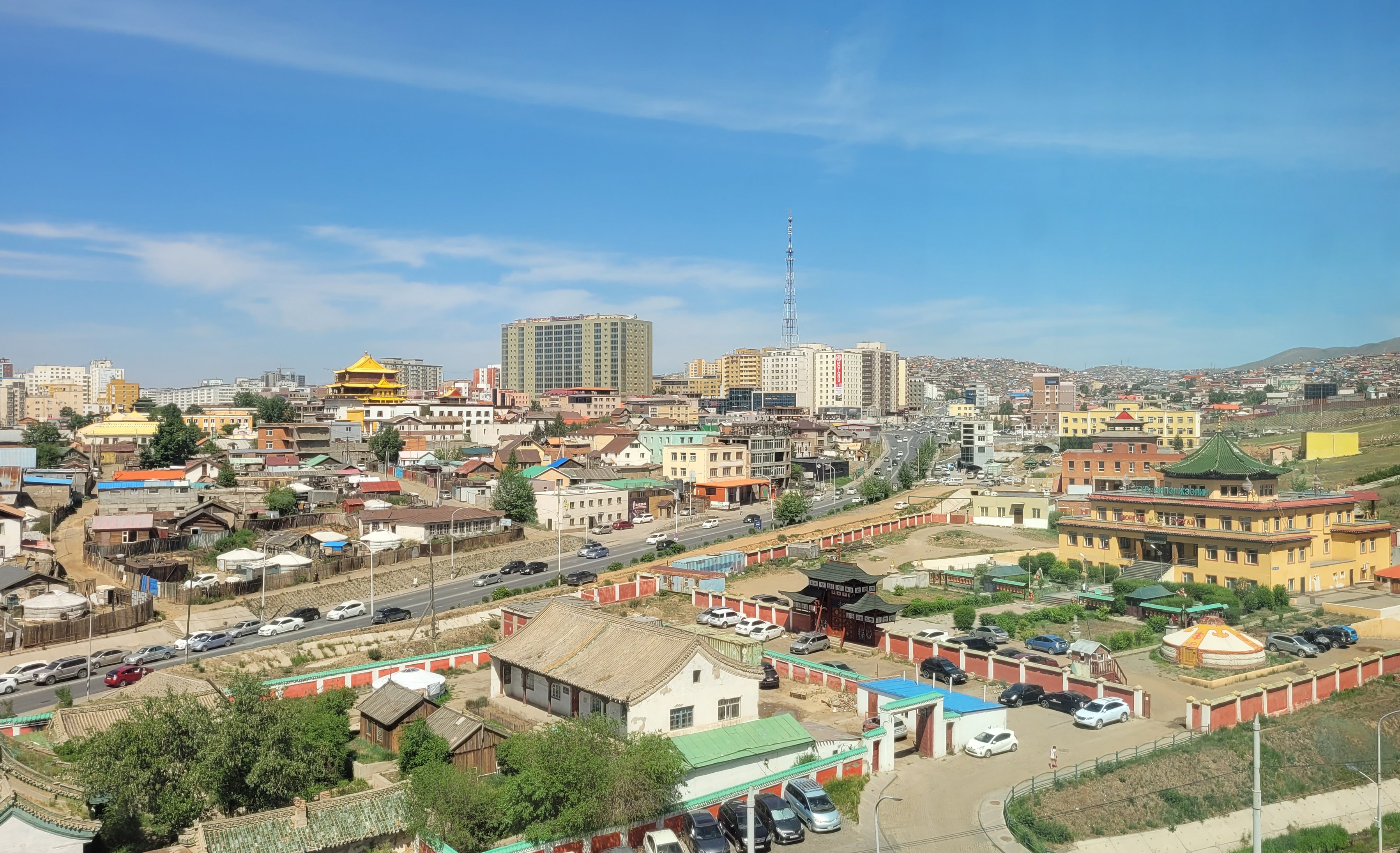
Ulaanbaatar — UB to everyone who goes there — is the capital of Mongolia and home to about half the country's entire population: 1.5 million people in a basin at 1,350 metres, surrounded by four sacred mountains and some of the emptiest steppe on earth. It is a strange, compelling city — part Soviet concrete, part glass-and-steel boom town, part ger (yurt) district where nomadic families who have moved to the city live in fenced compounds of traditional felt tents within sight of the high-rises. In winter it is one of the coldest capitals in the world, regularly hitting -30°C; in summer it is warm, dusty, and alive with the preparations for the Naadam festival.
Most visitors to Mongolia pass through UB on the way to the countryside — the Gobi, the Khentii mountains, the Orkhon valley — and the city works best as a base for organising those trips. But it has a few things worth a day or two. The Gandantegchinlen Monastery (Gandan), in the west of the city, is the most important Buddhist monastery in Mongolia — destroyed under the Soviets, rebuilt since 1990, and now home to a 26-metre gilded statue of the bodhisattva Avalokiteśvara and a community of working monks. The National Museum of Mongolia gives a strong overview of the country's history from Stone Age to Soviet era. The Chinggis Khaan Square (formerly Sükhbaatar Square) is the ceremonial centre of the city, with the Parliament House and a large seated statue of Genghis Khan.
UB's food scene has improved enormously: Mongolian cuisine (buuz — steamed dumplings, khuushuur — fried meat pies, airag — fermented mare's milk) alongside a growing number of Korean, Japanese, and international restaurants. The Naran Tuul (Black Market) is the city's vast outdoor bazaar where you can buy anything from a saddle to a satellite dish, and it is the best people-watching in the city.
The Naadam Festival (11–13 July) is the reason to time a visit: three days of the "three manly games" — wrestling, horse racing (with child jockeys riding 30 km across the steppe), and archery — in and around the national stadium. It is Mongolia's defining cultural event and one of the great spectacles in Central Asia.