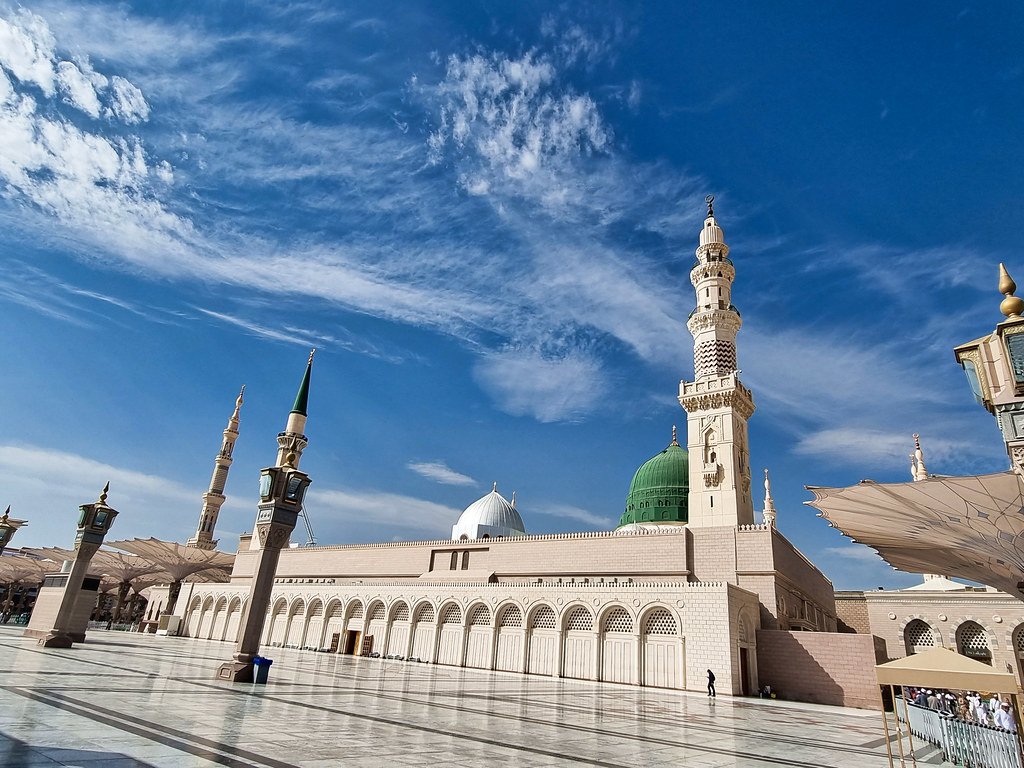
Medina is the second holiest city in Islam, after Mecca. It lies in the Hejaz region of western Saudi Arabia, about 400 kilometres north of Mecca and close to the Red Sea harbour town of Yanbu. The name literally means "the city" — short for Madinat al-Nabi, the City of the Prophet.
Medina is not a tourist city. Non-Muslims are prohibited from entering the city and its sacred precincts, and most visitors come on the Hajj pilgrimage or the Umra. A stop here is not technically required for either, but vast numbers of pilgrims make the journey to pray at the Prophet's Mosque and visit the tomb of Muhammad. The city is also important in the history of Islam: it was here, not in Mecca, that the first Islamic community was established, that the early battles of Islam were fought, and that the Prophet spent the last decade of his life.
The Prophet's Mosque, with its iconic green dome, dominates the city centre and is one of the largest buildings in the world. The adjacent Jannat al-Baqi cemetery is among the oldest Islamic burial grounds in existence, containing many of the Prophet's family and companions. Beyond the central precincts, the Hejaz Railway Museum tells the story of the Ottoman railway that briefly connected the city to Damascus, and the Seven Mosques complex on the northwestern edge marks the site of the Battle of the Trench. The volcanic rock of Sela rises nearby, the vantage point from which Muhammad directed that famous battle.