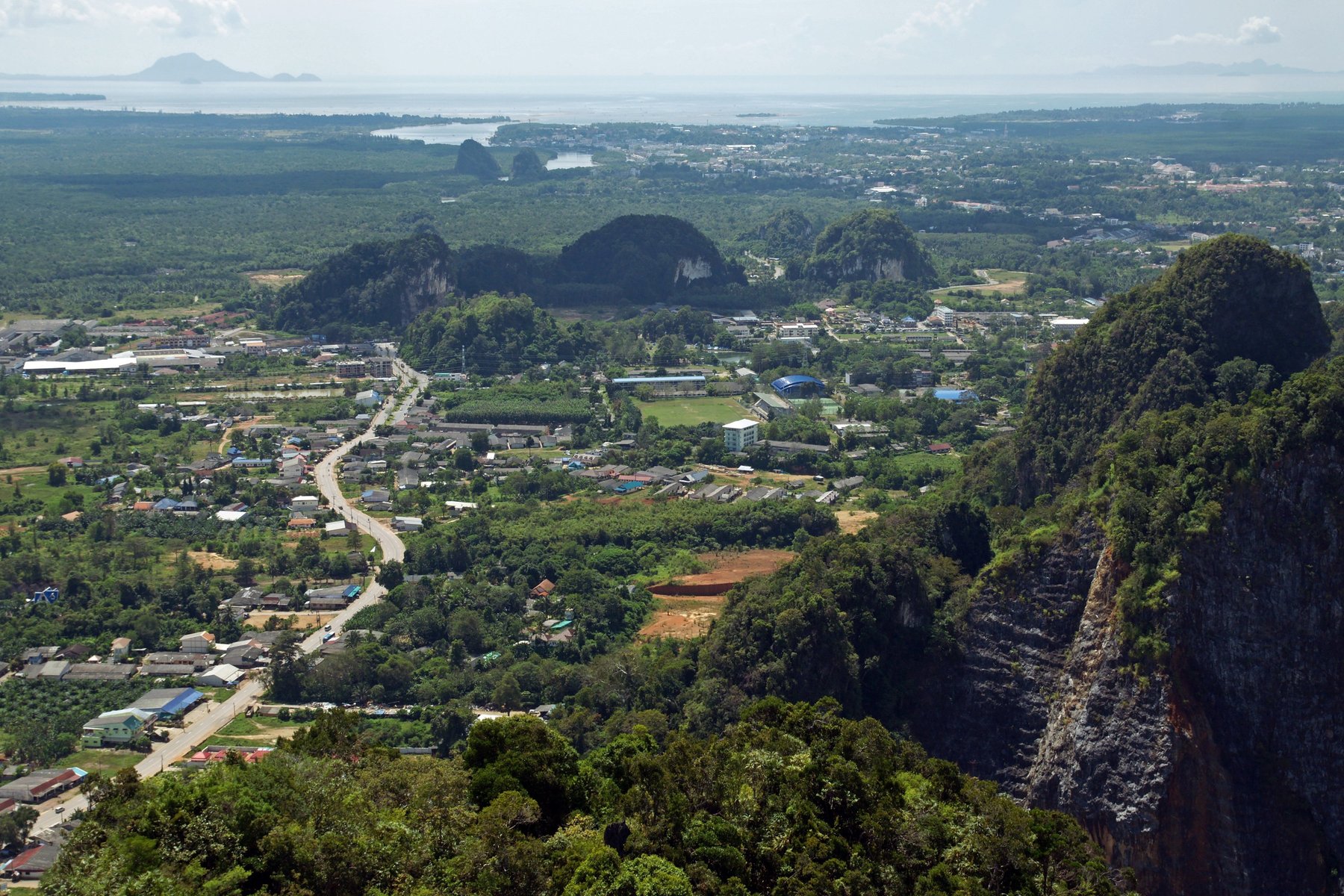
Provincial capital on the Krabi River, with markets and temples near Andaman coast ferries.
Krabi Town is the provincial capital of Krabi, sitting where the Krabi River flows into Phang Nga Bay on Thailand's Andaman coast. Most travellers pass through on their way to the beaches and islands — Ao Nang, Railay, and the ferry piers are all nearby — but the town itself is worth a couple of days. It has a genuine character that the resort strips lack: a busy morning market, a walkable riverside promenade, Buddhist temples, and a lively night market.
The setting is spectacular. Limestone karst peaks rise straight out of the flat coastal plain in every direction, and the river mouth is lined with mangroves. Longtail boats tie up at the pier where fishermen unload their catches alongside tour operators selling island trips. The pace is relaxed and the prices are much lower than at the beaches.
Wat Kaew Korawaram, the town's main temple, gleams white on a hill above the centre and is worth climbing for the views. The Krabi Fossil Shell Beach (Susa Hoi) — a 75-million-year-old shellbed that looks like a rocky walkway — lies about 17 kilometres west of town and is one of only three such formations in the world. Tiger Cave Temple (Wat Tham Suea), with its 1,237-step climb to a hilltop viewpoint, is the most dramatic excursion in the area.
For the beaches: Ao Nang is the nearest resort beach, about 4 kilometres west by road. The islands — Ko Phi Phi, Ko Lanta, Ko Jum — are reached by ferry from the pier. Songthaews (shared trucks) and tuk-tuks cover most local routes. Long-distance buses and minivans depart from the bus terminal on Uttarakit Road.
Guide
Getting Around
Krabi Town itself is walkable. Most hotels, restaurants, and the main market are within easy walking distance of the riverside pier.
For trips out of town, songthaews (red trucks converted to carry passengers) run to Ao Nang and the Nopparat Thara Beach about every 20 minutes from the town centre. Tuk-tuks cover shorter distances and shorter budgets; agree a price before getting in.
Longtail boats from the main pier run to Ko Klang island and to the ferry terminals for islands further afield. The pier is also the departure point for the passenger ferries to Ko Phi Phi and Ko Lanta.
Motorbike rental is available from several shops near the market. This is the most flexible option if you want to explore the surrounding karst countryside or reach Tiger Cave Temple and the Shell Cemetery under your own steam.
Guide
Getting There
Krabi Airport (KBV) lies about 15 kilometres from the town centre and has direct flights from Bangkok (Suvarnabhumi and Don Mueang), Kuala Lumpur, and several European cities in high season. A taxi from the airport to town costs around 300–350 baht; shared minibuses are cheaper.
From Bangkok by bus or train, the journey is long — around 11–12 hours by overnight bus from the Southern Bus Terminal, or you can take the train to Surat Thani and then a connecting bus. Most travellers fly.
From Phuket (about 160 kilometres), minibuses and public buses run throughout the day; journey time is 2–3 hours. From Ko Lanta and Ko Phi Phi, ferries arrive at the main pier in town — the pier is central, not at the airport or on the edge of town.
Guide
When to Go
The Andaman coast has a pronounced wet season driven by the southwest monsoon. The dry season runs from November to April, with the peak months being December to February: sunny, lower humidity, and excellent sea conditions for island hopping. March and April are still good but temperatures rise sharply.
The wet season (May to October) brings heavy rain, particularly in August and September. The sea can be rough and some boat services to the islands are suspended during this period. However, prices drop considerably and the crowds thin out. Krabi Town itself is perfectly functional in the wet season — the rain usually comes in short afternoon bursts rather than all-day downpours.
The Friday and Saturday walking street market on the riverside is year-round and well worth timing your arrival around.