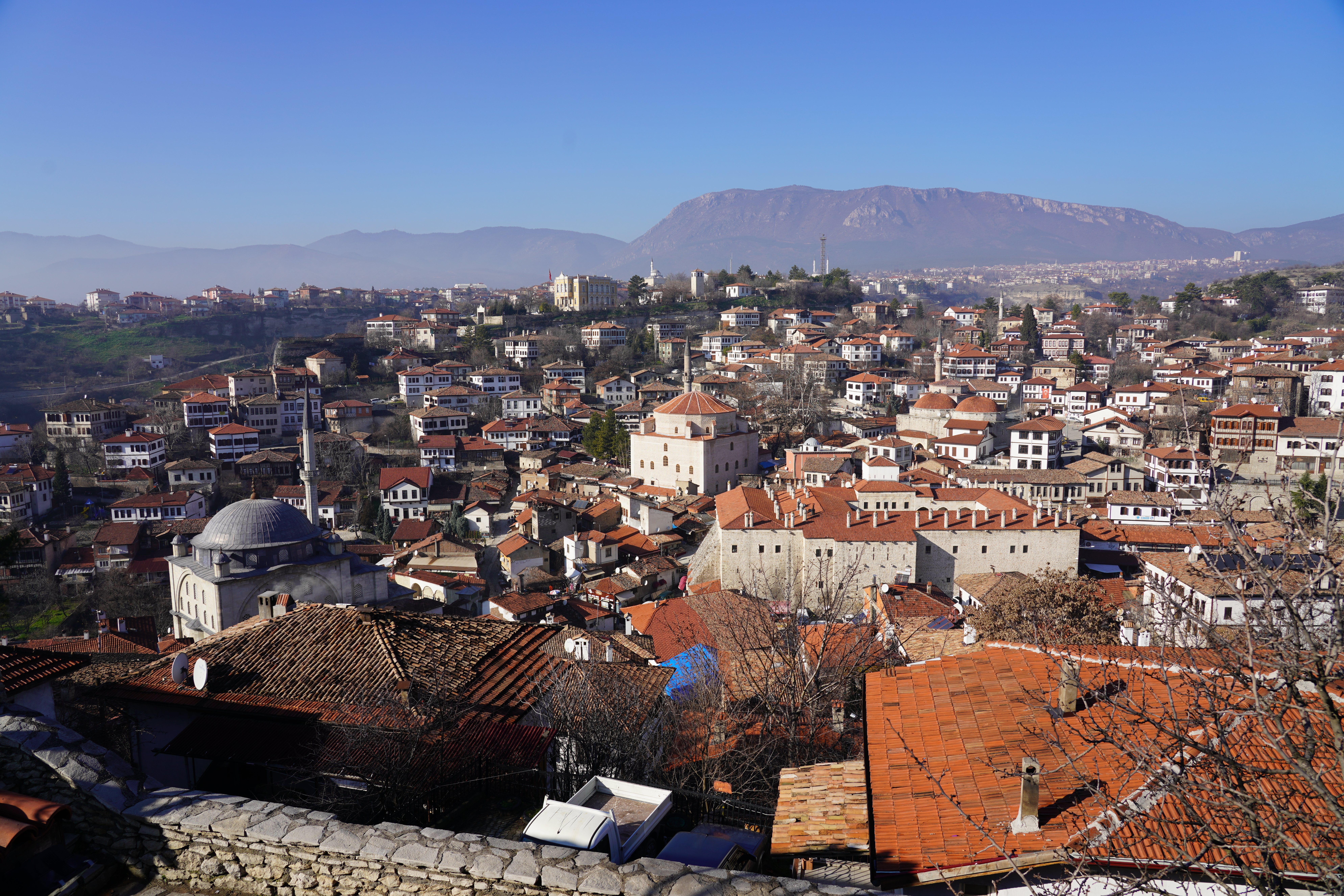
Safranbolu is one of the best-preserved Ottoman towns in existence — a UNESCO World Heritage Site since 1994 and one of the rare cases where a designation like that actually describes something real. The old town (Çarşı) is a maze of 18th and 19th-century Ottoman houses with overhanging upper floors, carved wooden interiors, and basement winter quarters, all built into a narrow valley with a stream running through it and a mosque marking the centre. Walk in any direction from the old bazaar and you will stumble onto something that looks like it should be in a museum but is instead someone's home.
The town takes its name from saffron — the crocus from which it is derived was cultivated here for centuries and still is, in modest quantities, in gardens around the valley. The spice trade, and later a position on the Ottoman road between Istanbul and Sinop on the Black Sea, made Safranbolu prosperous enough to build the houses that now define it. The iron and steel industry came to the nearby city of Karabük in the 1930s, and while that brought the region employment, it also brought pollution and industrial sprawl — which paradoxically helped preserve Safranbolu by keeping it slightly off the main circuit of modernisation.
The key sights are the Cinci Han caravanserai, still operating as a hotel, the Cinci Hammam next door, the İzzet Mehmet Pasha Mosque, and the Kaymakamlar House, a beautifully restored mansion open to visitors. Above the old town sits the Hidirlik Hill, with sweeping views over the valley, and outside town the İncekaya Aqueduct is a surprising piece of 18th-century hydraulic engineering. The town is compact enough to cover on foot in a day, but it rewards a slower pace — stay a night, eat in the old bazaar, and walk the residential lanes in the evening when the day-trippers have gone.