Papeete is the capital of French Polynesia, a low-rise waterfront city of about 130,000 people on the north-west coast of Tahiti. It is not a beautiful city — the harbour is industrial, the centre is dominated by concrete offices and a cruise-ship terminal, and for many travellers it is mostly a transit point on the way to Bora Bora, Moorea, or the Marquesas. That said, nearly every visitor to French Polynesia passes through here at some point, and a day or two is enough to see what there is of it.
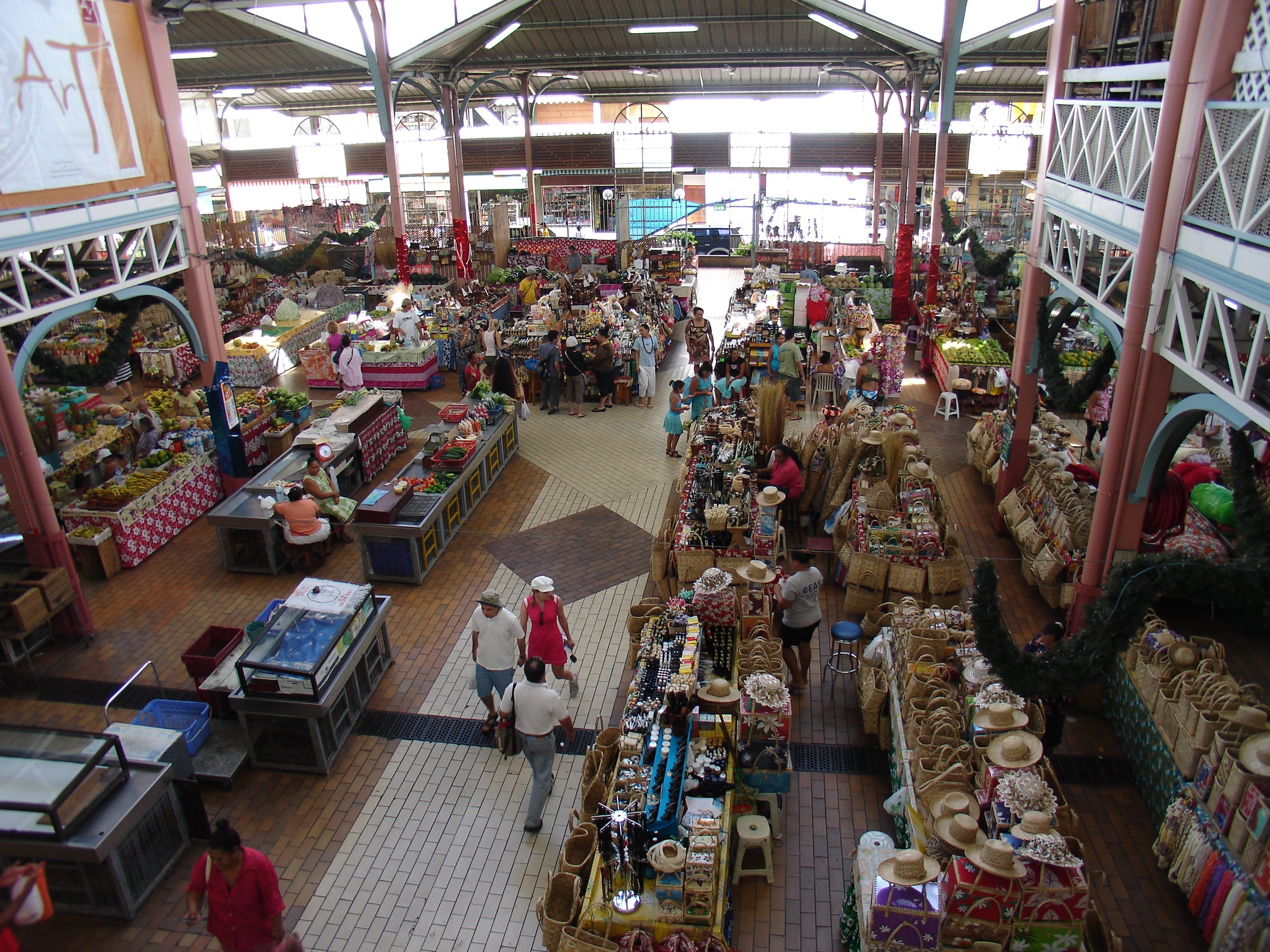
The Marché de Papeete, a two-storey covered market in the centre of town, is the most characterful spot — ground floor for fish, flowers, tropical fruit and vanilla, upper floor for pareos, woven hats, monoi coconut oil, and the famous Tahitian black pearls. Along the harbour, Place Vai'ete comes to life every evening when the roulottes (food trucks) set up to serve cheap grilled fish, steak-frites, and chow mein to locals and tourists alike. For culture, the Museum of Tahiti and Its Islands (a short drive west of the centre in Punaauia) has the best collection of Polynesian artefacts in the country, and is worth a half-day. The Cathedral of Notre-Dame on Rue Général de Gaulle is the city's one pretty colonial building.
Beyond Papeete, Tahiti itself has good hiking in the mountainous interior (the Fautaua Valley waterfall is reachable on a half-day walk), black-sand volcanic beaches on the east coast (the lighthouse and historic Point Venus where Cook observed the 1769 Transit of Venus), and the smaller Tahiti Iti peninsula in the south-east where the surfing break of Teahupo'o is one of the most famous in the world. Most visitors, however, use Papeete as a jumping-off point for the outer islands; ferries to Moorea leave several times a day and take 30 minutes, and the inter-island airport handles flights to Bora Bora, Rangiroa, and the Marquesas.