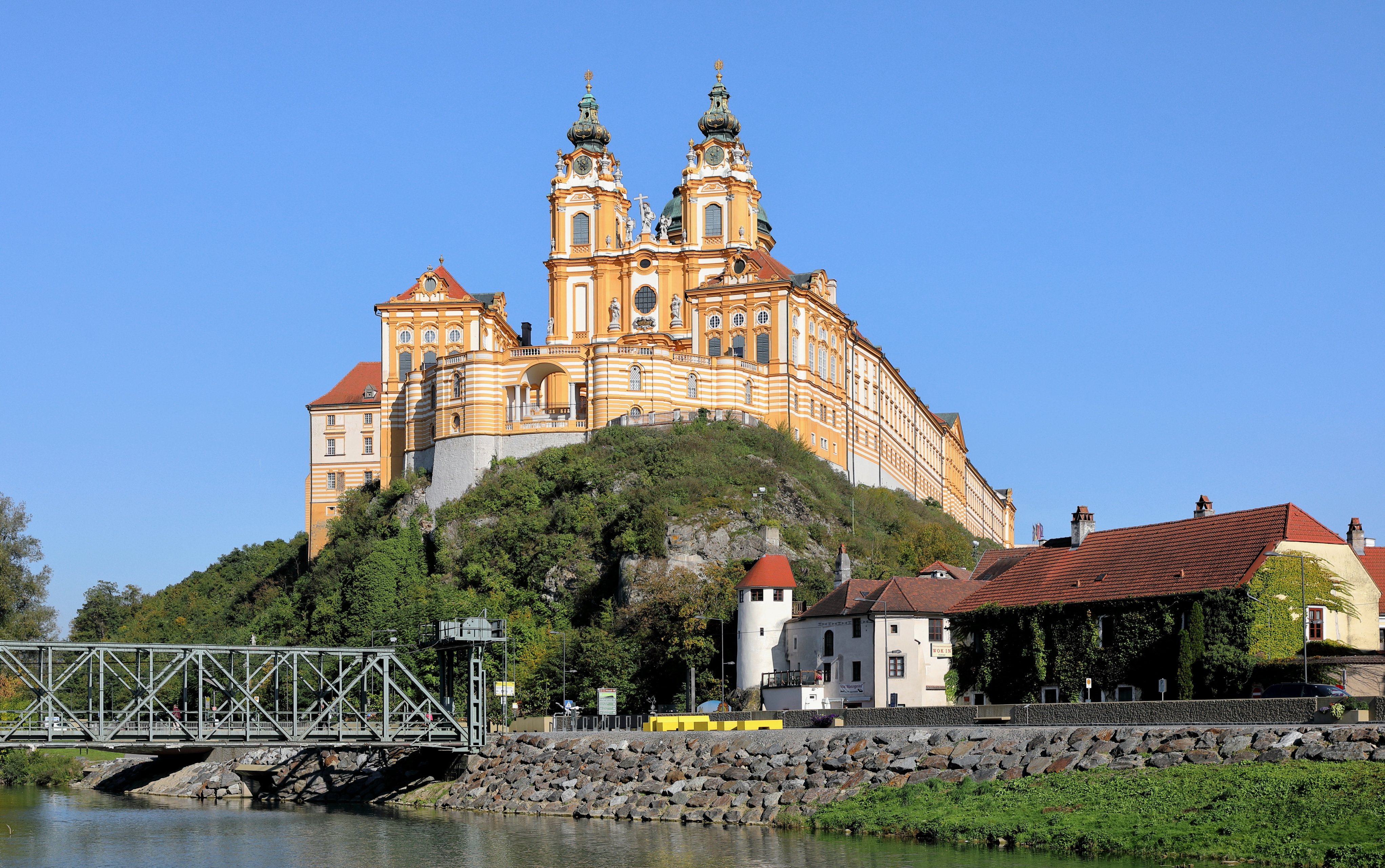
Melk is dominated by its abbey. Stift Melk, a Benedictine monastery perched on a rocky bluff above the Danube, is one of the finest Baroque buildings in Europe and the sight of it rising above the river is genuinely breathtaking. The building you see today dates from the early eighteenth century, when Abbot Berthold Dietmayr commissioned Jakob Prandtauer to transform the medieval monastery into something spectacular. He succeeded — the golden-yellow facade stretches for over 300 metres, and the interior, particularly the church and the library, is Baroque excess at its most magnificent.
The abbey library alone is worth the trip. Two rooms hold some 100,000 volumes behind walnut shelving, beneath ceiling frescoes by Paul Troger that depict the triumph of faith and reason. Umberto Eco used it as inspiration for the library in The Name of the Rose. The church, with its swirling frescoes, gilded pulpit, and theatrical high altar, feels less like a place of worship than a stage set designed to overwhelm — which, in the context of Counter-Reformation Austria, is precisely what it was.
The small town below the abbey is pleasant in a quiet, well-kept Austrian way, with a short main street of pastel-coloured houses, a few cafes, and not much reason to linger once you have seen the monastery. Melk's real value beyond the abbey is its position at the western gateway to the Wachau Valley, a 30-kilometre stretch of the Danube between Melk and Krems that is among the most beautiful river landscapes in Europe. Terraced vineyards, ruined castles, and apricot orchards line both banks, and you can explore by boat, bicycle, or car. Many visitors combine a morning at the abbey with an afternoon cruise or cycle downstream through the Wachau.