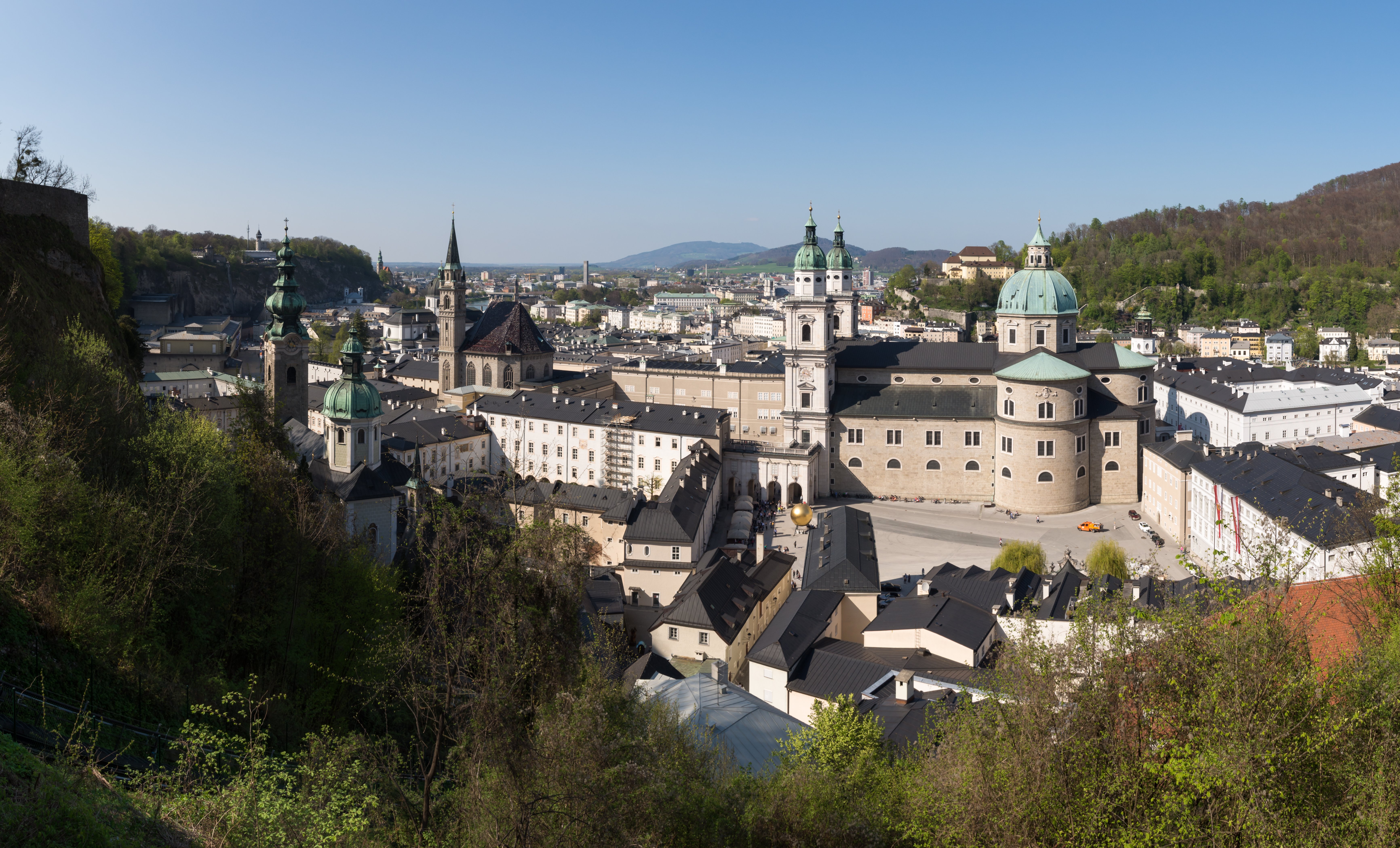
Salzburg is the fourth-largest city in Austria and the country's most improbably perfect baroque ensemble — a UNESCO World Heritage old town of marble fountains, painted churches, and narrow arcaded lanes, wrapped around a fast-flowing Alpine river at the foot of the mountains. For a thousand years, from the 8th century until 1803, Salzburg was not an Austrian city at all but an independent prince-archbishopric, ruled by a succession of powerful and ambitious prince-bishops who spent the city's salt revenues on building projects, Italian architects, and the musical establishment that later produced Mozart. The name itself means "salt castle", and it was salt mined in the mountains above the city that made the archbishops rich enough to do all this.
Wolfgang Amadeus Mozart was born here in 1756 at Getreidegasse 9; his birthplace, now a museum, is one of the most visited sights in Austria. Directly above the old town, the Festung Hohensalzburg — the largest fully preserved medieval castle in central Europe — dominates the skyline, reached by a funicular from the cathedral square. Below, the Salzburger Dom, the Residenz (the archbishops' state palace), and St Peter's Abbey (founded in 696 CE, possibly the oldest continuously occupied monastery in the German-speaking world, with its famous cemetery and catacombs) make up the ceremonial heart of the city. Across the river, the narrower and quieter Neustadt holds the Mozart family home and the Mirabell Palace and gardens, famous as the setting of the "Do-Re-Mi" sequence in The Sound of Music.
Every summer, for six weeks in July and August, the Salzburg Festival — founded in 1920 and still one of the most prestigious classical music festivals in the world — takes over the city with opera, concerts, and theatre. The rest of the year, the city is calmer but no less pretty. Just outside the city, the Hellbrunn Palace — a 17th-century pleasure villa built by one of the more eccentric archbishops — is famous for its trick fountains, a series of hidden water jets in the gardens that the archbishop used to spray his guests mid-dinner. It is still running, still funny, and a required stop with children.