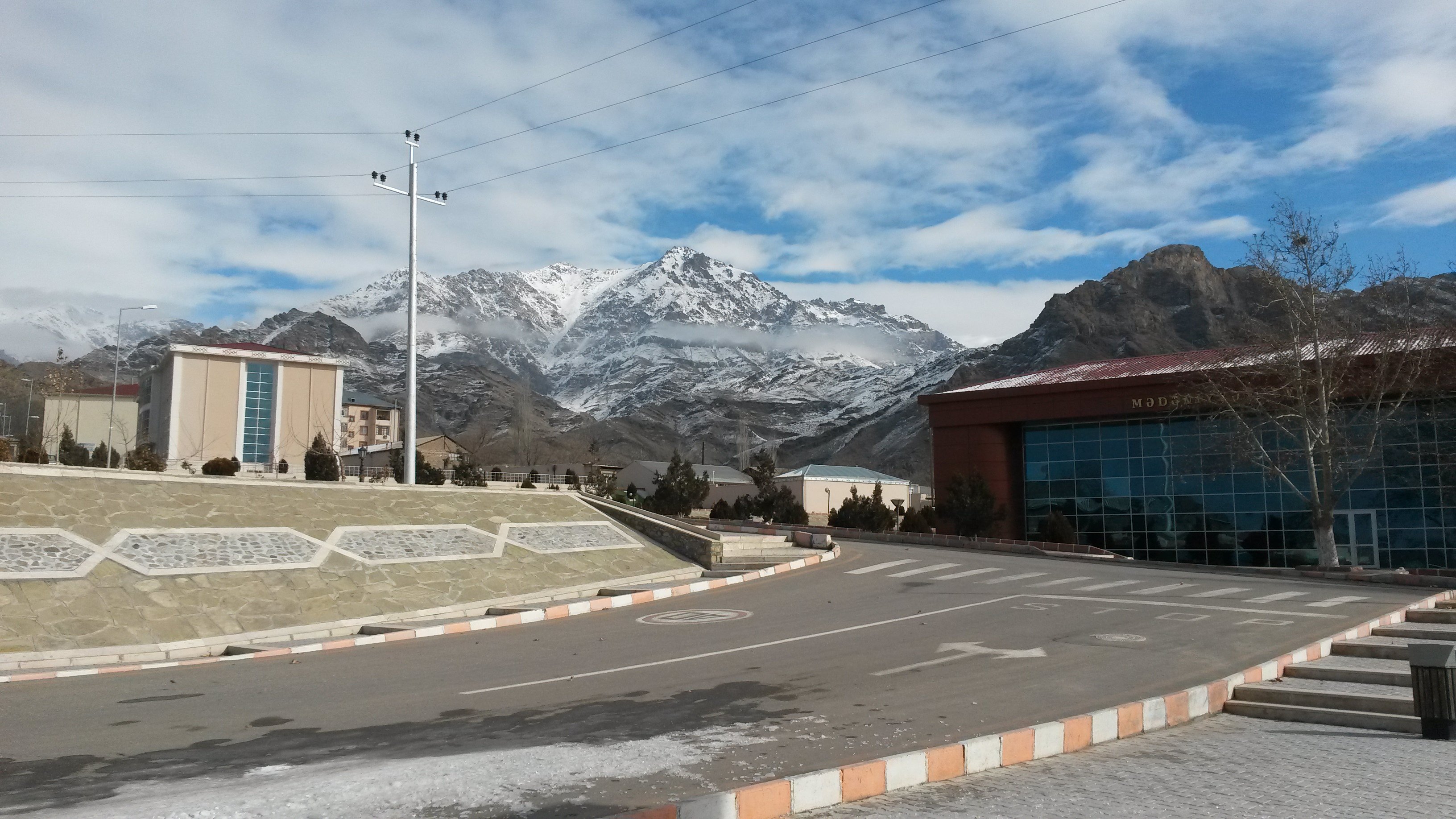
After Nakhchivan City, Ordubad is the most important town in the Nakhchivan Autonomous Republic, once the capital of a semi-independent sultanate that yielded sovereignty to the Russian tsars in 1828. Situated near the river of the same name — a tributary of the Araz — Ordubad is a mountain town, built at 850 metres under the imposing presence of the Zangezur range.
Several buildings from the seventeenth and eighteenth centuries are well preserved, notably three mosques — Saatabad, Dilbar, and Juma — the last of which retains a religious school (madrasa). The Ordubad History Museum provides a glimpse into a town with a rich cultural tradition: Ordubad was one of the early printing centres in the region and home to the family of astronomer and mathematician Nasraddin Tusi.
The train ride to Nakhchivan City is memorable. The line runs along the Araz river, the border with Iran, with views of the Iranian bank including the ancient church of St. Stephanos near where the Qotur river joins the Araz. Note that the station is almost 4 kilometres south of town.
Around the town, vast orchards and mulberry plantations — used for silkworm breeding — give the landscape a green, productive character unusual for this part of the Caucasus.