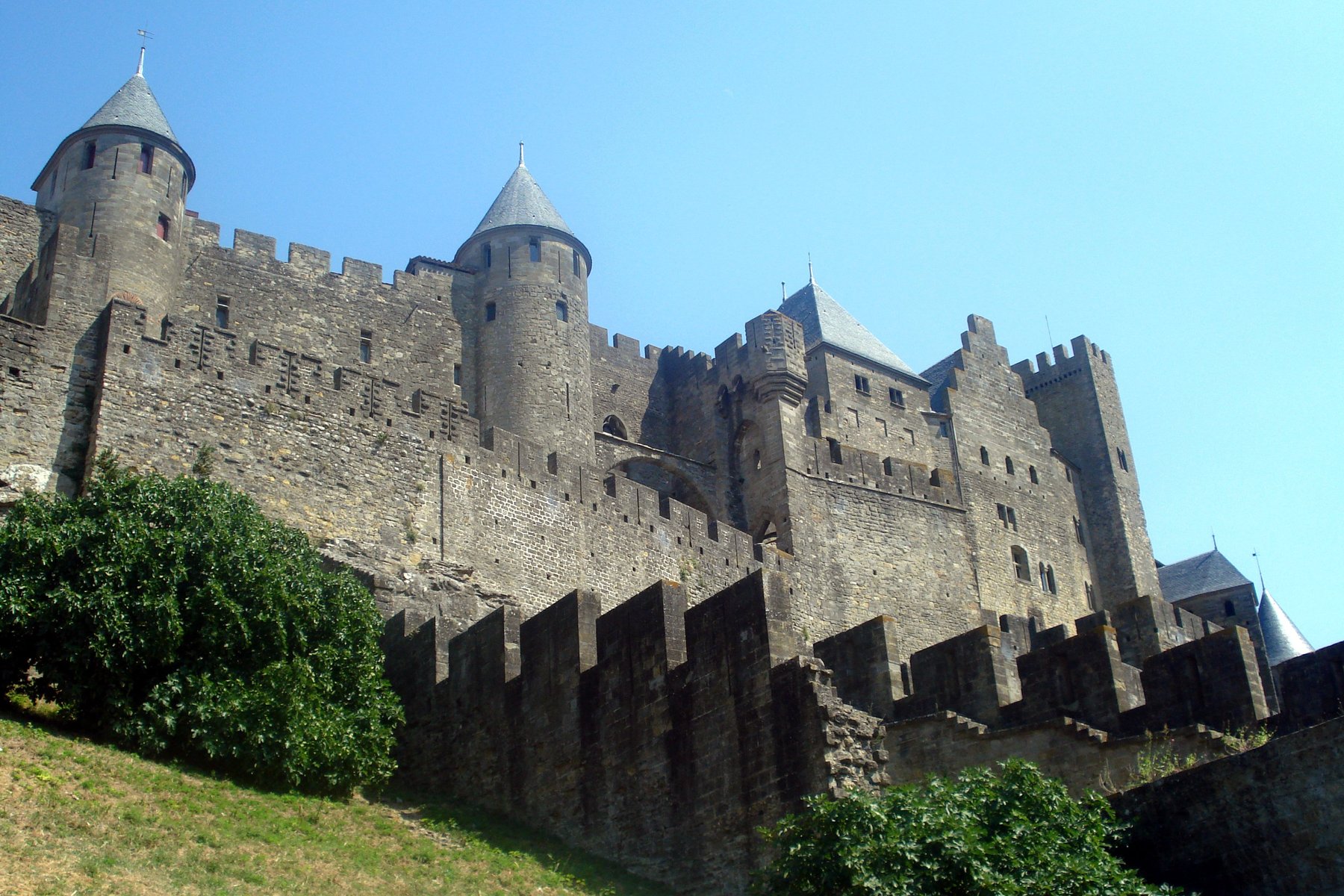
The province of Aude in the Languedoc is beautiful, wild and rugged — soaring mountains, dense forests, rich red soil, extensive vineyards, picturesque villages, and Cathar castles perched like eagles' nests on the tops of high mountains.
It is a remote and peaceful land, bathed in warm sunshine. A visitor could easily feel it has always been so. But in the 13th century, this lovely countryside was the scene of one of the cruellest events in the history of the Catholic Church — the Albigensian Crusade, in which tens of thousands of people were tortured, burned and massacred for their beliefs. They called themselves Cathars, meaning "pure." Their only crime was to refuse to submit to the orthodoxy of the Roman Church, and their punishment was total annihilation.
There are no Cathars today, but their memory remains vividly alive in the folklore and language of the region, a language called Occitan. They left nothing but some texts, and those amazing castles.
The Sentier des Cathares
Take a six-day hike along a waymarked path called the Sentier des Cathares — the Way of the Cathars. It takes in forest, mountain, gorge, village and river, plus hard climbs up to hilltop castles. Your accommodation will be in gites or farmhouses, varying from fairly basic to comfortable, with an evening meal, breakfast and a packed lunch.
Spend the first night near the tiny hamlet of Bouriege, south of Carcassonne, and set out the next morning through a limestone landscape into the valley of the Aude River. Follow this with a steep climb up to the hilltop village of Rennes-le-Chateau — a tiny place, but one with a curious mystery.
About a hundred years ago, the parish priest was renovating the church and discovered mysterious encoded parchments inside a pillar. He took these to his superiors, who sent him to Paris, where he met with delegates from the Vatican and members of the European nobility. When he returned, he had changed completely. He started spending money on a vast scale — elaborate building projects, a bizarre redecoration of the church, a library. Yet he never disclosed the source of his wealth, and when he died, he was revealed to be penniless. The locals today have various theories: that he discovered the Treasure of the Temple of Jerusalem, or a secret so detrimental to the Catholic Church that he blackmailed the Vatican. Whatever the truth, the mystery endures.
From Rennes-le-Chateau the view is spectacular. In the distance the jagged peaks of the Pyrenees rise above the Corbieres Mountains. A few miles away, the isolated peak of Pech de Bugarach rises sheer from the plain to 1,230 metres, while below stretch miles of vineyards in rich red soil, small villages with red-tiled roofs and yellowish stone walls.
If you are fit, take the climb to the top of Pech de Bugarach. In summer it will be hot and the track steep, but the lower slopes zig-zag through forest, providing welcome shade. Higher up the going gets more difficult, and you will have to scramble over rocky outcrops for the last few hundred metres. Four hours after you start, you reach the summit, and the views in all directions make the effort worthwhile.
A steep two-hour descent brings you to the hamlet of Le Linas, where you will need to refill your water bottles at the village pump.
The Gorges de Galamus
Next morning, walk through the Gorges de Galamus, a steep-sided ravine cut by the river Agly through the limestone. The road winds halfway up between river and cliff, in places cutting through the rock with barely three metres of clearance overhead. As you round a bend, you will see a tiny hermitage carved into the rock face, below the road but above the highest flood level. Your path then climbs through scrubland to emerge in a valley with breathtaking views of two of the most important Cathar castles — Queribus and Peyrepertuse, perched on the highest ridges.
After a night's rest, take the steep, narrow path to Peyrepertuse, a castle shaped like the prow of a ship, running along the top of an 800-metre crag. From below it looks almost inaccessible, and it is easy to see how it was never besieged during the Albigensian Crusade. It fell to French forces in 1240, through negotiation rather than armed conflict, and was then used as a base to harass the remaining Cathars.
The last of the Cathars
On the sixth day, climb to Termes castle near the village of the same name. It held out boldly against Simon de Montfort in 1210, eventually succumbing for lack of water. A hundred and forty Cathars were burned here. In Villerouge-Termenes, the next stop, the castle has been recently restored and houses an exhibition telling the story of Guillaume Belibaste, the last of the Cathars to be tried by the Inquisition. He was captured and burned alive here in 1321.
It is fitting to finish your trek in a village where a period of history also ended. You will have walked about 100 kilometres in six days, through varied scenery, visited numerous villages and talked to some of the villagers. You will also have learned a little about a religion relatively unknown in modern times, but which in its various forms had dominated much of southern Europe in the Middle Ages. In an era of violence it preached peace and tolerance, and in this land of Occitania its memory lives on in those lofty memorials to those who died for their beliefs.