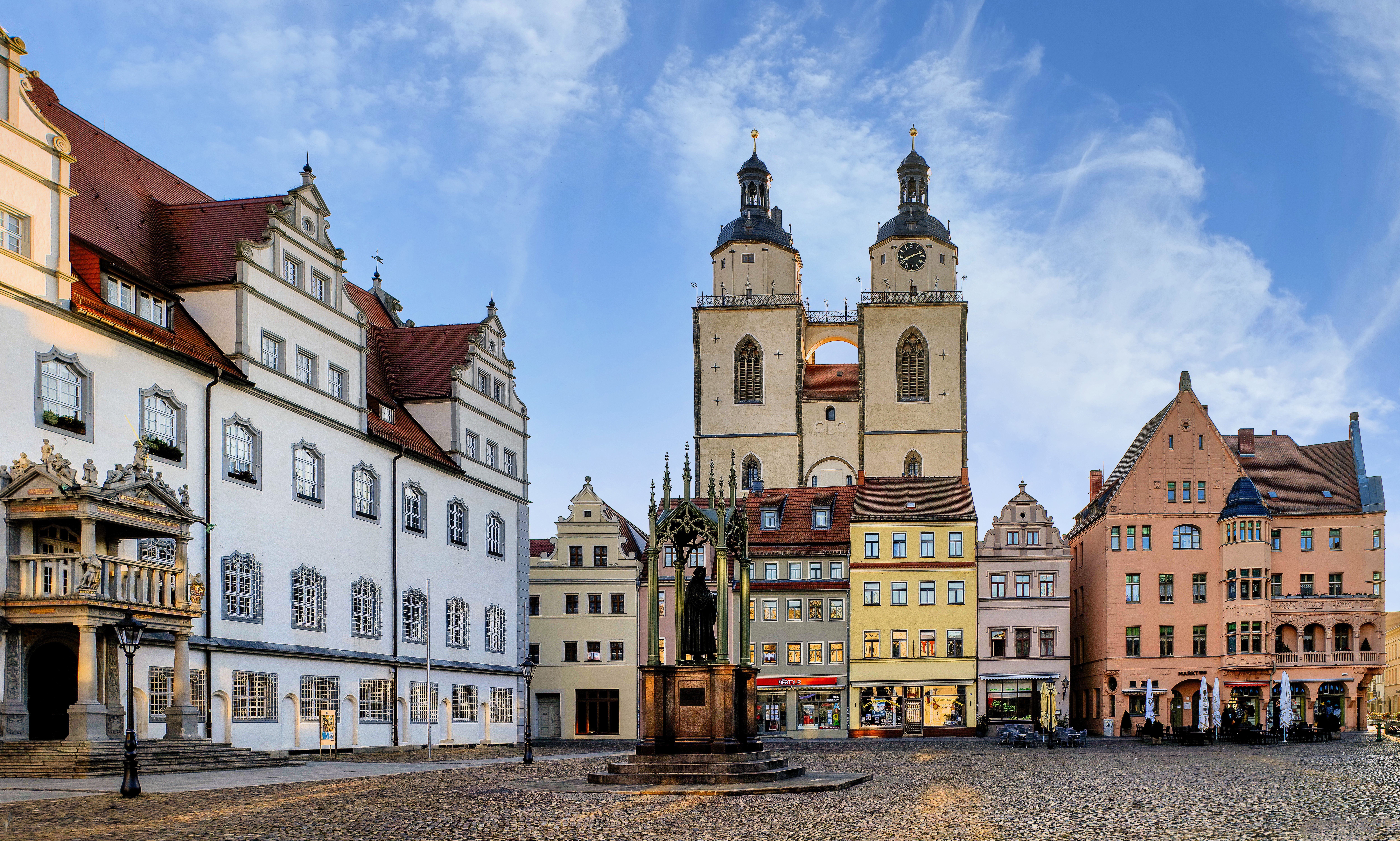
Lutherstadt Wittenberg — to give it its official name — sits on the Elbe in eastern Saxony-Anhalt, roughly halfway between Berlin (80 km) and Leipzig (70 km). This is where Martin Luther nailed his 95 theses to the door of the Castle Church in 1517 and set the Reformation in motion. The town has been trading on that moment ever since, and the concentration of well-preserved Renaissance buildings makes it a rewarding half-day or day trip.
The best starting point is the Marktplatz, the central square flanked by the Renaissance town hall (completed 1535) and the Stadtkirche St. Marien, where Luther preached regularly. Together with the facades of the surrounding townhouses, these buildings form one of the finest historical ensembles in Germany.
The All Saints' Church (Schlosskirche), at the western end of town, is where Luther posted his theses. The castle and church were built by Frederick the Wise between 1490 and 1511. The originals were destroyed by fire during the Seven Years' War in 1760; the current church was rebuilt in 1892 as a monument to the Reformation. Luther and Melanchthon are both buried inside.
The Lutherhaus — the largest surviving Reformation-era residence in the world — holds an extensive museum on Luther's life. The Melanchthonhaus nearby is the best-preserved Renaissance domestic building in Germany. The Cranachhof records the workshop where Lucas Cranach the Elder produced the portraits that made Luther's face known across the Protestant world. The town is compact enough to cover all of these on foot in a couple of hours.