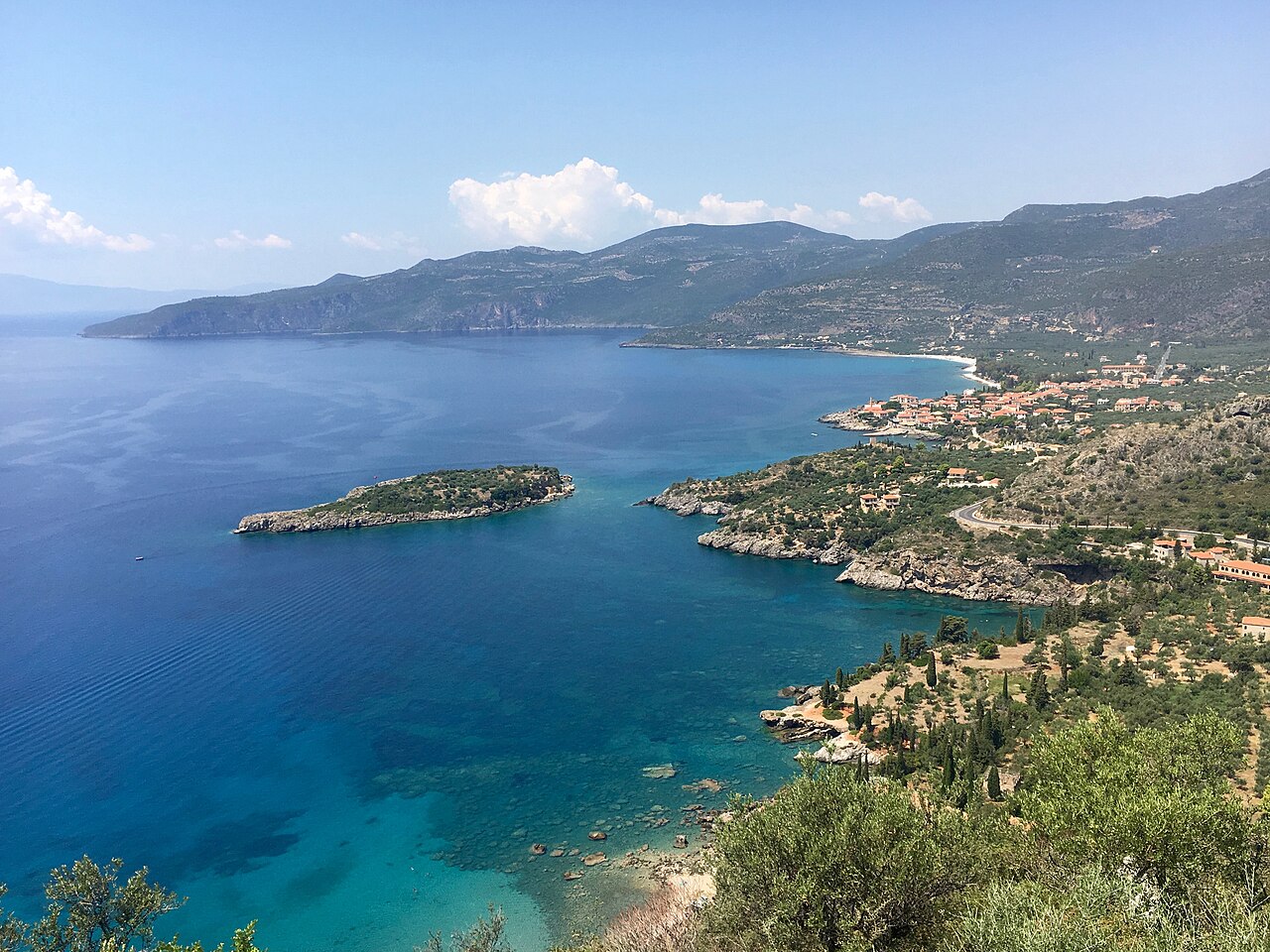
Coastal Mani village backed by the Taygetos mountains, linked to ancient legend and Patrick Leigh Fermor.
Kardamili is a small coastal village in Exo Mani, about 35 kilometres south of Kalamata, backed by the grey limestone wall of the Taygetos mountains and fronted by a pebble beach the colour of slate. It is quieter and less developed than Stoupa to the south, which is precisely what draws the kind of traveller who finds Stoupa too crowded.
The village has been continuously inhabited since antiquity — it is one of the seven cities that Agamemnon offered Achilles in the Iliad — and a ruined Venetian tower and a clutch of old stone houses at the top of the village hint at the layers underneath. But Kardamili's modern fame rests largely on one man: Patrick Leigh Fermor, the great British travel writer, who fell in love with the Mani in the 1950s and built a house in the olive groves just south of the village. He lived here, on and off, for the rest of his long life. His book Mani: Travels in the Southern Peloponnese is one of the finest pieces of travel writing in English, and reading it before you arrive will change how you see everything around you.
Hikers come for the Viros Gorge, which cuts up into the Taygetos from just outside the village. The trails are well-marked and range from easy riverside walks to strenuous ridge climbs with views over the entire southern Peloponnese. In spring, the gorge is full of wildflowers and the sound of water; in summer, it offers shade when the coast is baking.
The main beach is grey pebble, clean, and backed by tamarisks — the water is extraordinarily clear. Old Kardamili up the hill is a different world: Maniot tower houses, a Byzantine church, and the quiet of a quarter still largely lived in. Zarnata Castle, about 15 km north, is a ruined Ottoman fortress on a ridge with sweeping views over the coast — largely unvisited and free to explore.
Guide
Books
Kardamili is inseparable from Patrick Leigh Fermor. Read him before you arrive.
Mani: Travels in the Southern Peloponnese by Patrick Leigh Fermor — The book that defined the place. Fermor arrived in the 1950s when the Mani was barely accessible and utterly itself, and his account of travelling through it — by foot, by donkey, on the hospitality of tower-house families — is one of the great pieces of English travel writing. It is half archaeology, half social history, half pure exhilaration at the strangeness of the world. The half that concerns Kardamili and the Viros Gorge is worth reading aloud while sitting at the village waterfront.
Roumeli: Travels in Northern Greece by Patrick Leigh Fermor — The companion volume, covering northern Greece. Not about Kardamili but soaked in the same sensibility. A natural sequel once you've finished Mani.
Between the Woods and the Water by Patrick Leigh Fermor — From an earlier adventure, crossing pre-war Europe on foot. Nothing to do with Greece, but the writing is so alive that it belongs on any Fermor devotee's reading list. Understanding why Fermor was special means following him across more than one journey.
Guide
Getting There
Kardamili has no train station and no airport. You arrive by bus or by car, and a car is strongly recommended if you want to explore the surrounding area.
By bus: KTEL buses run several times daily from Kalamata's bus station to Kardamili, continuing south to Stoupa and Areopoli. The journey from Kalamata takes about an hour. Kalamata itself is served by flights from Athens and several European cities in summer, and by buses and a limited train service from Athens.
By car: From Athens, the drive via the E65 motorway to Kalamata takes around three hours, then another 40 minutes south on the coast road. The coastal route south from Kalamata through Kardamili to Areopoli and the Deep Mani is one of the great drives in Greece — winding, dramatic, with the sea always visible below.
By ferry: In summer, ferries connect Gythio (about 80 km south) with Piraeus; this is a slow but atmospheric alternative to the motorway.
Guide
When to Go
Kardamili is at its best in spring (April to early June) and autumn (September to October). The weather is warm but not overwhelming, the village is relatively quiet, the Viros Gorge is at its most beautiful — the stream running, wildflowers out in spring, the plane trees golden in autumn — and you can walk and swim without the crowds of July and August.
July and August are busy. Greeks on holiday fill the tavernas and the beach, prices rise, and the village loses some of its quietness. That said, the surrounding landscape absorbs the crowds reasonably well, and the evenings remain pleasant.
Winter (November to March) is very quiet — most tavernas close, accommodation is limited, but the village and coast have a melancholy beauty and you will have the gorge entirely to yourself. The Mani is famous for its microclimate; it is often warm and sunny when the rest of southern Greece is grey.