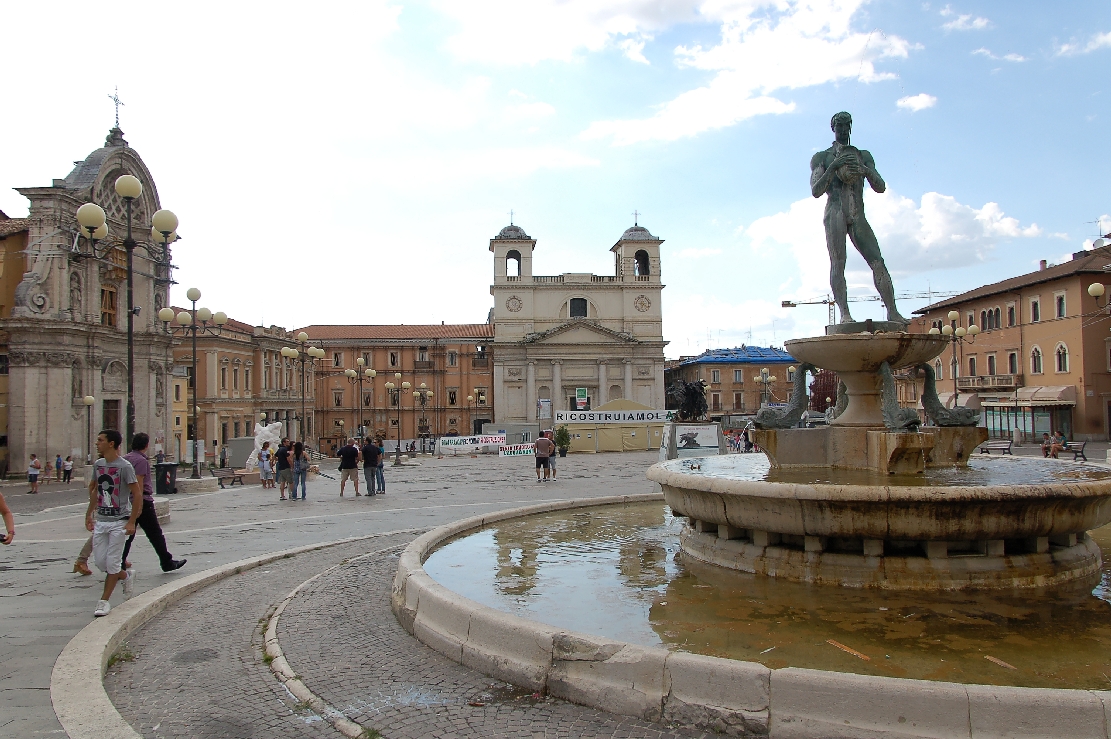
L’Aquila sits in a broad valley at 700 metres altitude, ringed by the highest peaks of the Apennines. The city was founded in the 13th century, legend says by the inhabitants of 99 surrounding castles — hence the recurring motif of 99 that runs through the city: 99 churches, 99 piazzas, 99 fountains. The famous Fontana delle 99 Cannelle, near the old city walls, has 99 stone-carved faces each spouting water.
The 2009 earthquake devastated the city centre, and reconstruction is still ongoing. But much has been restored, and the medieval bones of the city remain impressive. The 16th-century Forte Spagnolo, built by Don Pedro of Toledo, dominates from the north — it is the finest Renaissance military architecture in central Italy and now houses the National Museum of Abruzzo. The Basilica di Santa Maria di Collemaggio, with its striking pink-and-white stone façade, is one of the most important churches in Abruzzo and the only place outside the Vatican where a pope (Celestine V) is buried.
The central Piazza del Duomo hosts a daily market and makes a good starting point for exploring the old town with its arcaded streets (portici), courtyards, and churches. The Gran Sasso, the highest peak in the Apennines, rises just north of the city — a cable car from the edge of town gives access to the mountain and to the high plateau of Campo Imperatore, where Mussolini was held prisoner during World War II. Pescara on the coast is about an hour away.