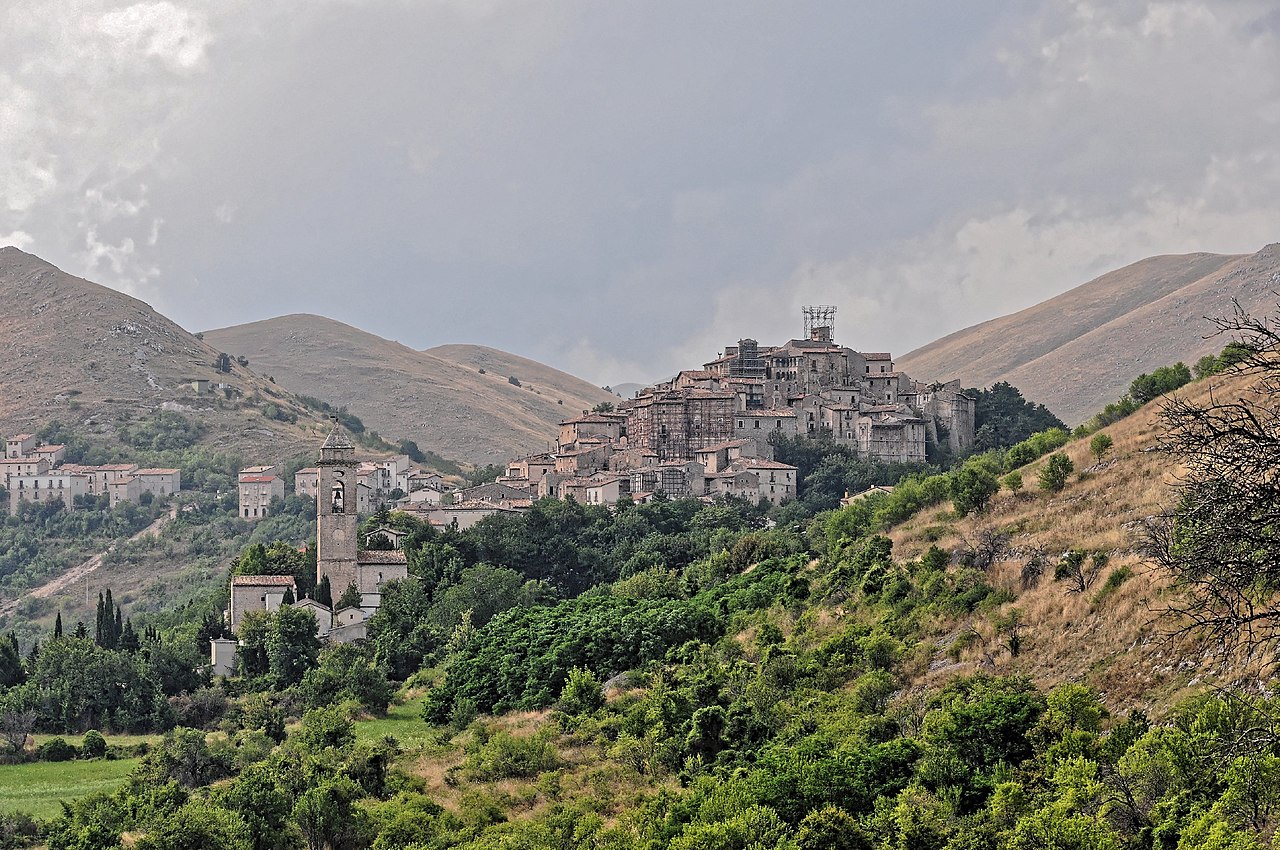
Santo Stefano di Sessanio
©
Santo Stefano di Sessanio

Santo Stefano di Sessanio

Abruzzo stone hill village restored as an albergo diffuso below the Gran Sasso massif.

Santo Stefano di Sessanio is one of the most beautiful hill villages in Abruzzo, perched at about 1,250 metres on the slopes of the Gran Sasso massif, roughly 30 kilometres from L'Aquila. The village is built almost entirely of pale stone and has been carefully restored -- in places the streets narrow to barely a shoulder's width as they thread between medieval towers and arched passageways.

The village was nearly abandoned by the mid-twentieth century, but a pioneering project turned many of its crumbling houses into a "diffuse hotel" (albergo diffuso), with rooms scattered through restored buildings across the village rather than concentrated in a single block. It helped bring Santo Stefano back to life and became a model for similar projects across rural Italy.

Below the village there is a small lake, and the surrounding Gran Sasso e Monti della Laga National Park offers excellent hiking. The area is also known for its lentils -- the tiny, dark Lenticchie di Santo Stefano di Sessanio have IGP status and taste markedly different from ordinary lentils.

Guide

Bars and Cafes

A village of under 120 people has minimal bar life, but there is somewhere to get a coffee or a glass of local wine. It is the sort of place where the few permanent residents gather, and sitting with them for an hour gives a better sense of the village than any guidebook.

Guide

Books

Walking in Abruzzo (Cicerone, various editions) — the standard English-language hiking guide to the region, covering routes in the Gran Sasso e Monti della Laga National Park including approaches to the Corno Grande. The Club Alpino Italiano also publishes detailed Italian-language guides to the Gran Sasso massif.

Italian Ways by Tim Parks — Parks travels Italy by train and takes in the country's textures, rhythms, and contradictions. Not about Abruzzo specifically, but gives a sharp and affectionate account of Italian life and landscape that sharpens the eye for everything you see here.

The Albergo Diffuso — the model pioneered at Santo Stefano di Sessanio has been written about widely in Italian architecture and rural-development literature. Daniele Kihlgren's project has been covered in Italian newspapers and international design press; searching his name alongside "Santo Stefano" turns up substantial background reading.

Christ Stopped at Eboli by Carlo Levi — set in Basilicata rather than Abruzzo, but essential reading for understanding the rural south of Italy that the albergo diffuso project was working against: the isolation, the abandonment, the gap between the Italian state and its mountain villages. Published in 1945, still startlingly vivid.

Guide

Day Trips

Campo Imperatore (10km) — the road climbs sharply from the village up to the Campo Imperatore plateau at around 1,800 metres: a vast, treeless upland that stretches for kilometres under the Gran Sasso peaks. In 1943 Mussolini was briefly imprisoned at the hotel on the plateau before a German glider rescue operation. In winter it is a modest ski area; in summer it is the base for hiking the Corno Grande and surrounding ridges. The drive alone is worth it for the scale of the landscape.

Rocca Calascio (8km south) — one of the most dramatic ruins in Italy: a medieval castle on a 1,460-metre rocky outcrop, largely unrestored, with a small octagonal church below and views across a vast mountain bowl. It was used as a filming location for Ladyhawke (1985). The walk up from the car park takes about 20 minutes. Go late in the day if you can -- the light on the stone at dusk is extraordinary.

L'Aquila (30km west) — Abruzzo's capital and a city in an unusual state: largely rebuilt after the devastating earthquake of April 2009 (which killed over 300 people), with the historic centre still bearing visible scars alongside gleaming new civic buildings. The 99 churches of L'Aquila include some fine examples of Abruzzese Romanesque and Gothic. The city has a good covered market and several good restaurants. An interesting and occasionally melancholy place to spend half a day.

Castel del Monte (20km north) — a beautifully preserved medieval village in the high Abruzzo, sitting at over 1,300 metres on a ridge with views across the plateau. Quieter than Santo Stefano and less visited, it feels genuinely untouched. The drive north through the national park is scenic.

Guide

Eating Out

Santo Stefano di Sessanio is a tiny village and the dining options reflect that -- but what exists is very good. The cooking is Abruzzese mountain food: hearty, honest, and built around exceptional local produce. Lentil soup, arrosticini, local pecorino, and pasta made in the house are the staples. The albergo diffuso also operates its own dining and can guide guests to the current best options in the village.

Guide

Getting Around

The village is entirely on foot. Santo Stefano di Sessanio has under 120 inhabitants and its medieval lanes are far too narrow for cars; you park at the edge of the village and walk everywhere from there. The whole place can be covered in a leisurely hour, though you will likely want to wander it several times at different hours of the day.

Hiking into the national park begins just outside the village. For the Campo Imperatore plateau -- the starting point for the higher Gran Sasso routes -- you need to drive about 10 kilometres up the mountain road. Day trips to Rocca Calascio, Castel del Monte, and L'Aquila all require a car.

Guide

Getting There

Santo Stefano di Sessanio is accessible by car only. The village is about 30 kilometres east of L'Aquila, roughly a 40-minute drive on the SS17 and local mountain roads. From Rome, allow around two hours: take the A24 motorway east towards L'Aquila (the toll road through the Apennines), exit at L'Aquila est, and follow signs east towards Calascio and Santo Stefano.

There is no public transport to the village. L'Aquila has regular bus connections from Rome (around two hours, run by several operators from Tiburtina station) and a train line, but getting from L'Aquila to Santo Stefano without a car is not practical. Car hire is essential if you plan to explore the area properly -- the surrounding villages, Rocca Calascio, and Campo Imperatore are all worth visiting and all require driving on mountain roads.

Guide

Things to Do

The village itself is the main attraction in Santo Stefano di Sessanio -- wandering its medieval lanes, ducking under arched passageways, and looking out over the Gran Sasso from the old tower. Beyond the village, the national park opens up for serious hiking, including the highest peak in the Apennines. The local lentil culture is worth engaging with too: the fields on the surrounding terraces produce one of Italy's most distinctive IGP products.