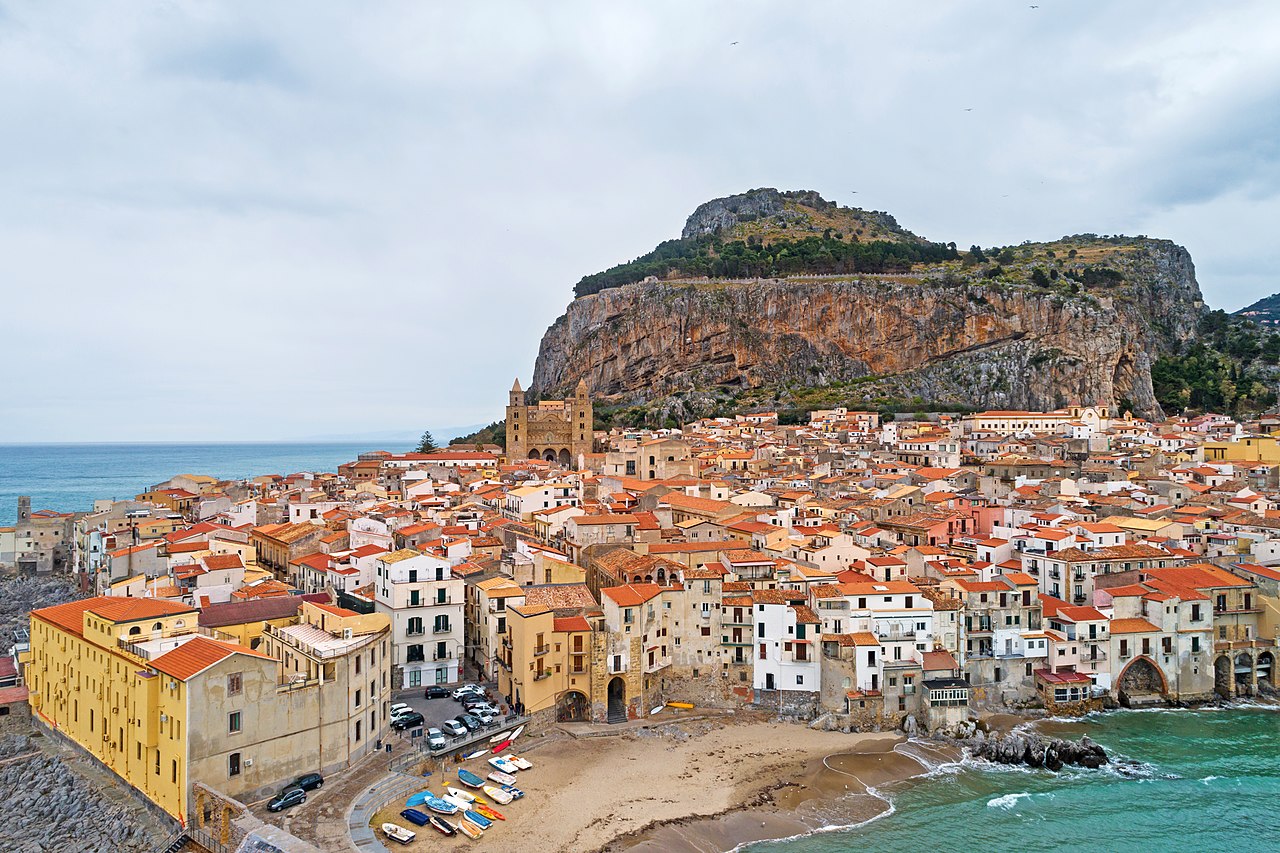
Cefalù is a small Norman town on Sicily's north coast, squeezed between a vast golden-sand beach and a sheer limestone rock that drops almost vertically into the sea. It sits roughly halfway between Palermo and Messina — compact, walkable, and largely free of the heavy industry that scars other Sicilian port towns.
The old town is built around a cathedral that stops you in your tracks. Roger II began it in 1131 and it took 200 years to finish, but the apse mosaics completed early in the project are among the finest Byzantine work in existence — Christ Pantocrator gazes down from the half-dome with an authority that has survived nine centuries in good shape. The narrow medieval streets radiating from the cathedral are genuinely old, not restored to look old, and the Museo Mandralisca on Via Mandralisca holds a haunting portrait by Antonello da Messina that is worth the detour alone.
Above it all, the rock — La Rocca — offers an hour's climb and a reward: the ruins of a Greek-Norman citadel, a medieval wash basin, and views across the rooftops to the sea that make the scramble entirely worthwhile. Go early or in the late afternoon to avoid the heat.
The beach is central, clean, and excellent. In July and August it fills with Italian families and European backpackers, and the restaurants along the lungomare get crowded and expensive. Come in May, June, or September and you get the beach nearly to yourself and the town at its most pleasant. Cefalù works as a day trip from Palermo (about 45 minutes by train) but it also makes a fine base for a few nights, with the Madonie mountains offering hiking and hilltop villages just inland.
Cinema Paradiso (1988) was filmed here, and the town has embraced the connection enthusiastically. This does not detract from the place — it is still the real thing. On the hillside below La Rocca, the Abbey of Thelema adds a stranger chapter: Aleister Crowley ran his occult commune here from 1920 until Mussolini expelled him from Italy.