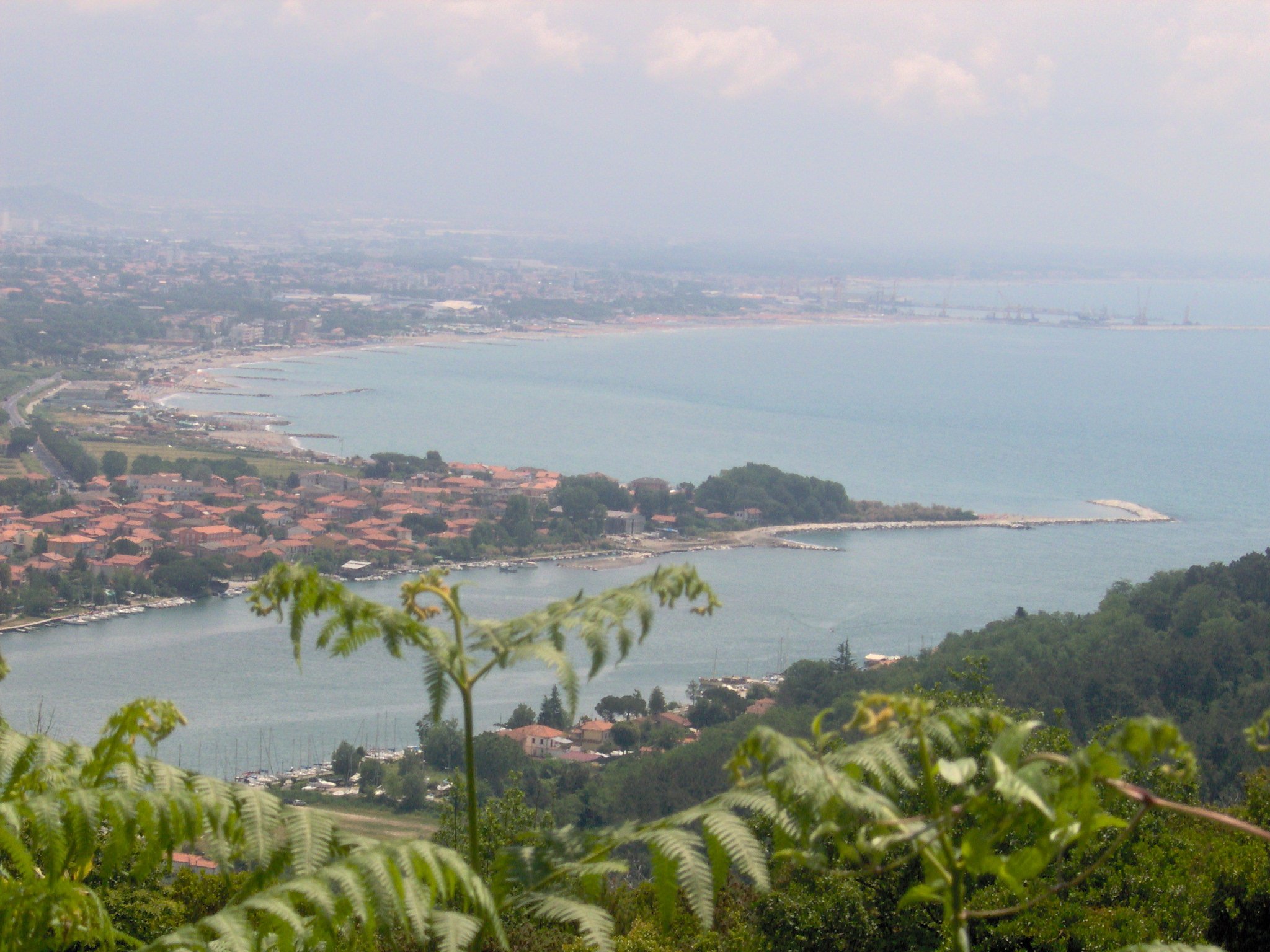
Small Ligurian river-mouth resort where the Magra meets the sea below Montemarcello's pine slopes.
Bocca di Magra is a small resort village at the mouth of the Magra River on the eastern edge of Liguria, where the river cuts through the hills into the Ligurian Sea. Its name means, literally, "mouth of the Magra". This is the unfashionable end of the Gulf of the Poets — less polished than nearby Lerici and Portovenere, but quieter, cheaper and still very pretty. Fishermen's houses line the riverbank, small boats are moored in rows along the quay, and on the far side of the river the pine-covered slopes of the Montemarcello-Magra Natural Park rise steeply out of the water.
The main reason to come is to use Bocca di Magra as a base for the surrounding area without paying Cinque Terre prices. It is well placed: the Cinque Terre is a short ride north by boat or train, the Roman ruins of Luni (once a major port in antiquity, now sitting a few kilometres inland after centuries of silt) are ten minutes away by car, and the Apuan Alps — the marble quarries where Michelangelo chose his stone — are visible across the plain to the south. The village itself has a sprinkling of good seafood restaurants on the river, a couple of small beaches on the sea side of the headland (including the dramatic Punta Corvo), and the hilltop Monastero di Santa Croce, which claims to have once hosted Dante. The trail up the headland to Montemarcello is the obvious half-day walk.
Guide
Beaches
The coast at Bocca di Magra is a mix of small sandy bays and rocky coves. The village's own beaches are modest — a public stretch reached by steps from the road, a couple of private bagni with loungers and umbrellas, and the small cove below the Monastero Santa Croce. The most dramatic beach in the area is Punta Corvo, a black-pebble strand at the base of a 700 m cliff on the far side of the headland; it is reachable by a steep trail from the Montemarcello road, or more easily by a 15-minute ferry from Bocca di Magra's pier in the park. Punta Bianca, on the other side, has striking white limestone cliffs.
Guide
Day Trips
Bocca di Magra is an unusually well-placed base. The Cinque Terre is a quick train or boat ride north. Portovenere and the Gulf of the Poets, including the little island of Palmaria, are just around the headland. The Roman port city of Luni — once the source of the marble used on most of Rome, now a set of ruins in the fields with a small but excellent museum and an amphitheatre — is ten minutes away by car. Further inland, the marble quarries of Carrara in the Apuan Alps can be visited on a half-day trip, and the pretty walled town of Sarzana is the obvious stop for lunch.
Guide
Eating Out
Bocca di Magra eats fish. A line of restaurants along Via Fabbricotti on the riverfront serves the local catch simply — spaghetti alle vongole, fritto misto, grilled sea bass — and the best of them, like the long-established Capannina Ciccio and Ristorante La Ferrara up the hill, can be very good. Expect to pay Ligurian-coast prices but not Cinque Terre prices. For something cheaper, the crêperies and snack bars by the ferry dock do passable sandwiches and focaccia to take onto the beach.
Guide
Getting There
The nearest international airports are Pisa (about 75 km, an hour by car) and Genoa (around 110 km). By train, the station at Sarzana, on the main Genoa–Pisa line, is 10 minutes away by taxi or bus; a regional bus connects Sarzana with Ameglia and Bocca di Magra. By car, take the A12 motorway (Genoa–Livorno) and exit at Sarzana. In summer, small ferries from La Spezia and the Cinque Terre also call at the dock by the park.