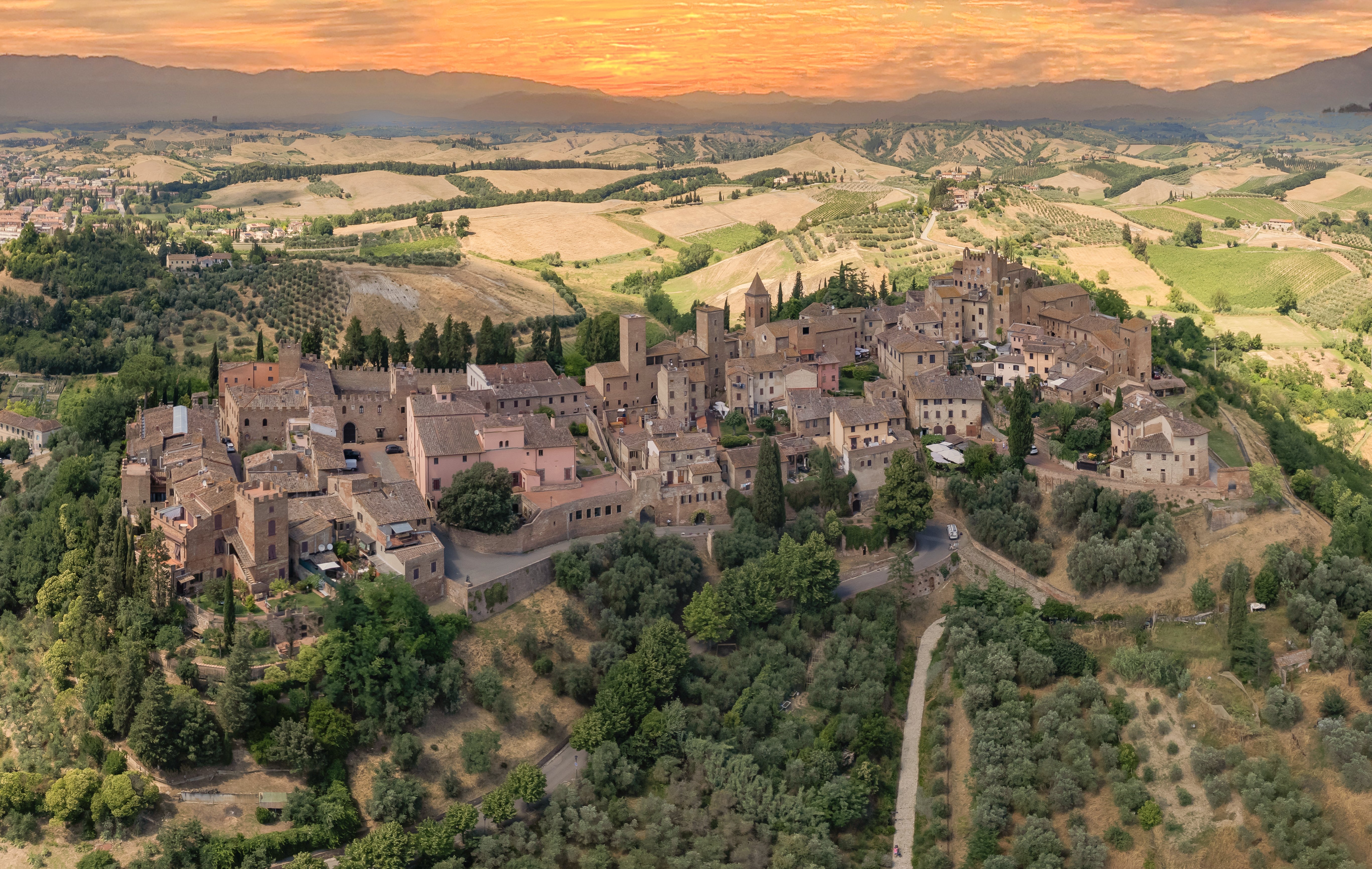
Tuscan Val d'Elsa town split between a lower centre and Boccaccio's medieval Certaldo Alto
Certaldo is a small town in the Val d'Elsa, south of Florence, split between a modern lower town and a beautifully preserved hilltop village — Certaldo Alto — reached by funicular. The upper town is entirely medieval, with brick towers, narrow streets, and views over the Tuscan hills.
Certaldo Alto is best known as the home of Giovanni Boccaccio (1313–1375), author of the Decameron and one of the founders of Italian literature. His reconstructed house is now the seat of the National Boccaccio Study Centre, with a library and a collection of over 500 works by contemporary artists. His tomb is in the church of Santi Jacopo e Filippo nearby.
The Palazzo Pretorio, built in the 12th century for the Alberti Counts and later used as the seat of the Vicariate, dominates the upper town. Inside and in the adjoining de-consecrated church of Santi Tommaso e Prospero, there are frescoes and sinopites from the 15th and 16th centuries.
Guide
Getting There
Certaldo is straightforward to reach by train. From Florence, trains run on the Florence–Empoli–Siena line and take around 40 minutes; there are frequent departures through the day. From Siena, the same line runs in the other direction, passing through Poggibonsi — the journey takes roughly 30 to 40 minutes depending on the service. The train station is in the lower town (Certaldo Basso), and the funicular up to Certaldo Alto departs a short walk away.
By car from Florence, follow the Superstrada Firenze–Siena (SGC Fi-Si) and exit at Certaldo Sud or Poggibonsi Nord — the drive takes around 45 minutes depending on traffic. From San Gimignano, Certaldo is only about 15 kilometres away by road, making the two towns natural companions for a day out in the Val d'Elsa. Parking in the lower town is straightforward; driving up to Certaldo Alto is possible but the lanes are narrow and parking is very limited.
Guide
When to Go
Spring (April to early June) and autumn (September to October) are the best times to visit Certaldo. The weather is mild, the Val d'Elsa countryside is at its most attractive, and the hilltop town is pleasantly uncrowded. Summers are hot — Tuscany in July and August can push 35°C — and while Certaldo is far less overrun than Florence or Siena, it does get busier.
The highlight of the summer calendar is Mercantia, an international street theatre festival held each July in Certaldo Alto. The entire upper town becomes a stage: jugglers, acrobats, theatre companies, and performers from across Europe fill the medieval streets for several days. It transforms the town entirely and is worth timing a visit around if you enjoy that kind of thing. The narrow lanes of Certaldo Alto make an ideal backdrop. Book accommodation in the area well in advance if you plan to attend.
August is the peak holiday month in Italy, and while Certaldo is not a mass-tourism destination, many local restaurants and businesses take their own holidays during this period. September brings grape harvest season to the surrounding vineyards and is a fine time to be in the Val d'Elsa generally.