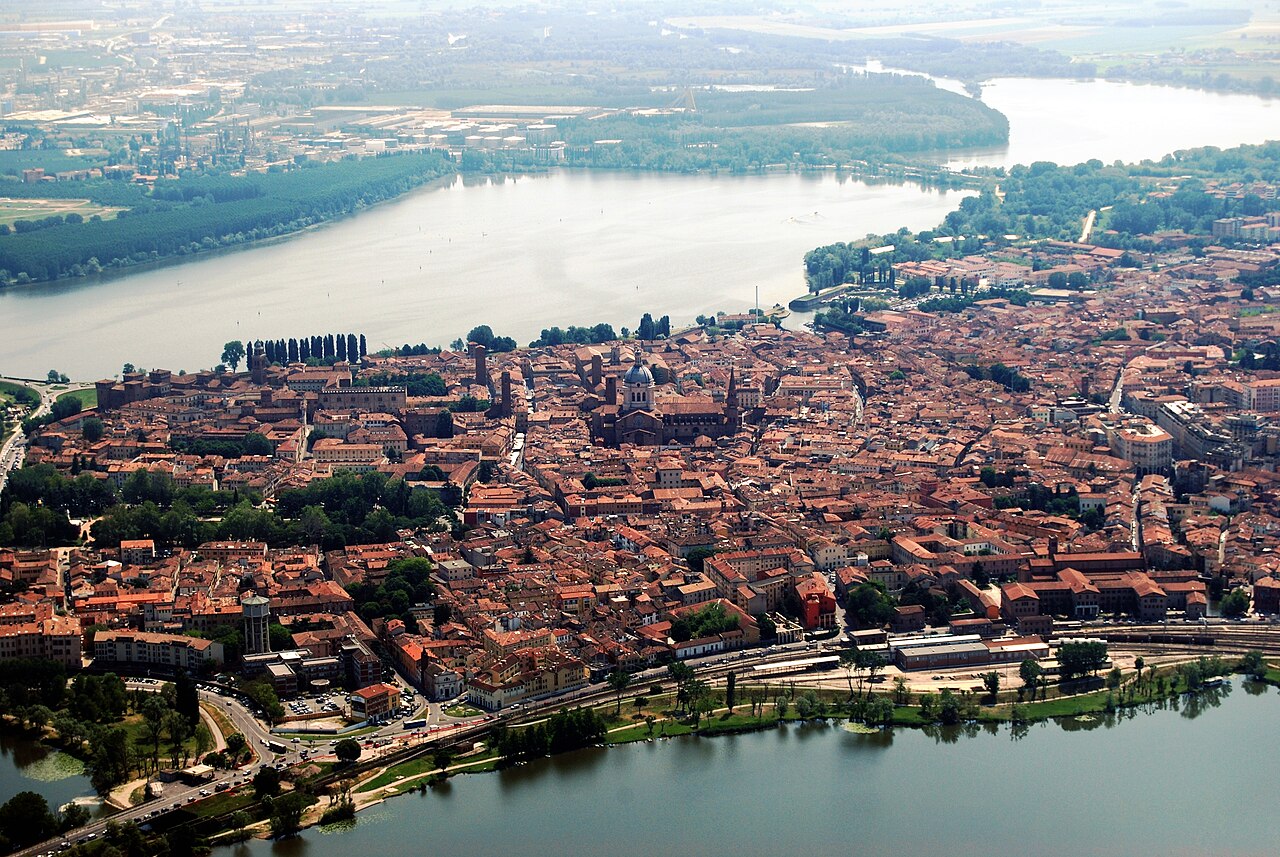
Mantua (Mantova in Italian) rose to its peak under the Gonzaga family, who came to power in 1328 and ruled until 1708. What they left behind is remarkable: two of the finest Renaissance palace complexes in Italy, churches designed by Alberti and Mantegna, and a cityscape that still feels largely intact. The old centre is a compact island of medieval streets opening onto grand piazzas, enclosed on three sides by the lakes formed by the Mincio river — the mist these lakes produce gives Mantua its characteristic hazy mornings.
The Palazzo Ducale, the Gonzaga's main seat, is the most important building — a labyrinth of 500 rooms containing Andrea Mantegna's extraordinary Camera degli Sposi frescoes. On the southern edge of the city, Palazzo Te is a Mannerist masterpiece by Giulio Romano, whose Sala dei Giganti wraps you in painted apocalypse from floor to ceiling. Leon Battista Alberti's Basilica di Sant'Andrea was revolutionary when built in the 1470s and remains one of the finest Renaissance church interiors in Italy. On Piazza Sordello, the city's historic core, the Rotonda di San Lorenzo is the oldest church in the city — buried under later buildings for centuries and only rediscovered in the 19th century.
The city also has unexpected pleasures: the Lovers of Valdaro, two Neolithic skeletons buried in an embrace 5,000 years ago, are displayed in the Palazzo Ducale museum. The Torre della Gabbia in Piazza delle Erbe still has its iron cage hanging from the exterior — a medieval public prison where criminals were displayed to the market crowd. And Lago Superiore to the north turns pink-white with lotus flowers in July and August, the largest expanse of lotuses outside Asia.
Mantua is also the birthplace of Virgil and the setting for Verdi's Rigoletto. The eating is excellent: tortelli di zucca — pumpkin-filled pasta with amaretti and mostarda — is the dish you will not find anywhere else.