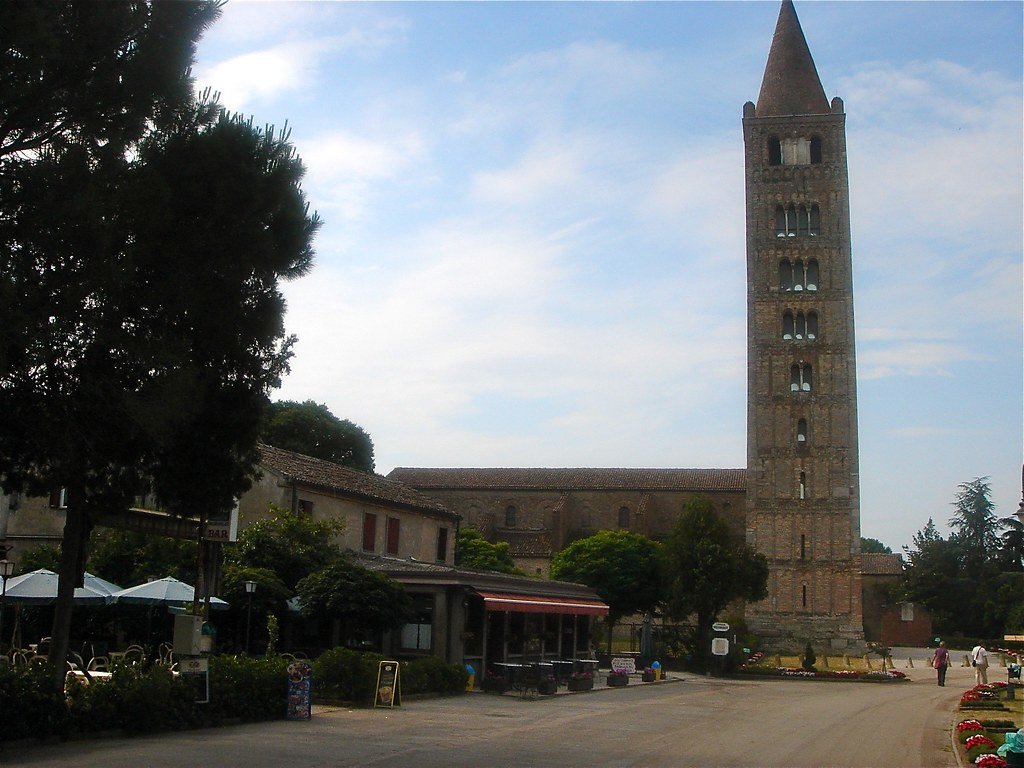
Pomposa is a beautiful old Benedictine abbey in the Po Delta, about 50 km north of Ravenna. Founded in the sixth century, the abbey became one of the most important centres of learning in medieval Italy. It was here that the monk Guido d'Arezzo developed the modern system of musical notation in the eleventh century, giving the world the do-re-mi scale that is still used today.
The complex is remarkably well preserved. The abbey church interior is covered with fourteenth-century frescoes depicting biblical scenes, and the mosaic floor dates back to the twelfth century. The tall Romanesque bell tower, built in 1063, is visible for miles across the flat marshlands of the delta and serves as a landmark for the whole area. Adjacent to the church, the chapter house and refectory contain more frescoes, and the small museum displays artefacts from the abbey's long history.
Pomposa sits in splendid isolation amid the wetlands and rice fields of the Po Delta, which adds to its atmosphere. The surrounding area is excellent for birdwatching and cycling along the quiet delta roads. The abbey is open daily and charges a small admission fee. You will need a car to get here, as there is no public transport, but it combines well with a day exploring the Po Delta or a visit to the beach resort of Comacchio to the south.