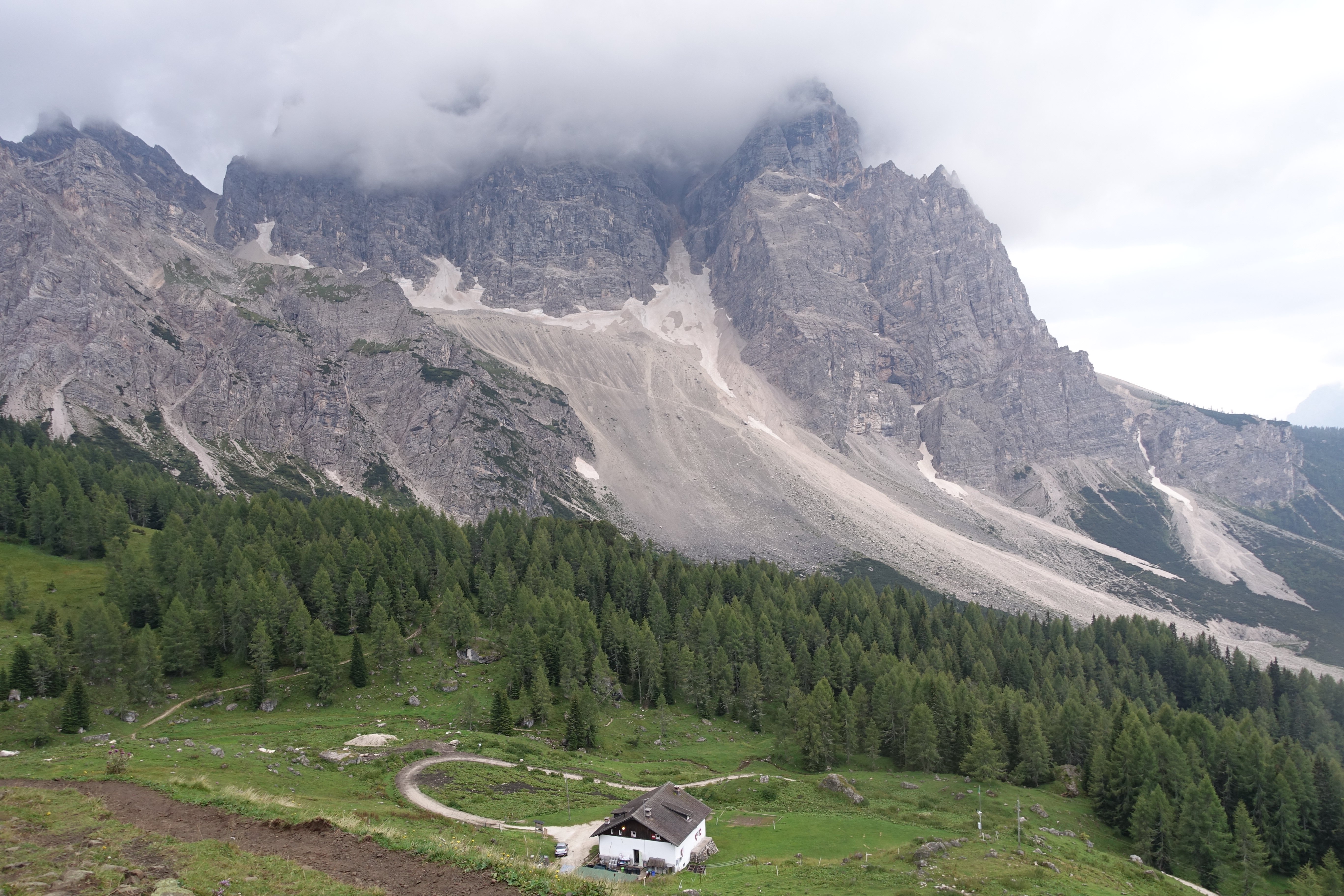
Borca di Cadore is a small comune in the Boite valley of the eastern Dolomites, sitting at about 940 metres between San Vito di Cadore to the north and Vodo di Cadore to the south. The village itself is unremarkable — a handful of stone houses, a parish church, the usual cluster of valley-floor shops — but Borca holds one of the most unusual architectural complexes in the Italian Alps, and that is why people come.
On a pine-covered slope west of the village stands the Villaggio ENI, a holiday colony built between 1954 and 1963 for the workers of the Italian state oil company. Edoardo Gellner designed the entire complex — bungalows, hotels, a campground, a colony for children — to merge with the forest rather than dominate it, and Carlo Scarpa contributed the church at its centre, a brutalist concrete chapel that is one of his lesser-known works. ENI withdrew in the 1980s and large parts of the village fell into ruin, swallowed by undergrowth and reclaimed by the trees. Restoration is now underway, and guided visits are possible through the Dolomiti Contemporanee foundation.
Beyond the Villaggio, Borca is mainly a base for the Dolomites. The walls of Monte Antelao rise directly above the village to the east, and the table-topped mass of Monte Pelmo closes the view to the west. The valley road is the only practical way through, and the ski lifts of San Vito and Cortina d'Ampezzo are a short drive north. There is little nightlife and even less shopping — Borca is a place to walk, to ski, and to look at one strange and beautiful piece of mid-century architecture.