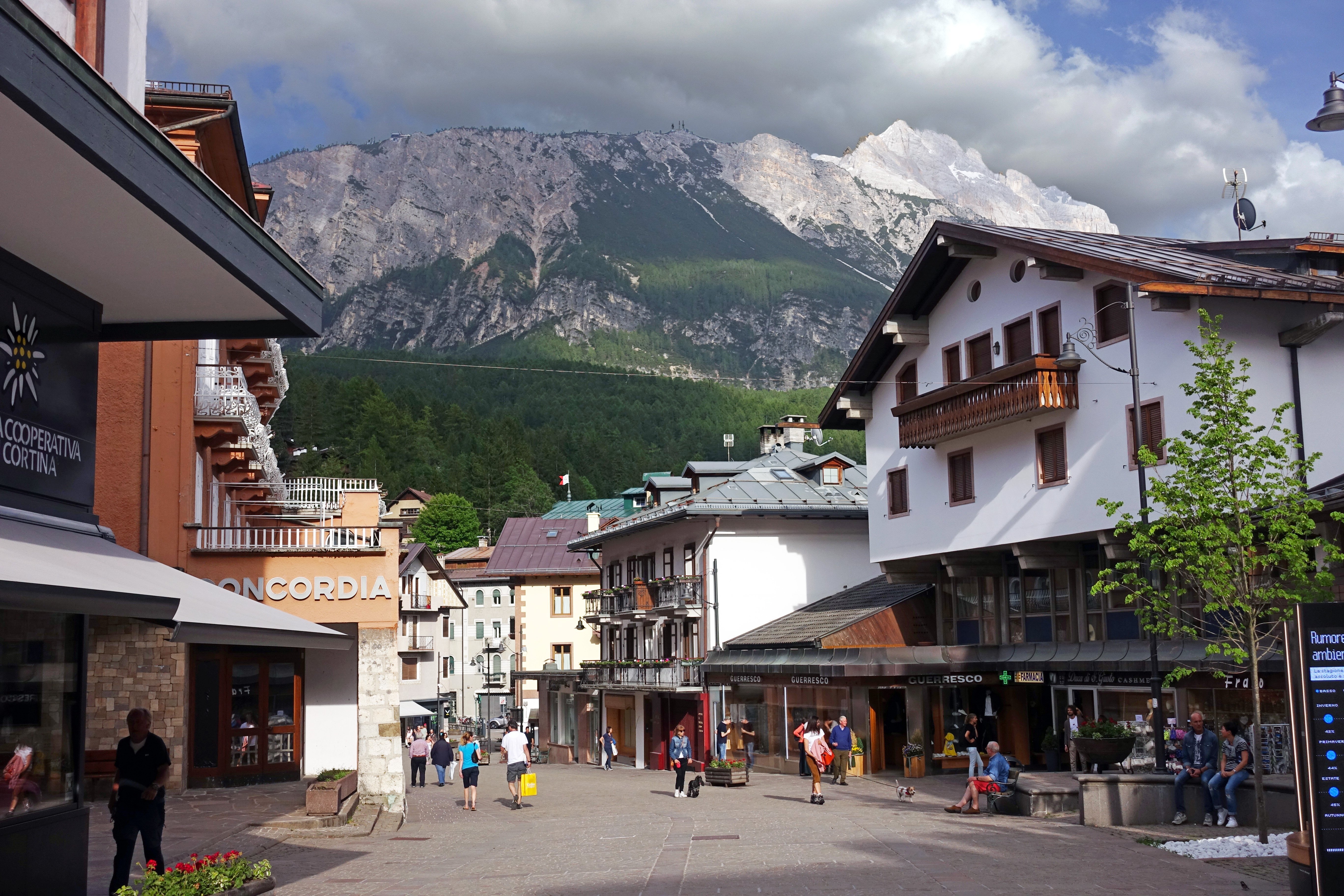
Cortina d'Ampezzo sits in a broad alpine valley surrounded by the jagged peaks of the Dolomites, and it earns its title as the "Queen of the Dolomites." The town hosted the 1956 Winter Olympics, will co-host the 2026 Winter Olympics, and has been a playground for Italian aristocrats and European celebrities ever since. The setting is genuinely dramatic — the Tofane, Cristallo, and Faloria massifs ring the valley on all sides, and at sunset the pale rock glows pink and orange in the phenomenon the Ladins call enrosadira. Photographs never quite capture it.
Winter brings serious skiing across several interconnected areas: the Tofana slopes above town, the quieter Faloria and Cristallo sectors to the east, and the Cinque Torri plateau to the south with its extraordinary rock towers. Cortina is part of the Dolomiti Superski network, connecting to dozens of resorts across the range on a single pass. The skiing is excellent, but so is the scene: the Corso Italia fills with fur coats and designer ski gear, the mountain refuges serve proper food at altitude, and the overall atmosphere is glamorous in a way no other alpine resort quite replicates.
Summer is a well-kept secret. Once the snow melts, the same peaks become world-class hiking and via ferrata terrain. The routes above Cortina thread through WWI fortifications blasted into the rock at 2,000 metres — the Dolomite front was one of the most brutal of that war, and the tunnels and galleries remain intact. The Cinque Torri are shorter hikes with outsized views; the Alta Via 1, one of Italy's great long-distance walks, passes right through.
The town itself is compact and walkable, centred on the Corso Italia pedestrian street. Beyond the boutiques and espresso bars, Cortina is a proper Italian mountain town: the locals speak Ladin as well as Italian, the cuisine blends Veneto and Tyrolean traditions — polenta, game, dumplings, strudel, funghi porcini — and the valley fills with birdsong rather than lift queues for most of the year. Prices are high by Italian standards, but the mountains are free.