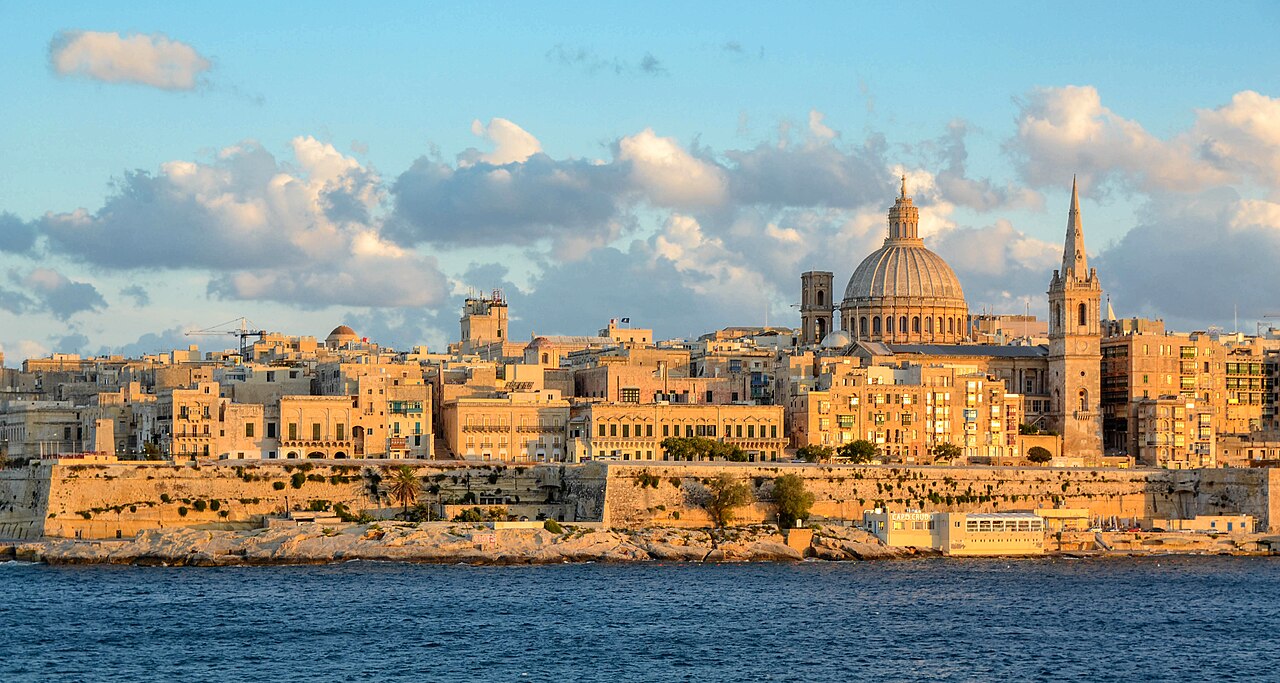
Malta's capital is one of the smallest and most densely historic cities in Europe. Built from scratch in the 1560s by the Knights of St John after their famous defence of Malta against the Ottoman siege, Valletta was one of the continent's first planned cities — laid out on a grid with building codes, drainage, and a hospital that admitted patients of any religion. It holds an astonishing concentration of Baroque architecture for a city of roughly 6,000 residents, and was named European Capital of Culture in 2018.
Start at the Upper Barrakka Gardens for the definitive view over the Grand Harbour and the Three Cities opposite. St John's Co-Cathedral is unmissable — the austere limestone exterior gives no warning of the gilded interior and the Caravaggio hanging in the Oratory. The Grand Masters' Palace on Republic Street held the seat of the Knights and later the British Governor; its Armoury houses 5,000 pieces of medieval arms and armour. The National Museum of Archaeology in the Auberge de Provence is the best place to understand Malta's extraordinary prehistoric culture before visiting the temples.
The city is compact enough to walk end to end in 20 minutes, which makes it easy to explore without an agenda. Wander down Merchants Street to the old market, or follow the southern bastions for views over Marsamxett Harbour. In the evening, Strait Street — the old sailors' quarter, once the most raucous street in the Mediterranean — has been revived as a bar and restaurant strip. The ferry across to the Three Cities (Vittoriosa, Senglea, and Cospicua) takes five minutes and is the best value excursion from Valletta.