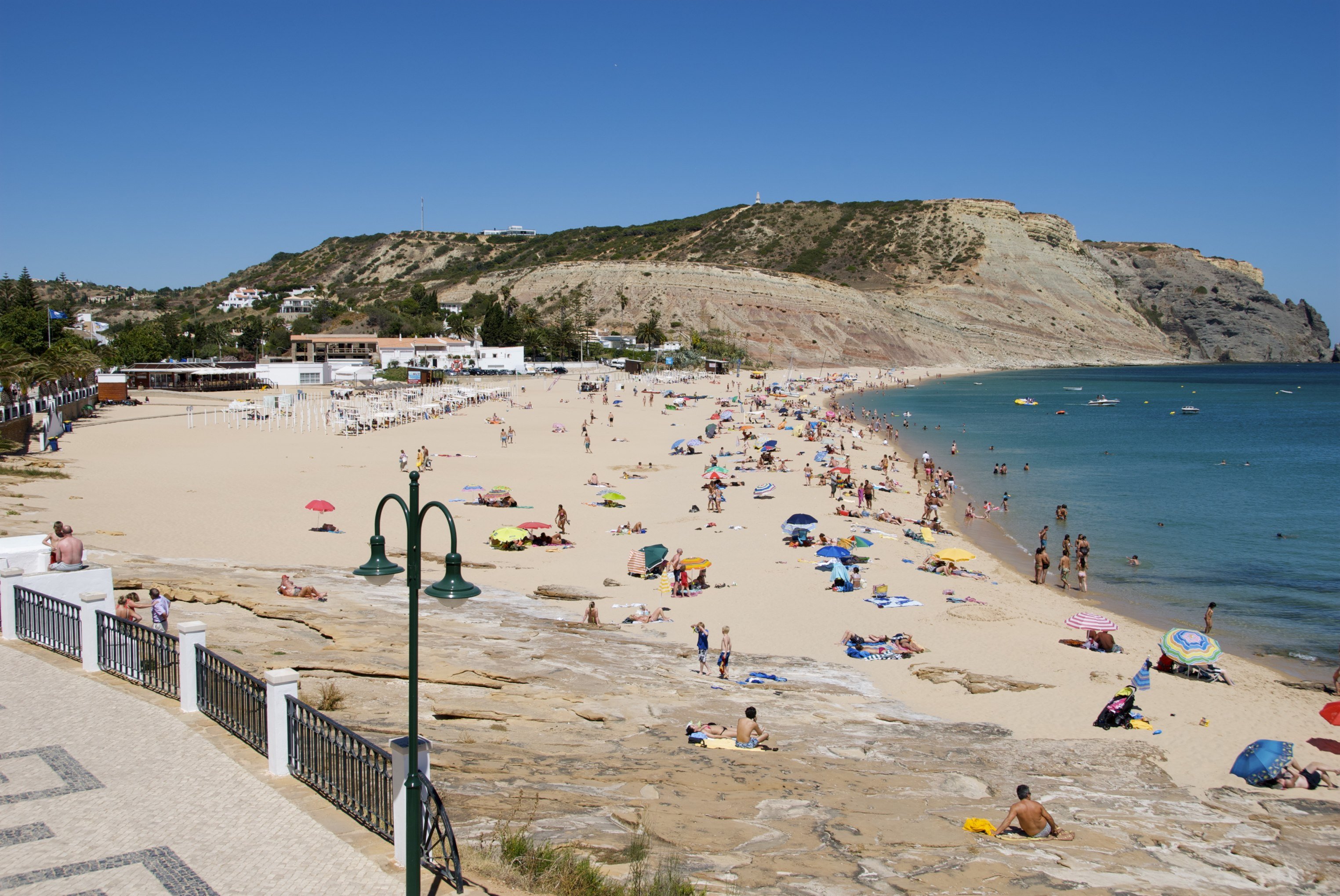
Low-key Algarve beach village near Lagos, set below Rocha Negra and a broad sandy bay.
Praia da Luz is a low-key beach village in the western Algarve, about five kilometres west of Lagos. It has the feel of a small resort that never quite went full package-holiday: the streets are calm, there are actual year-round residents, and the pace is slower than the bigger resorts to the east.
The village beach is a broad sandy bay, pleasant but busy in July and August. The more dramatic scenery is to the east, where the Rocha Negra — a great mass of black volcanic rock — juts into the sea above ochre cliffs. The rock gets its dark colour from ancient lava flows originating in the Monchique mountains inland, somewhere between 135 and 190 million years ago.
A 17th-century coastal fort overlooks the western end of the bay, now converted into a restaurant. The village has a good range of bars and restaurants, with a particular pull for British visitors, and there is a small cinema that shows films in their original language with Portuguese subtitles.
Guide
Day Trips
Praia da Luz sits in easy reach of some of the western Algarve's best coastline. Lagos is five kilometres east and worth a half-day for the old town walls, the Slave Market museum, and the Ponta da Piedade cliffs and grottoes — among the most photographed stretches of coast in Portugal. Sagres and Cabo de São Vicente, the southwesternmost point of Europe, are 40 minutes' drive west and feel genuinely end-of-the-world on a windy day.
The small fishing village of Burgau, ten minutes west, has held onto more of its old character than most Algarve villages and has a good beach beneath low cliffs. Inland, the Monchique mountains — source of Praia da Luz's distinctive black basalt — offer cooler air, eucalyptus forests, and the spa town of Caldas de Monchique.
Guide
Eating Out
Praia da Luz has a tighter cluster of restaurants than its small size suggests, in part because of the long-established British population. The strip along Rua 25 de Abril and the seafront promenade covers the basics: grilled fish, cataplanas, piri-piri chicken, a handful of Indian and Italian places, and the inevitable English pubs serving Sunday roasts.
For Portuguese cooking, head off the seafront. The fish you want is whatever was landed that morning at Lagos — bream, sea bass, sardines in summer — grilled over charcoal and served with potatoes and salad. Cataplana, the regional copper-pot stew, is on most menus and worth trying once.