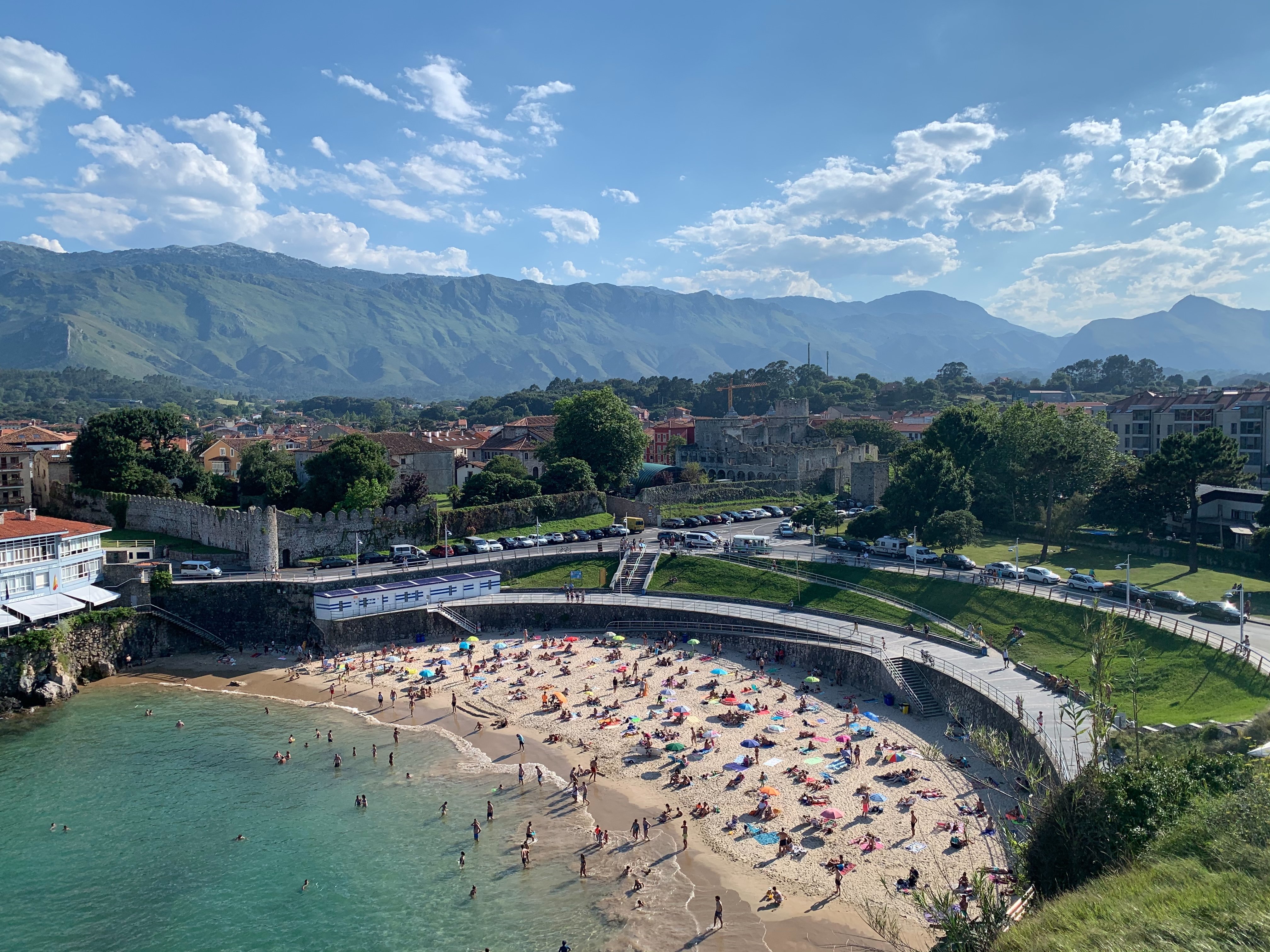
Asturian coastal town between the Cantabrian Sea and Picos de Europa, with beaches and blowholes.
Llanes is a small coastal town in eastern Asturias, wedged between the Cantabrian Sea and the Picos de Europa mountains. The combination is extraordinary — you can swim on a beach in the morning and be hiking in serious mountain country by lunch. The old town, built around a medieval harbour, still has its walls and towers, and the port fills with fishing boats that supply the restaurants along the waterfront.
The coastline around Llanes is one of the most dramatic in Spain. The Bufones de Pría, blowholes in the cliff where the sea shoots geysers of spray through the limestone, are spectacular in rough weather. Dozens of small beaches — Torimbia, Ballota, Gulpiyuri (a tiny inland beach fed by the sea through underground channels) — line the coast in both directions. The Senda Costera, a walking path along the cliffs, connects many of them.
In town, the Cubos de la Memoria — the painted concrete blocks along the harbour wall, covered in vivid murals by Basque artist Agustín Ibarrola — have become Llanes' most photographed sight. The old quarter is good for an evening paseo, with cider bars and seafood restaurants filling up after dark. Asturian cider, poured from height in the traditional way, is the drink here — ask for a culín.
Llanes has its own FEVE narrow-gauge railway station, connecting it along the coast to Santander and Oviedo. The Picos de Europa are about 30 minutes south by car.
Guide
Getting There
Llanes is on the FEVE narrow-gauge railway line that runs along the Cantabrian coast, connecting it to Santander to the east and Oviedo to the west. The journey from Oviedo takes about two hours; from Santander about three. The train is slow by main-line standards but runs through spectacular mountain and coastal scenery, making the journey worthwhile in itself.
By car, Llanes is on the A-8 Autovía del Cantábrico, the main coastal motorway, about 100 km east of Oviedo and 90 km west of Santander. The Picos de Europa are about 30 minutes south by the AS-114 road through Panes. The nearest commercial airport is Asturias Airport (OVD), about 90 km west near Avilés.
Guide
When to Go
The Asturian coast has a genuinely Atlantic climate — green, mild, and wet for much of the year. Summers are warm but rarely hot (average highs around 22°C in July and August), and this is when Llanes fills with Spanish holidaymakers from Madrid and further inland. July and August are the busiest months; beaches get crowded and accommodation should be booked well in advance.
June and September are the best compromise: the weather is good, the beaches less crowded, and the prices lower. Spring (April–May) is beautiful — the countryside is intensely green and the wildflowers are out — but sea temperatures are still cold for swimming. The blowholes at Bufones de Pría are most spectacular in autumn and winter storms, if that is your reason to come. Llanes' own annual festival (La Magdalena) runs in late July; the town is lively and packed.
Rain is possible at any time of year. Bring a waterproof layer whatever the season.