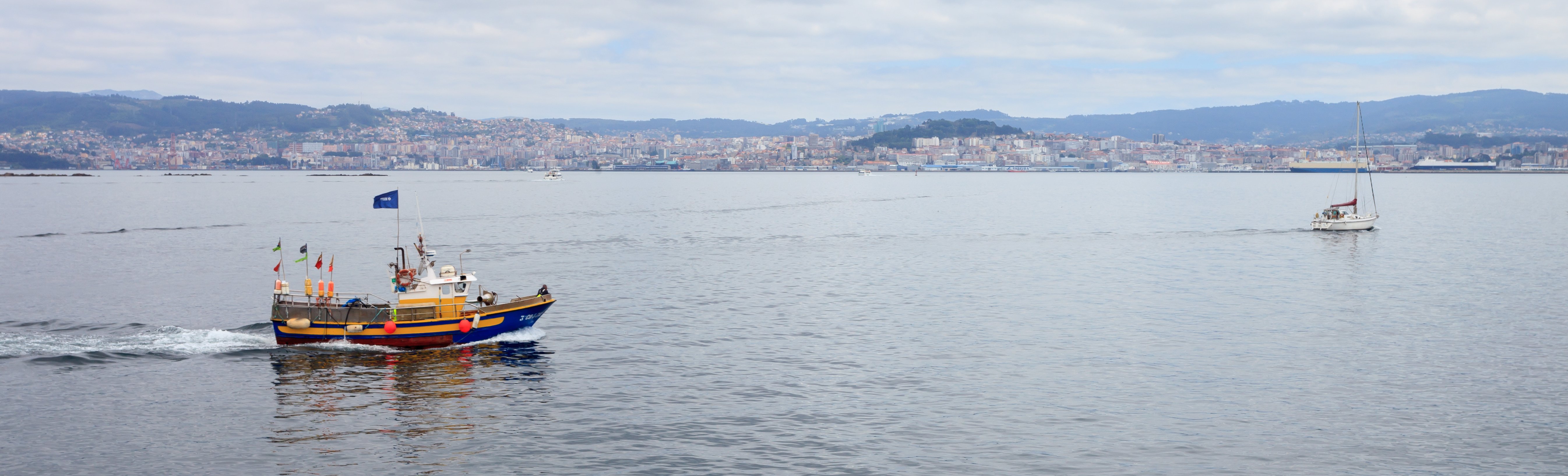
The Ría de Vigo is the southernmost of Galicia's great sea inlets — an unusual one, because it narrows at Rande before widening again into the inner San Simón Bay, giving it a more complex shape than the other rías. At the entrance stand the Cíes Islands, a protected natural park of dramatic cliffs and white-sand beaches, reachable by ferry from Vigo. The Spanish government has described the Cíes beaches as some of the finest in the world, and in summer access is limited by permit to protect the ecosystem.
The ría's shores hold several distinct places. Vigo itself, on the southern bank, is Galicia's largest city and has one of the best natural harbours in Europe — an important fishing port and ferry gateway to the Canary Islands and the Azores. Baiona, at the ría's mouth, is where the Pinta arrived in 1493 to bring the first news of Columbus's discovery of the Americas to Europe; a replica sits in the harbour. Cangas, on the northern peninsula, is a quieter fishing town reachable by catamaran from Vigo in 20 minutes. At the ría's head, Arcade is one of the main oyster-producing areas in Spain.
The mussel-farming platforms (bateas) visible throughout the ría are central to Galicia's food economy — these waters, churned by Atlantic currents, produce some of the best mussels and shellfish in Europe.