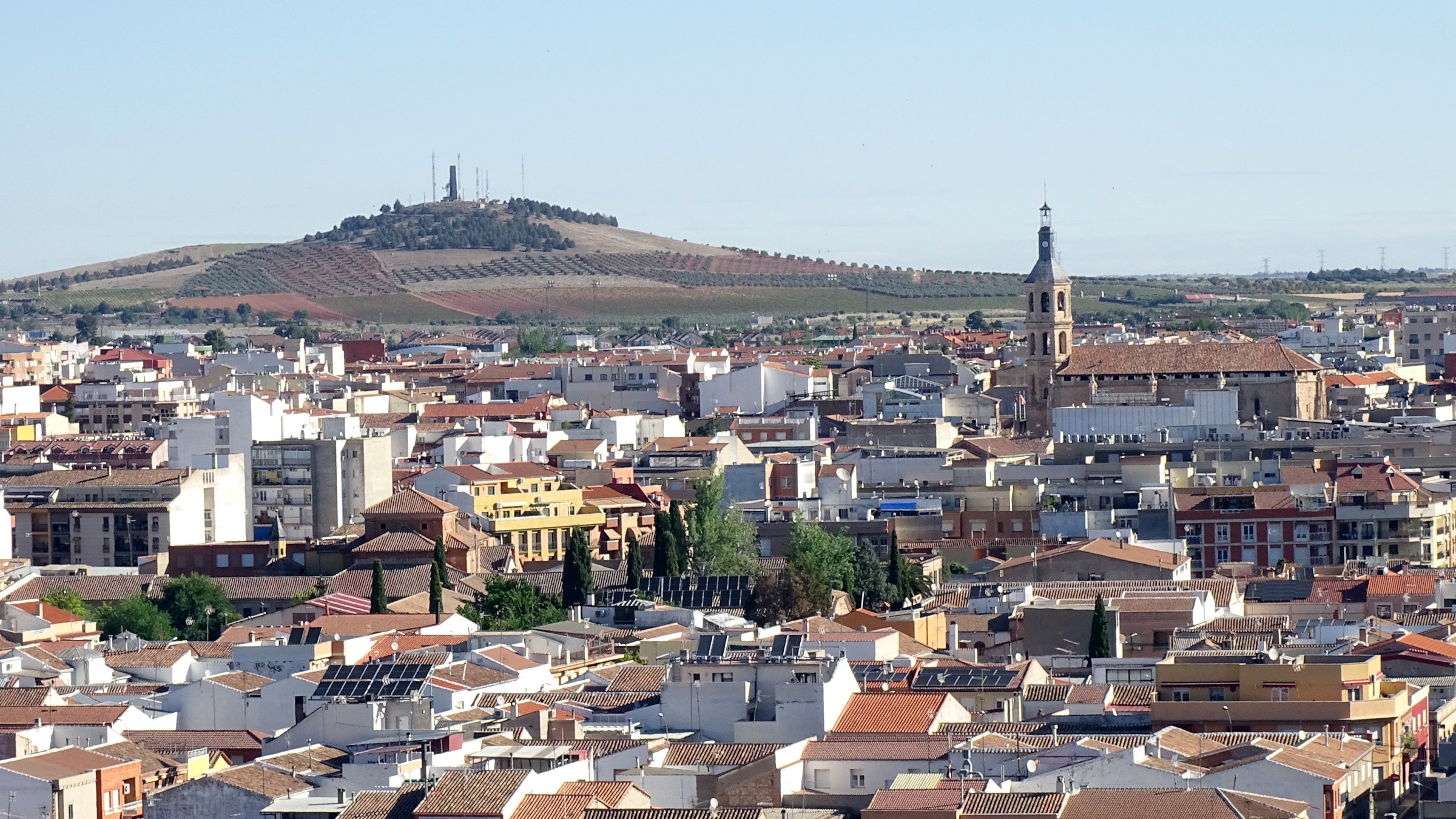
La Mancha wine town whose name still marks one of Spain's everyday red-wine regions.
Valdepeñas is the wine capital of La Mancha, sitting at the southern edge of the vast Castilian plateau about two hours south of Madrid. The town gives its name to one of Spain's most widely drunk denominations — Valdepeñas wine is the reliable house red in bars across the country, though the best producers here make far more interesting bottles than that reputation suggests.
The centre is pleasant and white-walled, focused on the long Plaza de España with its arcaded buildings and the late Gothic church of Nuestra Señora de la Asunción. The Museo del Vino, housed in a renovated bodega on Calle Princesa, covers the history of local winemaking and includes a tasting. Several bodegas on the edge of town offer visits — the underground cellars, some carved centuries ago, are impressive even if you are not particularly interested in wine.
The Molinos de Gregorio Prieto windmill park, just outside town, is one of several spots in La Mancha where you can see the kind of windmills Don Quixote famously tilted at. The painter Gregorio Prieto, born in Valdepeñas in 1897, has a small foundation museum in town with portraits of his circle, which included Lorca and Dalí.
Valdepeñas is an easy stop on the road between Madrid and Andalusia. The AVE high-speed train passes through nearby Ciudad Real, and the town is right off the A-4 motorway. See Getting There for details.
Guide
Books
Don Quixote by Miguel de Cervantes is the obvious starting point — and not just as homework. The novel is set in La Mancha, and reading it before or during a visit here gives the flat, windmill-dotted landscape an entirely different resonance. Cervantes never named the village his hero came from ("a village in La Mancha whose name I have no desire to recall"), but the landscape he describes is recognisably this one. The Penguin translation by John Rutherford is a good modern version.
Homage to Catalonia by George Orwell does not cover La Mancha specifically, but it is the essential book for understanding the Spanish Civil War that tore through these towns and villages in the late 1930s. Orwell's honest, first-person account of fighting on the Republican side gives weight to the war memorials and divided memories you will encounter across Castile.
Spain by Jan Morris is a portrait of the country written in the 1960s and revised in subsequent decades. Her chapter on Castile captures the austerity and grandeur of the plateau better than most travel writing. It ages unevenly but the core observations still hold.
Guide
Getting There
Valdepeñas is well connected to Madrid by both rail and road, making it an easy day trip or overnight stop.
The quickest option is the AVE high-speed train from Madrid Puerta de Atocha to Ciudad Real (about 50 minutes), followed by a regional RENFE service the remaining 30 km to Valdepeñas — the full journey takes around 90 minutes with a good connection. Alternatively, direct regional trains on the Madrid–Cádiz line stop at Valdepeñas station, with a journey time of around two hours. The station is about a ten-minute walk from the town centre.
By car, Valdepeñas is directly on the A-4 motorway (the old road to Cádiz and Andalusia), 215 km south of Madrid. The drive takes around two hours depending on traffic leaving the capital.
From Toledo, the drive south on the CM-42 takes about an hour. There is no direct train connection between Toledo and Valdepeñas.