La Mancha hill town whose ridge of white windmills overlooks the wide Don Quixote plains.
Mota del Cuervo sits on a low hill in the province of Cuenca, about 160 km southeast of Madrid. The town calls itself the Balcón de la Mancha — the Balcony of La Mancha — and from the ridge where the windmills stand, you can see why: the plain stretches out in every direction, flat and enormous, the kind of landscape that makes Don Quixote's giants feel plausible. There are seven windmills up there, white and round-towered, and on a windy day they actually turn.
The windmills date to the 18th century. Three are open to visit. El Gigante, rebuilt in 1967, functions as a milling museum with working machinery; on Saturday mornings staff grind flour the old way. Look for El Zurdo — it's the one whose sails turn counterclockwise, which is unusual enough to have earned it a nickname (zurdo means left-handed). The view from the ridge at dusk is worth the climb on its own.
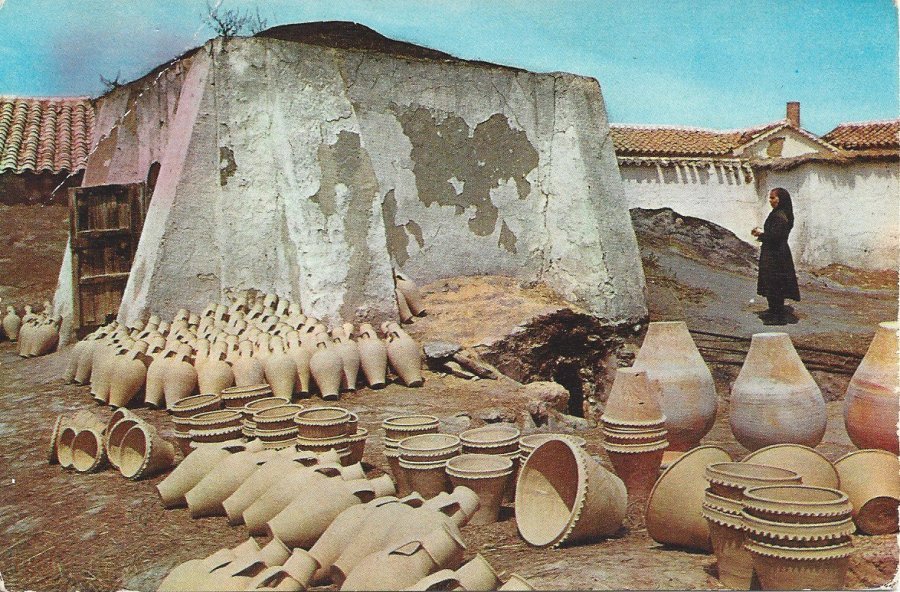
Down in town, the Pottery Museum in the Las Canteras neighbourhood documents a craft that was long a source of income for local women: they made the pitchers and bowls, the men fired and sold them. The last pitcher kiln in town still stands at the museum entrance and gets used once a year. It's a modest collection but specific and unhurried.
Belmonte, 15 km west, has one of the best-preserved castles in Castilla — a Gothic-Mudéjar fortress from 1456 that you can walk through properly, not just photograph from outside. Campo de Criptana, with its own cluster of windmills, is 30 km to the southwest. Either makes a natural combination with a stop here.
Mota del Cuervo is small and not set up for tourism in any heavy way, which is part of its appeal. Come for the windmills and the view, stay long enough to look around, and head on.
Guide
Getting There
Mota del Cuervo is in the province of Cuenca, about 160 km southeast of Madrid. By car, take the A-3 motorway toward Valencia and turn off at Tarancón, then continue southeast on the N-400 and CM-3101; the drive from Madrid takes around two hours. There is no direct train service to the town.
By bus, there are connections from Madrid's Estación Sur to Cuenca province via ALSA, with services calling at nearby towns. Check current timetables carefully as rural connections can be infrequent. The easiest independent approach is by rental car from Madrid, which also gives you the freedom to visit Belmonte and Campo de Criptana in the same day.
The nearest large town with better transport links is Cuenca, about 80 km to the northeast, which has regular train services from Madrid Chamartín and its own considerable attractions — the famous Casas Colgadas (hanging houses) and the abstract art museum inside them.
Guide
When to Go
Spring (March to May) and autumn (September to October) are the best times to visit Mota del Cuervo. Temperatures are moderate, the light across the plateau is beautiful, and the countryside is either in bloom or turning gold. Spring is particularly good if you want to see the windmills turning — the winds that gave them their purpose blow more reliably in the wetter months.
Summer in La Mancha is harsh. July and August bring intense heat, regularly above 35°C, with little shade on the ridge where the windmills stand. Visits early in the morning or in the early evening are still worthwhile, but a midday walk up to the mills in high summer is uncomfortable. Winter is cold and can be grey, but the plateau has a stark beauty and the roads are quiet.
Saffron — La Mancha's most famous crop — is harvested in late October and early November. The fields around Mota del Cuervo fill with the purple flowers of Crocus sativus, and the harvest, done entirely by hand at dawn, is one of the more extraordinary agricultural spectacles in Spain.