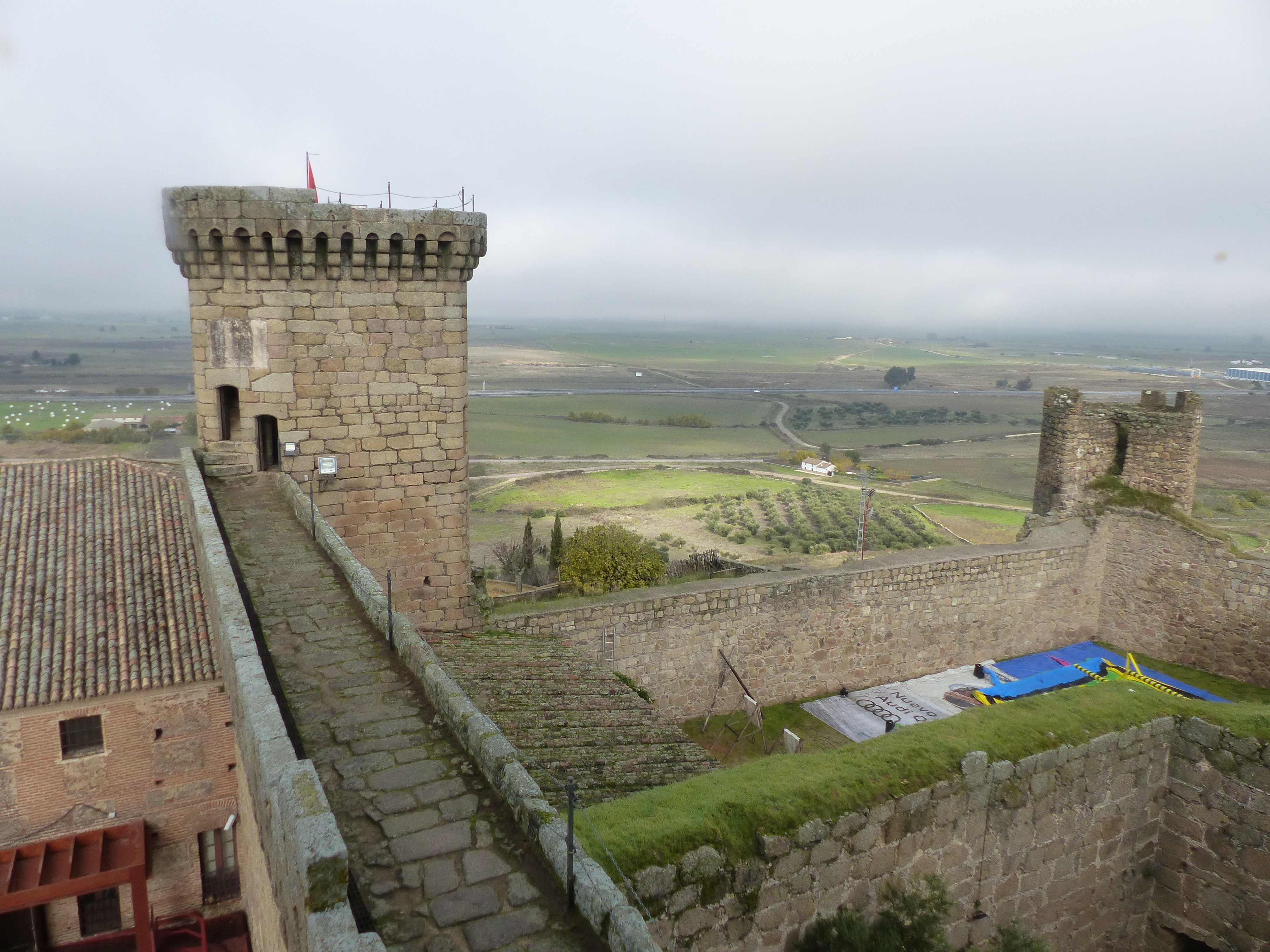
Perched on a hilltop in Toledo province, Oropesa is a compact medieval town with a disproportionately grand castle. Its skyline is dominated by the fortified complex of the Álvarez de Toledo family, counts of Oropesa — and the castle's 15th-century keep surveys a sweep of farmland running all the way to the Sierra de Gredos, which rises sharply to the north. Halfway between Toledo and the Portuguese border on the old Roman road linking Toledo with Mérida, the town has been a stopping point for travellers and armies for two thousand years.
The Parador de Oropesa — and not just any Parador: it was the first in Spain to open in a historic building, in 1930. Even if you're not staying, it's worth walking up through the old town to see the complex, which spans two medieval castles and two Renaissance palaces built in successive centuries by the same noble family. Carlos I of Spain (later Holy Roman Emperor Charles V) lodged here on his way through Castile. The views from the ramparts over the Tagus valley are some of the best in the province.
Below the castle, the old town is tight and quiet — a tangle of stone lanes with the 16th-century Iglesia de Nuestra Señora de la Asunción and the convent of Las Misericordias among the main landmarks. The Plaza del Navarro, at the heart of things, has a clock tower and a handful of bars. In April the town runs a Medieval Days festival that fills the streets with markets, costumed guilds, and jousting — worth timing a visit around if you're in the area.
Oropesa also makes a useful base for a couple of detours. Just 3 km away, the village of Lagartera is known across Spain for its traditional embroidery — a distinctive style of coloured stitching on white linen — and has a small museum displaying historic pieces and local costume. A short drive in the other direction brings you to Puente del Arzobispo, a working pottery town on the Tagus, where you can watch potters throw the characteristic green-glazed ceramics that have been made here since the 15th century.