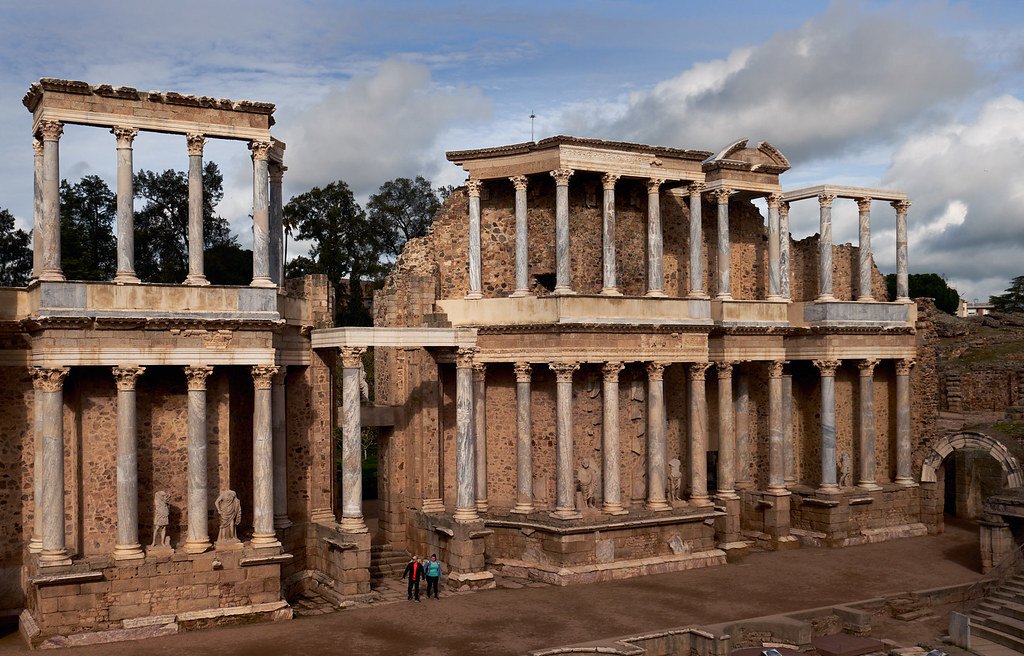
Mérida punches well above its weight. A quiet provincial capital of around 60,000 people in the heart of Extremadura, it sits on top of what was once one of the most important cities in Roman Spain — Augusta Emerita, founded in 25 BC as a retirement colony for veteran legionaries. The ruins left behind are extraordinary: a theatre that still hosts performances each summer, an amphitheatre, two aqueducts, a Roman bridge across the Guadiana that remained in daily use until the 1990s, and temples scattered through the modern town. UNESCO added it to the World Heritage List in 1993.
The Teatro Romano alone is worth the journey. Its reconstructed stage facade — two tiers of marble columns in pale honey and white — is one of the most photogenic Roman structures in the Iberian Peninsula. In July and August it hosts the International Classical Theatre Festival, and sitting in the stone seats watching a Greek tragedy performed where Romans watched the same plays two thousand years ago is a genuinely moving experience.
The Museo Nacional de Arte Romano, a short walk from the theatre, is essential. Designed by Rafael Moneo and opened in 1986, the building itself is a statement — Roman-scale brick arches housing mosaics, sculpture, and funerary monuments from the excavations underway beneath and around the city. Mérida is still being dug up; new finds surface regularly.
Mérida is easily skipped by travellers rushing between Madrid and Seville, which is exactly why it remains unhurried and unaffected. The old town around the Alcazaba and the Plaza de España is pleasant without being prettified for tourists. Come for at least one night — the ruins look different in the late afternoon light, and dinner at a terrace in the square is a good reason to stay.