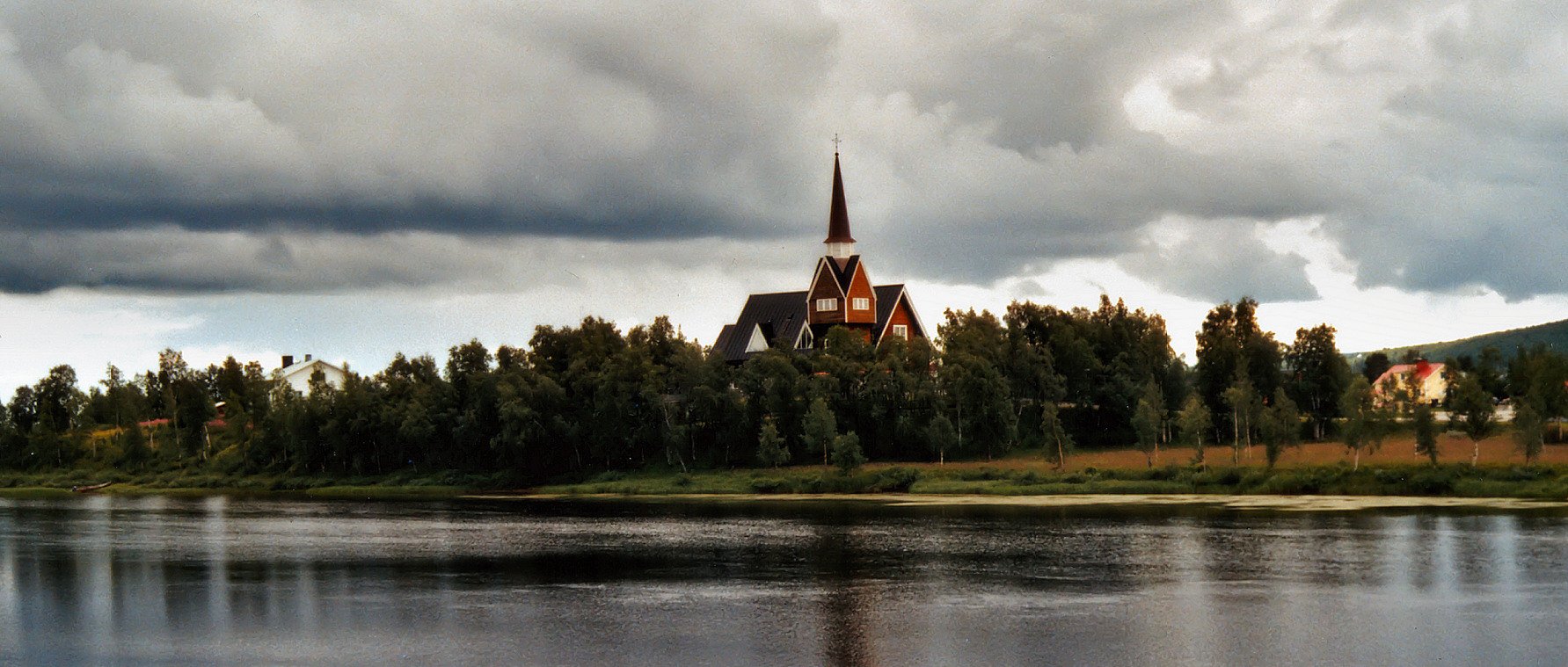
Sweden's northernmost town, on the Muonio River opposite Finnish Karesuanto.
Karesuando is the northernmost town in Sweden, sitting on the Muonio River right at the Finnish border. The Finnish town of Karesuanto is just across the bridge, and the two communities share a culture that is as much Finnish and Sami as it is Swedish. The landscape up here is subarctic tundra and birch forest, flat and vast, with temperatures that drop below minus 40 in winter.
The town is small — a few hundred people — but it has an outsized place in Swedish history. Lars Levi Laestadius, the 19th-century botanist and preacher whose revivalist movement still has followers across northern Scandinavia, was the parish priest here. His parsonage is preserved as a museum. The Vita Huset cultural centre has exhibitions on Sami and Tornedalian culture.
Karesuando is a starting point for wilderness excursions into the Karesuando-Enontekiö fell area, and in winter it is one of the best places in Sweden to see the northern lights. The midnight sun shines from late May to mid-July. If you are driving north through Swedish Lapland, this is quite literally the end of the road.
Guide
Getting There
Karesuando is at the northern end of the E45, Sweden's longest road, which runs from Gothenburg all the way to the Norwegian border above the Arctic Circle. If you are driving north through Swedish Lapland, Karesuando is quite literally where the road runs out — the E45 continues into Finland as Finnish national road 21, but the road does not carry on further north into Sweden.
The nearest airport is Kiruna, roughly 200km to the south-west. There is no train service to Karesuando. Bus services run along the E45 corridor from Gällivare and Kiruna, though they are infrequent — check current timetables with Länstrafiken Norrbotten before depending on them.
From the Finnish side, Karesuvanto is connected by road to Enontekiö and the Finnish road network. The border crossing on the bridge is open and unstaffed, as it has been since Finland joined the Schengen zone.
Guide
When to Go
Karesuando has two extreme seasons and they attract different kinds of visitor. In winter — roughly November through February — temperatures regularly fall below minus 30°C, and in a harsh winter they can touch minus 40°C. The payoff is darkness: the northern lights appear frequently, and when conditions are right the entire sky moves with them. A clear, cold night with a full display is one of those experiences that makes the discomfort worth it.
Summer is the opposite extreme. The midnight sun shines without setting from late May to mid-July, turning days and nights into a continuous golden blur. The birch forests come alive, the river runs full, and temperatures occasionally climb into the twenties. The fell country east toward Finland is excellent for hiking and fishing.
Spring and autumn are transitional and often grey, but the autumn colours in September are spectacular across the tundra.