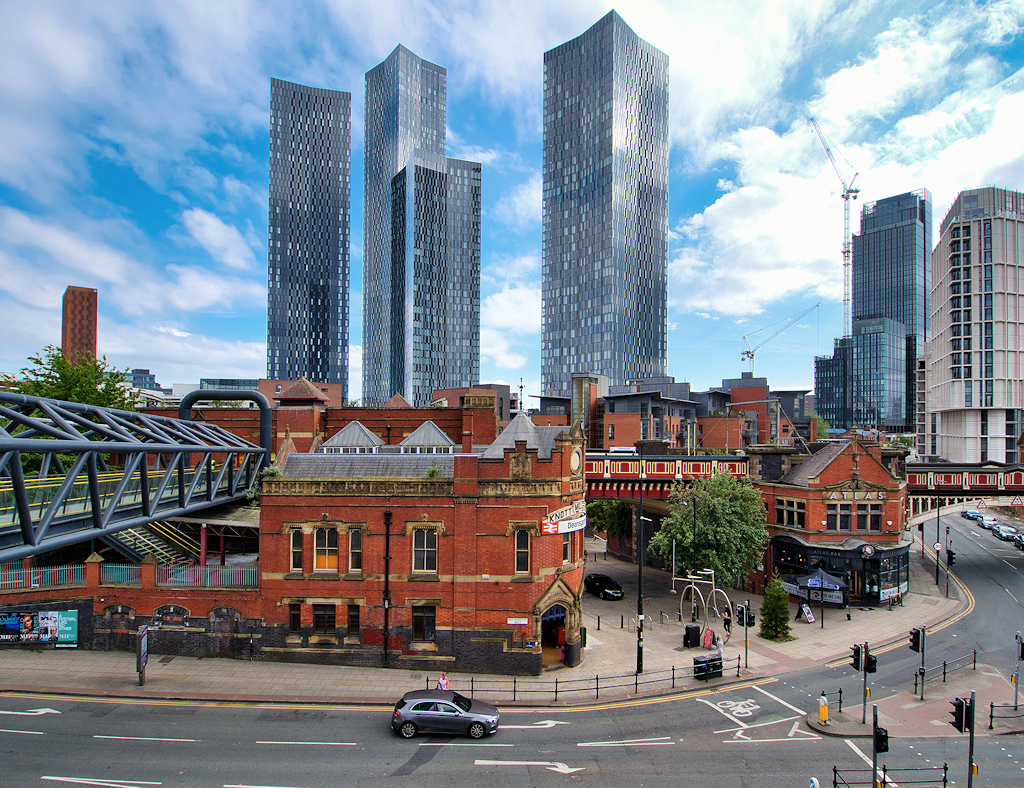
Manchester is the great industrial city of northern England — the place where the modern world, for better and worse, was largely invented. The first passenger railway ran from here to Liverpool in 1830. The first programmable computer was built here in 1948. The cotton mills that powered the Industrial Revolution lined every river and canal in the city, and the wealth they generated built the grand Victorian warehouses, exchanges, and civic buildings that still define the centre. The mills are gone, but Manchester has reinvented itself as successfully as any post-industrial city in Europe: the music scene (Joy Division, The Smiths, Oasis, The Stone Roses), the football (two of the biggest clubs in the world, United and City), and a nightlife that regularly outpaces London's have made it the de facto second city of England.
The city centre is compact and walkable. Deansgate and the area around St Ann's Square are the commercial heart, with the John Rylands Library — a neo-Gothic cathedral of books, free to enter, with a Gutenberg Bible and the world's oldest New Testament papyrus — hidden just off the main shopping streets. The Northern Quarter, north of Piccadilly Gardens, is the independent, slightly scruffy creative district: vintage shops, record stores, street art, and the best café culture in the city. Ancoats, the world's first industrial suburb, has become the city's most interesting food and restaurant neighbourhood in former Victorian cotton mills. Castlefield, to the south-west, is where the canals, railway viaducts, and Roman ruins converge in a surprisingly atmospheric urban landscape.
Manchester's museums are excellent and mostly free. The Museum of Science and Industry, in the world's oldest surviving passenger railway station, tells the story of industrialisation with working steam engines and a hands-on textile gallery. The Imperial War Museum North, Daniel Libeskind's fractured-aluminium building at Salford Quays, is one of the most powerful war museums anywhere. Nearby, The Lowry holds the largest public collection of L.S. Lowry's matchstick-men paintings of industrial Lancashire. The Manchester Art Gallery has an unexpectedly strong collection of Pre-Raphaelites, and Manchester Museum at the university holds Egyptian mummies and dinosaurs. The People's History Museum tells the story of the labour movement with extraordinary silk banners and a frank account of the Peterloo Massacre of 1819. The Pankhurst Centre marks the house where Emmeline Pankhurst founded the suffragette movement in 1903. And Chetham's Library, the oldest free public library in the English-speaking world, is where Marx and Engels worked during the 1840s.
The Curry Mile on Wilmslow Road in Rusholme — a long strip of South Asian restaurants, sweetshops, and shisha cafés — is one of the most famous food streets in Britain. Chinatown, just off Piccadilly, is the second-largest in the UK. Canal Street is the centre of the Gay Village — one of the most celebrated LGBTQ+ districts in Europe. And the Alan Turing Memorial in Sackville Gardens is a moving tribute to the man who broke the Enigma code and was then prosecuted by his own government for being gay.