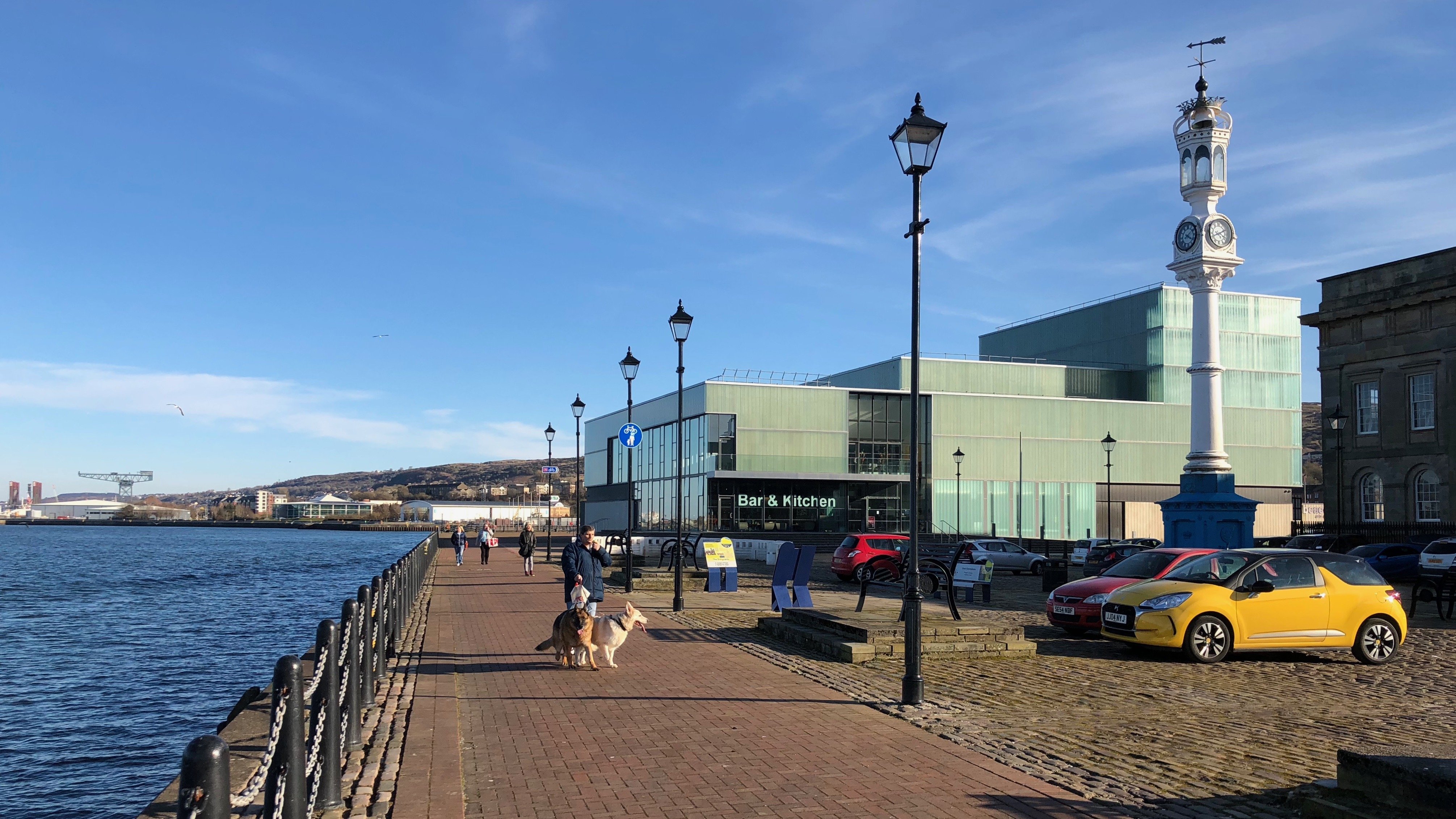
Greenock sits on the south bank of the Firth of Clyde, about 30 kilometres west of Glasgow, where the river widens into something that feels genuinely oceanic. It was one of Scotland's great shipbuilding and maritime towns, and the waterfront still carries that industrial weight — the Custom House, built in 1818, is a fine neoclassical reminder of when Greenock was a significant port handling transatlantic trade and emigration.
The town is the birthplace of James Watt, the engineer whose improvements to the steam engine powered the Industrial Revolution. The McLean Museum and Art Gallery does a solid job explaining Watt's legacy and the broader story of Clyde shipbuilding. The Watt Library, opened in 1837, is one of the oldest working libraries in Britain. Down at the waterfront, the James Watt Dock Crane is a striking piece of industrial heritage.
Greenock also has an unexpected French connection. The Free French Memorial on Lyle Hill — a Cross of Lorraine with extraordinary views over the Firth — honours the French sailors based here during the Second World War. The views from the hill on a clear day are worth the climb regardless of the history.
Most visitors use Greenock as a stopping point rather than a destination in itself — it's on the way to the Cowal Peninsula, Bute, and Dunoon, and the ferry connections from Gourock (immediately to the west) make it a natural gateway to western Scotland.