Marie-Galante
©
Marie-Galante

Marie-Galante

Rural Guadeloupe island of sugarcane fields, windmill ruins, rum distilleries, and quiet beaches

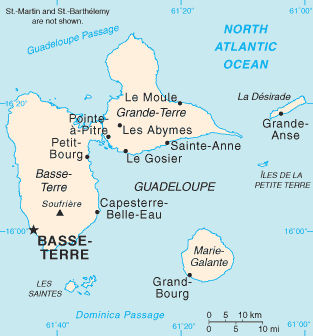
Marie-Galante is a round, flat island about 25 km south of Guadeloupe's main island, reachable by ferry in roughly an hour from Pointe-à-Pitre. It is quieter and more rural than Guadeloupe proper — a place of sugarcane fields, ox carts still used on some farms, and beaches that haven't been packaged for mass tourism. The islanders call it "the island of a hundred windmills," a reference to the sugar mills that once dominated the landscape; some forty stone towers still stand scattered across the interior, remnants of a sugar economy that shaped everything about the island.

The three main towns each have a distinct character. Grand-Bourg, on the south-west coast, is the capital and the livelier of the three, with a proper market, a seafront square, and most of the island's services. Saint-Louis, to the north-west, is a quieter fishing town with easy access to the best beaches. Capesterre, on the south-east coast, sits near the island's second distillery and is the most traditional of the three.

The beaches are the draw. Anse de la Feuillère, on the north-west coast, is a kilometre of white sand backed by sea grapes — calm, clear, and rarely crowded. The beaches around Saint-Louis, including Anse Canot and Anse Moustique, are popular with islanders at weekends. The water here is warmer and calmer than the Atlantic-facing beaches of Guadeloupe, with coral close to shore in many spots.

Rum is serious business on Marie-Galante. Three distilleries still operate on the island — Bellevue, Bielle, and Capesterre (also called Poisson) — and each produces a distinct agricole rum from fresh-pressed sugarcane juice. All three welcome visitors, offer tours of the distillery, and give generous tastings at the end. The rum from Marie-Galante has a reputation for being among the finest in the French Caribbean; buy a bottle at the distillery to take home.

The pace is slow, the roads quiet, and the population around 12,000. Plan to stay at least two nights — a day trip from Guadeloupe is possible but doesn't do the island justice. Creole is still the primary language in everyday life, and traditional culture — music, food, crafts — feels more intact here than on Guadeloupe itself.

Guide

Bars and Cafes

The bar scene on Marie-Galante is informal and local. Rum punches (ti' punch — white rum, cane syrup, a squeeze of lime) are the standard order, and the quality of the local rum means even a simple bar serves something memorable. Grand-Bourg's seafront square has a cluster of bars that liven up on weekend evenings. There is no nightlife to speak of in the urban sense — the island winds down early — but the atmosphere around the waterfront and at distillery tasting rooms more than compensates.

Guide

Beaches

Marie-Galante has some of the least-developed beaches in the French Caribbean. The west and north coasts face the Caribbean Sea — calm, warm water and white sand. The east coast faces the Atlantic and is rougher, better for walking than swimming. Most beaches have no facilities; bring water and sun protection.

Guide

Eating Out

Eating on Marie-Galante means Creole cooking — acras (salt-cod fritters), colombo (the island's version of curry), grilled whole fish pulled from the Caribbean that morning, and rice and peas as standard accompaniment. The ingredient quality is high and the cooking is unhurried. Grand-Bourg has the most choice; Saint-Louis and Capesterre each have a handful of restaurants, many operating only at lunch.

Most restaurants close by early evening, and several only open for lunch. If you are staying self-catering, the Grand-Bourg market (busiest Saturday mornings) has excellent fresh fish, produce, and prepared Creole dishes.

Guide

Getting Around

Car rental is the most practical option for exploring the whole island. Rental agencies operate from Grand-Bourg, and some meet ferries at the dock. The island circuit road (about 60 km) is well-paved; the interior roads are narrower but passable. Expect to pay around €40–50 per day. Driving is on the right, as in metropolitan France.

Scooter and bicycle rental are available in Grand-Bourg and near the ferry terminal. The island is flat enough for cycling — no serious climbs — though the heat makes a scooter more comfortable for longer distances. Scooters rent for about €30 per day.

Taxis operate on the island but are not metered; agree a price before getting in. Most taxi drivers offer informal island tours for a fixed rate — useful if you only have a day and want to hit the distilleries and main beaches without driving yourself.

There is no public bus service worth relying on for tourists. The occasional minibus (taxi collectif) runs between the three towns but on no fixed schedule.

Guide

Getting There

By ferry is by far the most common approach. CTM Deher and L'Express des Îles both operate from the ferry terminal in Pointe-à-Pitre (Gare Maritime de Bergevin) to Grand-Bourg on Marie-Galante. The crossing takes around 45 minutes on the fast ferry. Several departures daily, more on weekends. Tickets cost around €25–30 each way; book online in advance during holidays.

There is also a less frequent ferry connection from Saint-François on Grande-Terre, useful if you are staying in that part of Guadeloupe.

By air, Marie-Galante Airport (IATA: GBJ) receives small aircraft from Pointe-à-Pitre's Pôle Caraïbes Airport. Air Antilles and Guadeloupe Air Services offer inter-island flights; the flight takes around 20 minutes. Useful in rough weather when the ferry is uncomfortable, but not significantly faster door-to-door.

Guide

When to Go

The dry season runs from January to June, with the sweetest conditions between February and April — low humidity, trade winds keeping temperatures around 27°C, and little rain. July through November is hurricane season; August and September are the peak risk months. Rain falls more intensely during the wet season but rarely all day — showers tend to be sharp and short.

The island hosts its biggest festival, the Carnival of Marie-Galante, in the days before Ash Wednesday (February or early March). Street parades, traditional Gwo Ka drumming, and costumed groups fill Grand-Bourg. It's rowdier and more local-feeling than the Guadeloupe mainland carnival.

Fête du Rhum celebrations coincide with the distilleries' harvest season, typically January to June, when fresh cane is being pressed and the new-season rum begins fermenting. Visiting a distillery during this period means seeing the whole process in action rather than just the ageing barrels.

Easter weekend draws Guadeloupean families to Marie-Galante's beaches — the island gets noticeably busier and accommodation fills up. Book ahead if travelling then.