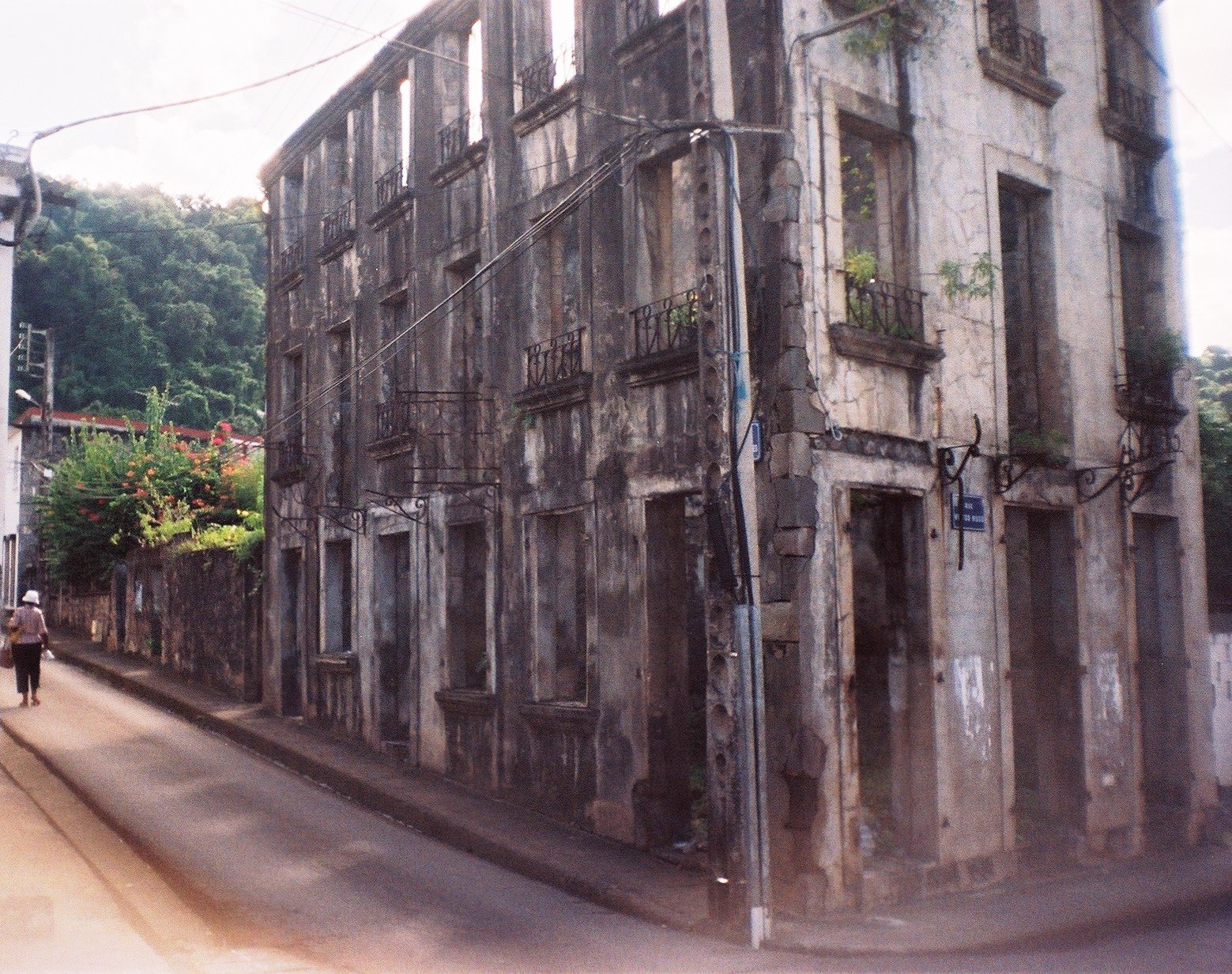
Saint-Pierre was once the cultural capital of the Caribbean — the "Paris of the Antilles," a prosperous colonial city of 30,000 people at the foot of Mount Pelée. On 8 May 1902, the volcano erupted with a superheated pyroclastic surge that killed virtually the entire population in minutes. The ruins have never been rebuilt. Walking through the overgrown streets and crumbled facades, you are essentially walking through a frozen moment in 1902.
Today Saint-Pierre is a small town rebuilt among and beside the ruins. The Musée Vulcanologique Frank Perret displays artifacts recovered from the disaster — clocks stopped at 8am, fused glass, a church bell melted out of shape. The ruins of the theatre, the cathedral, and the military hospital are woven into the fabric of the living town. The dungeon where Auguste Cyparis survived — the only known survivor of the initial blast — is one of the most affecting small sites you will find anywhere.
Offshore, the harbour holds at least ten ships sunk by the 1902 eruption. Divers rank this among the best wreck diving in the world: intact hulls and cargo at 15–50 metres, encrusted with decades of coral growth, in clear Caribbean water. If you dive, this is the reason to come. The Depaz Distillery, on the lower slopes of Mont Pelée just above town, makes some of Martinique's finest agricole rum and has its own haunted history: the founding family died in the eruption, and Victor Depaz built the distillery on the same ground the pyroclastic flow had crossed.