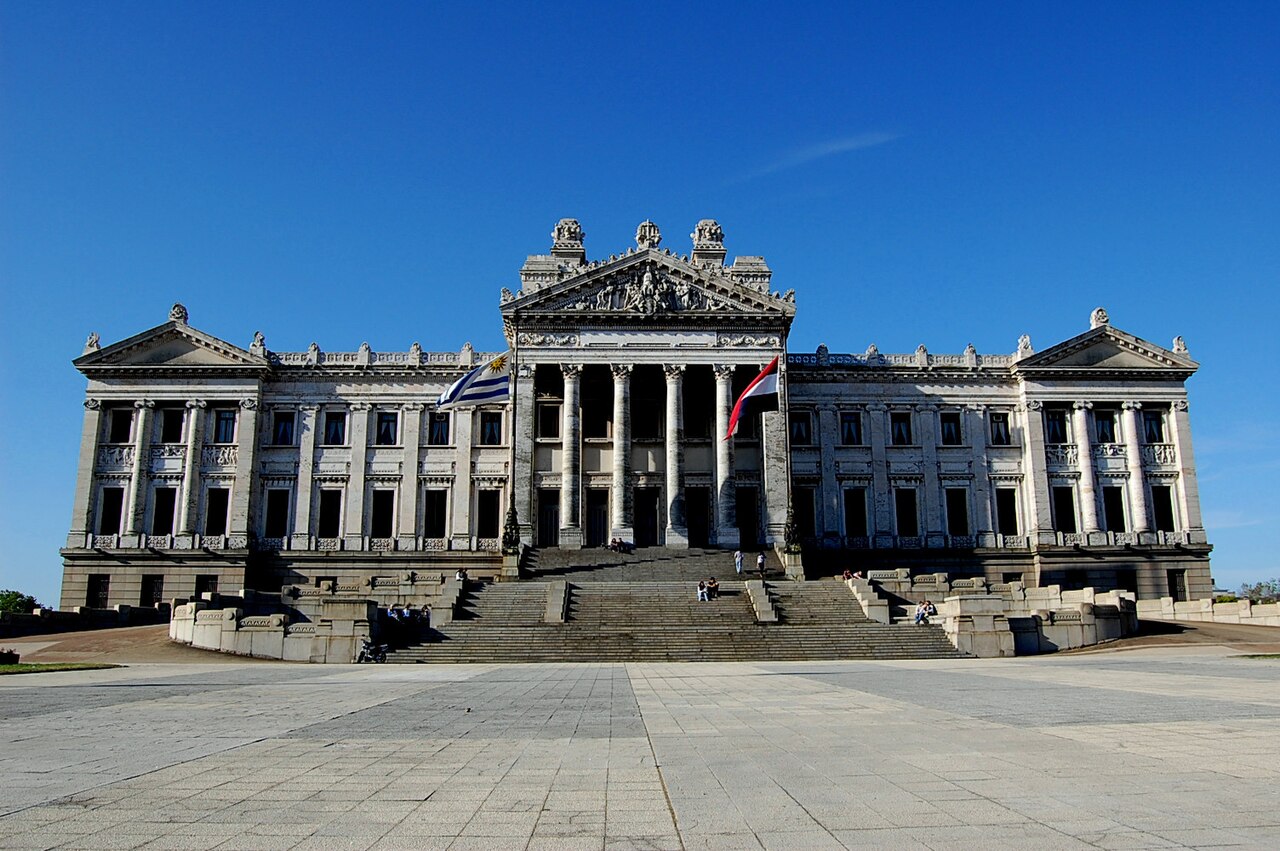
Montevideo is the capital of Uruguay and home to about half the country's population — a compact, walkable city on a promontory between the Río de la Plata and an inner bay. It has a strong European character, the result of large-scale immigration from Spain, Italy, and later central Europe, but it also has something distinctly Rioplatense: the same mix of faded grandeur, café culture, and waterfront promenades that defines Buenos Aires across the water, but quieter and less frantic.
The historic core is the Ciudad Vieja, where the street grid is still 18th-century and the architecture ranges from colonial to art deco. Plaza Independencia marks the transition between old and new city. On it stands the Palacio Salvo, once the tallest building in South America, and the Artigas Mausoleum, where the national hero lies in state beneath an eternal flame. The Gateway of the Citadel, the one remaining fragment of the old city walls, frames the entrance to the old town.
The Teatro Solís on Constitution Square is Uruguay's finest theatre, opened in 1856 and still in regular use. A block away, the Museo Torres García holds the best collection of Joaquín Torres García's constructivist work — a major collection that most visitors miss entirely.
La Rambla, the 22 km waterfront promenade, is the defining civic space of the city. Locals walk, run, cycle, and sit with their mate flasks along it at all hours. It connects Pocitos — the densest residential neighbourhood, full of apartment towers and good restaurants — with Palermo, the bar district that has taken on new life over the last decade.
For history beyond the colonial centre, Fortaleza del Cerro sits on the hill west of the bay and offers the best panoramic view of the city. The Estadio Centenario hosted the 1930 World Cup final and is still in use for football; the attached museum covers Uruguay's disproportionate football history. On Sundays, the Tristán Narvaja Market in Cordón is one of the best flea and book markets in South America.
The Mercado del Puerto at the old port is the place for a long, smoky lunch of grilled meat and red wine — a Montevideo ritual best done on a weekend afternoon when the market is at full bustle. The Café Brasilero on Calle Ituzaingó, where Eduardo Galeano used to write, is worth a coffee for atmosphere alone.