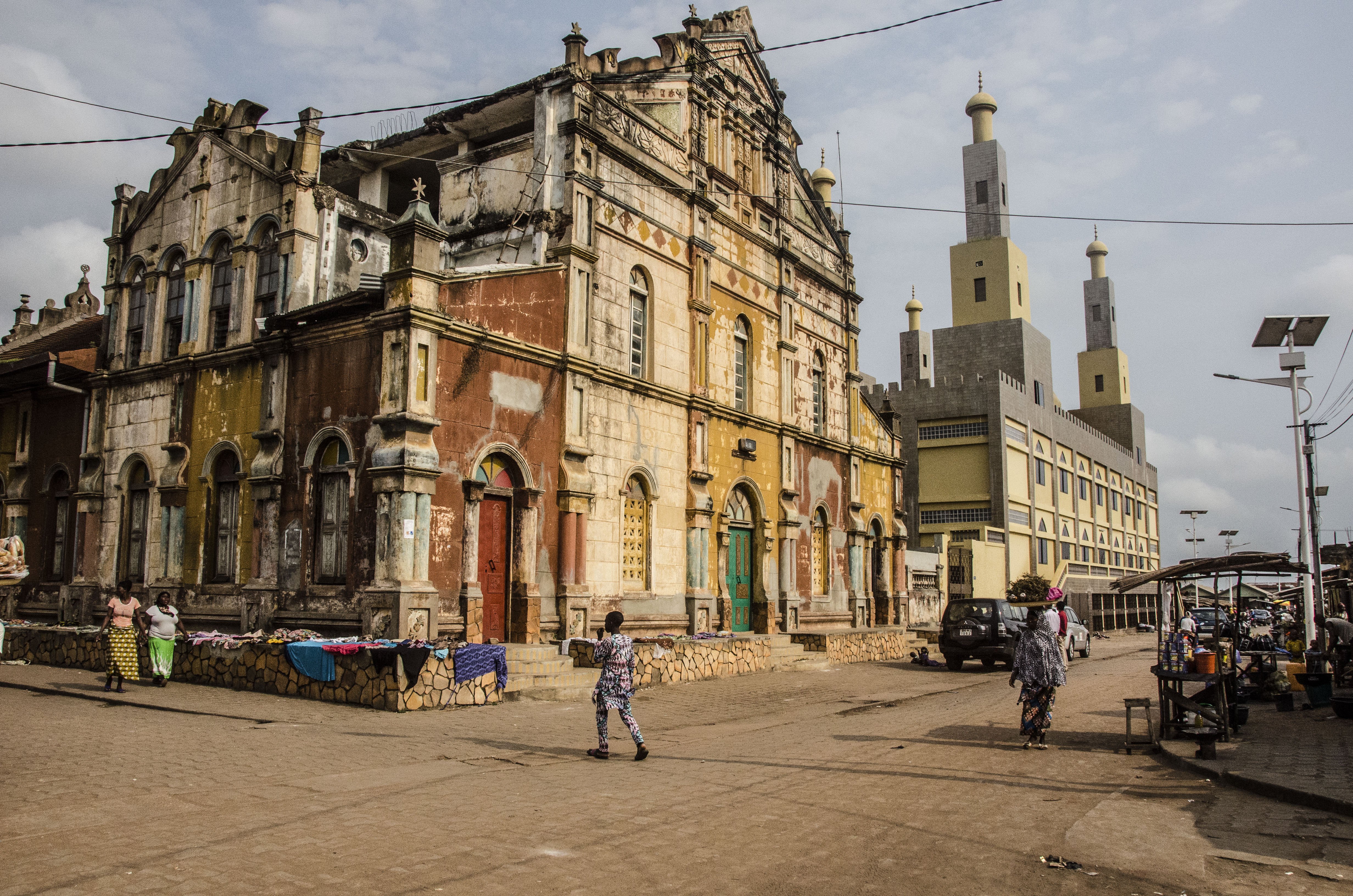
Porto-Novo is the official capital of Benin, a compact city on the shores of a lagoon that traces its origins to the 16th century, when the Portuguese used it as a staging point for the Atlantic slave trade. That layered history gives it an architectural character unlike anywhere else in West Africa: colonial administrative buildings, a Brazilian-influenced mosque built in the shell of a church, and Yoruba palace architecture all coexist within a short walk of each other.
The heart of the old town is the Palais Royal of King Toffa, now the Musée Honmè, which gives a vivid picture of court life before colonial rule — throne rooms, royal possessions, and genealogical paintings of the Yoruba dynasty. A short distance away, the Musée Ethnographique holds one of the better collections of Yoruba masks and ceremonial objects in the region. The Brazilian Mosque, with its ochre Afro-Brazilian facade, stands a few minutes walk away — a church built by repatriated freed slaves from Brazil, later converted to a mosque. The old city grid is best explored on foot or by zémidjan (motorcycle taxi).
Just east of town, the Grand Marché d'Adjara convenes every four days in a rotating cycle — a large open-air market drawing vendors and buyers from the surrounding villages. Cotonou, the economic capital and transport hub, is only 30 km to the west, and Lake Nokoué to the south offers pirogue trips to Ganvié, a village built entirely on stilts above the water.