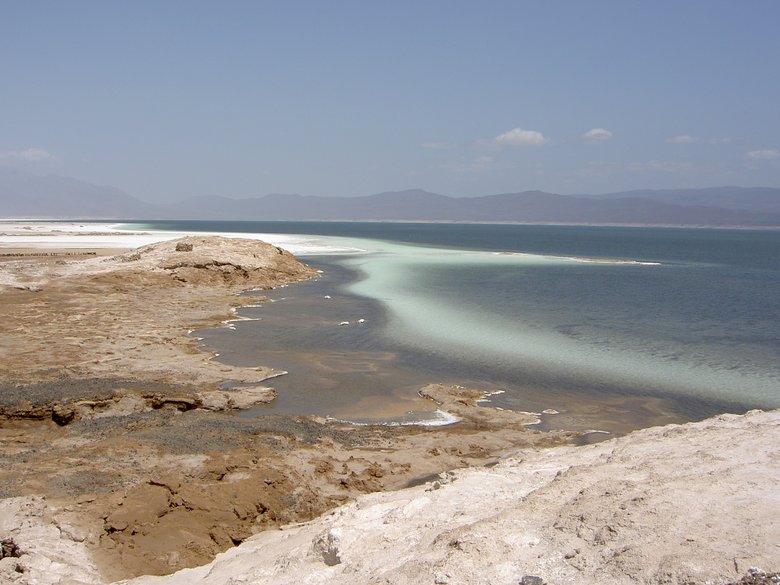
Djibouti is one of the smallest and least visited countries in Africa, a sliver of volcanic rock and salt flats wedged between Eritrea, Ethiopia, and Somalia at the mouth of the Red Sea. It is brutally hot, genuinely expensive, and rewards the traveler with landscapes that look like they belong on another planet.
The country sits right on the Afar Triple Junction, where three tectonic plates are slowly pulling apart. The result is a terrain of black lava fields, steaming fissures, and crater lakes. Lake Assal, 155 meters below sea level, is the lowest point in Africa and one of the saltiest bodies of water on earth. Further inland, Lac Abbe rises in a forest of travertine chimneys venting sulfurous steam — an eerie moonscape on the Ethiopian border. Between November and February, juvenile whale sharks gather in the Gulf of Tadjoura in numbers that make Djibouti one of the easiest places in the world to swim with them.
Two thirds of the population lives in Djibouti City, the capital and only real urban center. The city carries a strong French imprint — baguettes, cafes, the Foreign Legion — but the culture is Afar and Somali at its core. Across the gulf, Tadjoura is the country's oldest town, a quiet base for diving and a gateway to the Goda Mountains, Djibouti's only green highlands.
France arrived in 1862, cutting deals with the Afar sultans of Obock and later Tadjoura to establish what became French Somaliland. The railway to Addis Ababa, completed in 1917, made Djibouti the main port for Ethiopian trade — a role it still plays. Independence came late, in 1977, and France never really left: its largest overseas military base sits here, alongside American, Chinese, Japanese, and Italian installations. The foreign military presence pumps money into the economy but also inflates prices. Budget travel in Djibouti is difficult.
The modern electrified railway to Addis Ababa opened in 2018, covering the 750-kilometer journey in about twelve hours. It is a spectacular ride and a practical way to connect Djibouti with Ethiopia.
Djibouti is not for everyone. It is small, hot, and there is not a lot of tourist infrastructure outside the capital. But if you are drawn to extreme landscapes, good diving, and the kind of travel where you feel genuinely far from home, it delivers.