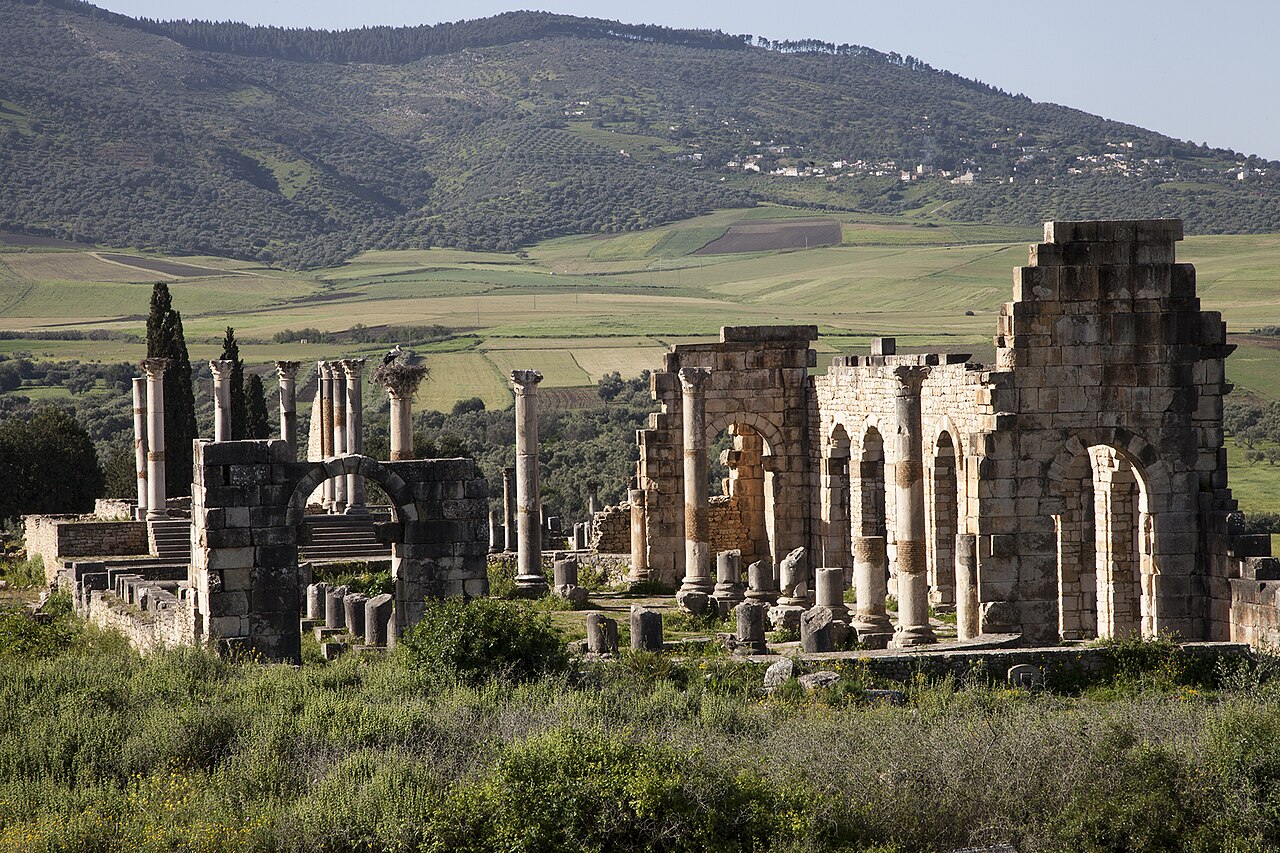
Roman archaeological site in Morocco, with mosaicked villas spread across a fertile plateau.
Volubilis is the best preserved Roman site in Morocco and is an easy excursion from Meknes. It is on the same winding road as Moulay Idriss, the birthplace of Moulay Idriss, the creator of the first Arab dynasty. Both sites (they are 4 km apart) are definitely worth a visit, especially if you are interested in Moroccan/Roman and Arab history.
As you approach Volubilis, you will see the ruins on a long, high plateau. This is where the Roman imperial road ended. After conquering France, Spain and Tangier, the Berber tribes stopped the Romans from entering the Atlas mountains. The Roman rule lasted two centuries, and when they left, change came very slowly. Christian churches survived until the arrival of Islam and the local population of Berbers, Greeks, Syrians and Jews spoke Latin until the seventh century. The city remained an active agricultural center and trading post until the 18th century when most of the marble was transported to build Meknes. This region’s land is some of the most fertile in North Africa, and the city exported wheat, olives and wild animals hunted in the hills to Rome. The ruins remaining are buildings from the second and third AD. They are impressively maintained and excavated.
The entrance to the site is through a small gate, built in 168 AD. There is a ticket office and a cafe with a terrace, where you can get cool drinks and a reasonable tajine. The best time to come is early morning or late afternoon, because it can get real hot at the site. The site is open from sunrise to sunset.
Coming from the entrance the first sight is the olive press, which reflects the olive’s importance to the city. When you walk on you see the Basilica and Forum and the Capitol. Continuing on you get to the Triumphal Arch. To your right, you will find most of the Mansions with their beautiful mosaic floors — above all the House of Venus with its mosaics of Diana bathing and Bacchus surrounded by the Four Seasons, and the House of Orpheus near the entrance. The Palace of Gordian at the north end of the site gives the best overview of the plateau.
Volubilis is a lovely place to be at sunset, just make sure you have arranged a ride back to Meknes or Moulay Idriss beforehand.
Guide
Bars and Cafes
There are no bars at Volubilis — the site is in a rural area near the sacred town of Moulay Idriss, and alcohol is not available in the vicinity. The café at the site entrance sells mint tea, coffee, soft drinks, and water.
For a café stop, Moulay Idriss has a few simple cafés on the main square where you can sit over a glass of mint tea and watch local life. They are not set up for tourists and menus are rarely in English, but they are welcoming. A glass of tea after the walk around the site is one of the pleasures of the combined visit.
If you need a cold beer or a glass of wine after a hot day at the ruins, wait until you return to Meknès, where hotel bars and licensed restaurants can oblige.
Guide
Day Trips
Volubilis is itself a day-trip destination from Meknès or Fès, but the most natural pairing is with Moulay Idriss, just four kilometres away. The town is the burial place of Moulay Idriss I, the founder of the Idrisid dynasty and the man credited with bringing Islam to Morocco. Non-Muslims were once forbidden from staying overnight and the prohibition was only lifted in 2005; the town retains a quiet, sacred atmosphere that contrasts sharply with the bustle of Meknès. Walking the narrow streets up to the viewpoint over the two hills of the town takes less than an hour.
From Meknès it is also easy to reach the Middle Atlas mountain town of Ifrane, sometimes called the "Switzerland of Morocco" for its French colonial architecture and cedar forests. The drive takes about an hour and the town is a complete change of register from the imperial medinas of the north.
Fès is about 60 kilometres east of Volubilis and easily combined on a longer day if you have your own transport or hire a private driver from Meknès. The standard itinerary — Volubilis in the morning, Moulay Idriss for lunch, Fès medina in the afternoon — is ambitious but doable and gives a compressed tour through Roman, early Islamic, and medieval Moroccan history in a single day.
Guide
Eating Out
Eating options at Volubilis itself are limited to the small café beside the ticket office, which serves mint tea, cold drinks, and a simple tagine. The food is unremarkable but the shaded terrace is a welcome refuge from the midday sun.
For a proper meal, Moulay Idriss is four kilometres away and has a handful of small restaurants serving Moroccan staples — harira, tagine, couscous on Fridays — at very reasonable prices. The town gets relatively few tourists compared with Fès or Meknès, and eating there has a pleasantly unhurried quality.
Most visitors who arrive on a grand taxi from Meknès combine Volubilis and Moulay Idriss in a single half-day trip and eat lunch in Moulay Idriss before heading back. If you are based in Meknès, the medina there has a much wider choice of restaurants for the evening.
Guide
Getting Around
Volubilis is a single archaeological site on an open plateau — there is no public transport within it and nothing to get around beyond walking. The site is roughly 400 by 500 metres, and a thorough visit covers most of it on foot.
Enter from the ticket office at the south end of the site. From there a path leads up to the olive press, then north past the House of Orpheus to the Forum, Basilica, and Capitoline Temple. The Decumanus Maximus — the main Roman road — runs north from the Forum to the Triumphal Arch, and the great mansion houses line the streets to the east of the arch. The Palace of Gordian is at the far northern end. Allow two to three hours for a complete visit.
There are no official guides at the entrance, but freelance guides regularly offer their services. A knowledgeable local guide can add considerably to the experience, particularly for explaining individual mosaic scenes and the layout of the Roman city. Agree on a price before starting.
Wear sturdy shoes — the ground is uneven and some mosaic areas have low protective barriers to step over. Bring water; the small café near the entrance is the only refreshment option on site.
Guide
When to Go
The best time to visit Volubilis is spring (March to May) or autumn (September to November), when temperatures are comfortable for walking across an exposed archaeological site with almost no shade. Mornings are cooler and the light is softer — both practical advantages and a gift to photographers shooting the mosaics and standing columns.
Summer (June to August) brings serious heat. The plateau sits in open scrubland and can reach 40°C by midday. If you visit in summer, arrive at opening time and plan to leave by 11am. The site opens at sunrise.
Winter visits are possible and often surprisingly pleasant — mild temperatures, good light, and far fewer tour groups. Rain can make the unpaved paths muddy, but the mosaics are best viewed on overcast days when glare is less of a problem. The Atlas Mountains visible from the northern end of the site are often snow-capped in winter, which makes for a striking backdrop.
Avoid visiting on the same day as the Moulay Idriss moussem (an annual religious festival in late August or early September), when the roads between Meknès, Moulay Idriss, and Volubilis are very congested and tour-group traffic at the site peaks.