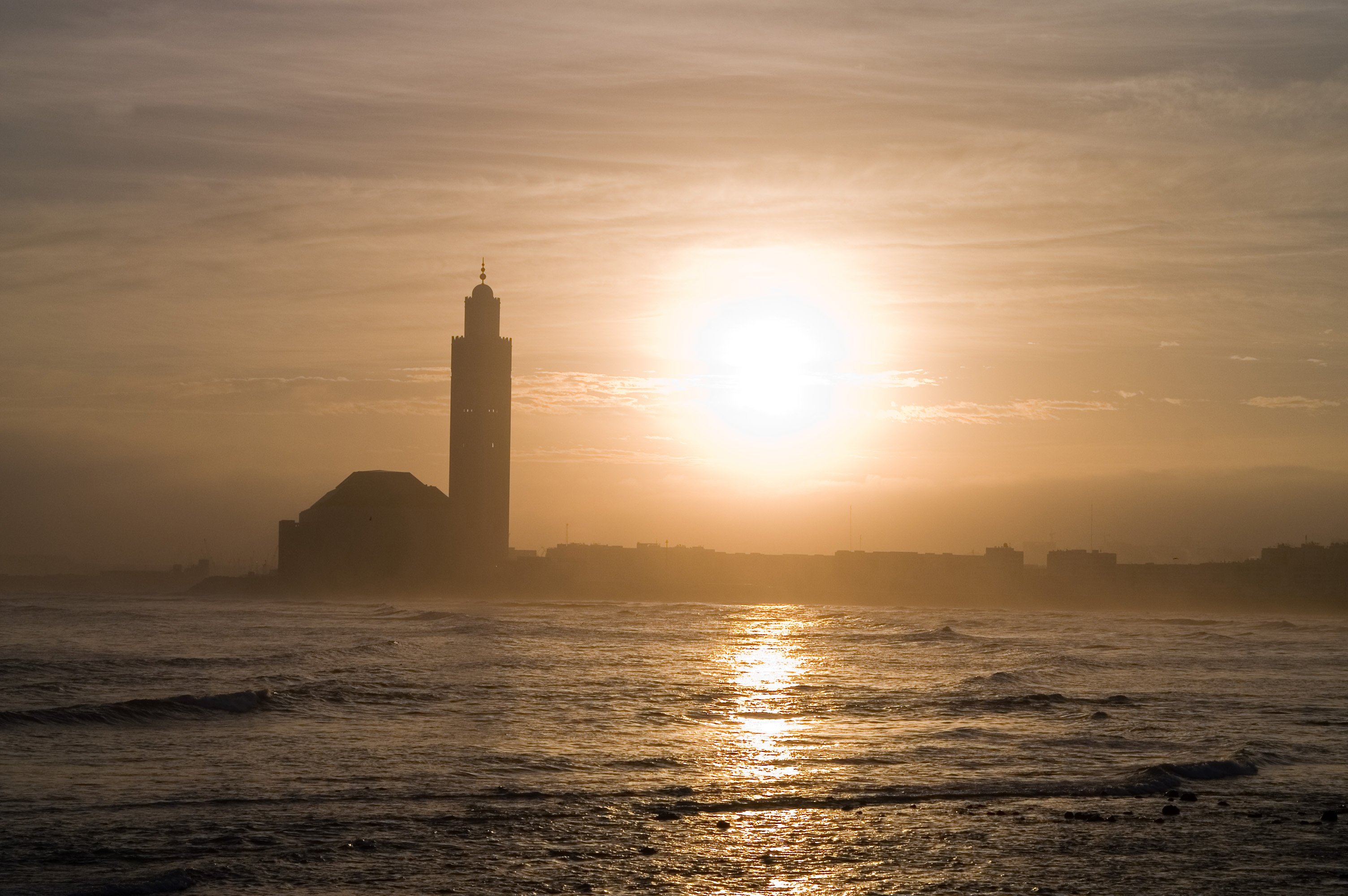
Casablanca is Morocco’s commercial capital and its largest city, home to around five million people. It does not have Marrakesh’s medinas or Fez’s labyrinthine old city — but it has something those cities lack: the feeling of a real, functioning metropolis with a coherent identity. That identity is largely architectural. In the 1920s and 30s, French planners invented a style called Mauresque — Art Deco merged with Islamic motifs — and built a downtown that remains one of the most distinctive examples of colonial urbanism in North Africa.
The Hassan II Mosque, completed in 1993, is the building that draws most visitors: an oceanfront giant with a 210-metre minaret and a glass floor over the Atlantic. It is worth the guided tour. Beyond it, the Habous Quarter offers a different version of the city — a planned "new medina" built by the French in the 1930s to house the traditional commercial life they were displacing, and now a pleasant neighbourhood of arcaded streets and craft shops. Boulevard Mohammed V and Place Mohammed V showcase the Mauresque civic architecture at its grandest.
The Corniche at Ain Diab, the city’s beach suburb, has a different energy again: beach clubs, seafood restaurants, and evening crowds that run late into the night. Casablanca rewards a full day rather than the half-day many guide books suggest — and functions well as a base for day trips to Rabat or the Portuguese fortress town of El Jadida.