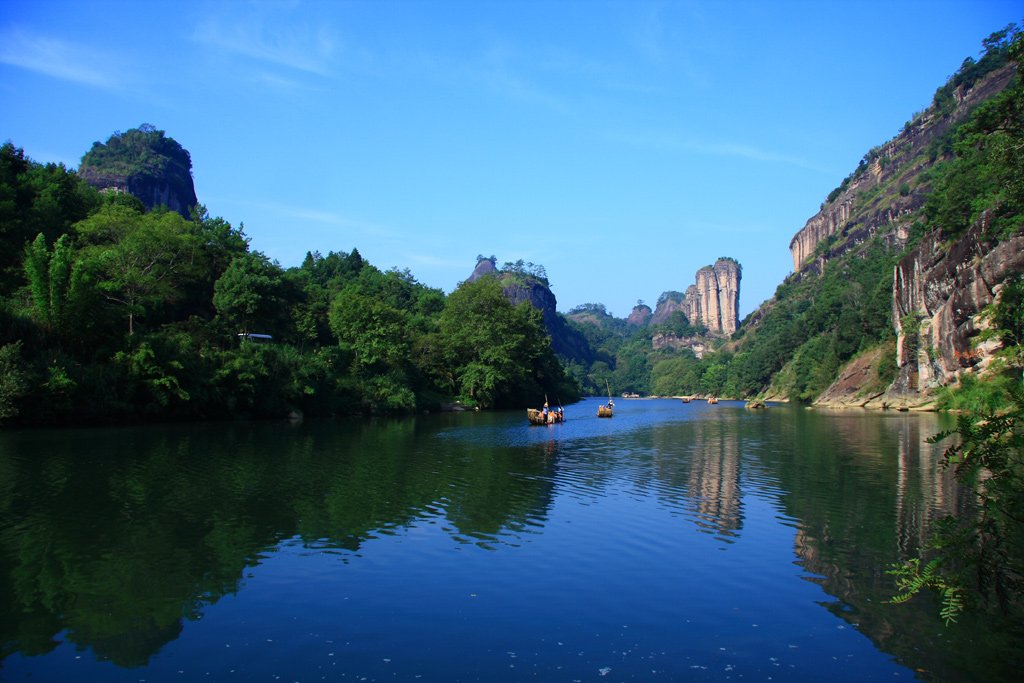
The Wuyi Mountains in northwestern Fujian are a UNESCO World Heritage Site for both their natural scenery and their cultural significance — a double designation that reflects the fact that these dramatic peaks have been a place of scholarship, Taoist practice, and extraordinary tea cultivation for over a thousand years.
The landscape is the thing that will stop you. The Nine-Bend River cuts through a canyon of vertical red sandstone cliffs, and the classic way to see it is on a bamboo raft — a slow drift downstream past overhanging peaks, ancient cliff-face burial caves (the coffins of an unknown Bronze Age people, wedged into crevices hundreds of metres up), and hanging temples built into rock faces. Tianyou Peak gives the best overview of the gorge and the surrounding mountains. The Thread of Sky passage — two rock faces leaning together into a narrow slit — is one of those geological oddities that justifies a detour.
The tea here is as good as the scenery. Wuyishan produces Da Hong Pao (Big Red Robe), one of the most prized oolongs in China. The story is that the original six bushes on a cliff face above Jiulong Ke produced tea reserved for emperors; the last true harvest from those bushes sold for millions per kilogram. You won't be drinking that, but the oolongs produced across the mountain valleys are genuinely excellent and the region's tea culture — small guesthouses with afternoon tasting sessions, tea fields terraced into every hillside — is a pleasure to be around. The theatrical Impressions Da Hong Pao show, staged outdoors against the mountain backdrop, is as spectacular as Zhang Yimou's productions tend to be.
The nearest town (also called Wuyishan) has an airport with connections to major Chinese cities. Most people stay two to three days — a day on the river, a day hiking the peaks, an afternoon devoted to tea.