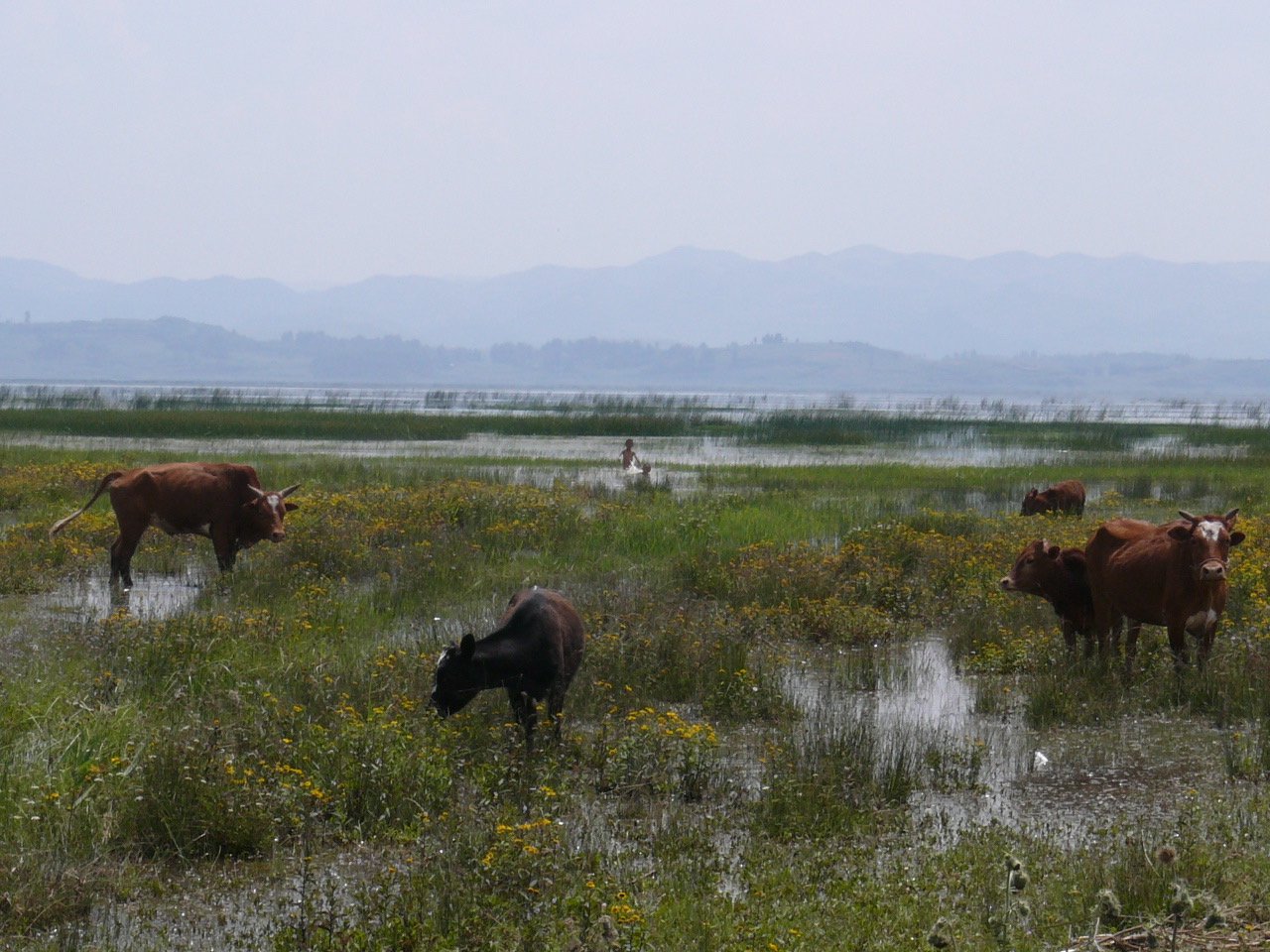
Weining is a county town in the far northwest of Guizhou, at over 2,200 metres on the plateau edge, and it has a single attraction that makes the journey worthwhile: Cao Hai Lake, a high-altitude wetland that serves as a wintering ground for black-necked cranes. The cranes — the only cranes that breed and winter at high altitude — begin arriving in late October from their summer range in Tibet and Qinghai and remain until early spring. At peak season, several hundred individuals can be visible from the lake shore, along with over 170 other bird species. The local farmers who work the fields around the lake have traditionally treated the cranes as auspicious, and the relationship between the village economy and the wetland has sustained both.
The standard way to experience Cao Hai is by narrow wooden boat, paddled by a local farmer along the reed channels and open water. The boats move quietly, the cranes ignore them, and on a clear winter morning with frost on the reeds and the high-altitude light low and sharp, it's one of the more quietly extraordinary wildlife experiences in China. The entrance fee covers access to the lake perimeter; the boats are hired separately, and the hour-long circuit is worth it.
Weining itself is a mixed-ethnicity town with Miao, Hui Muslim, and Yi communities alongside the Han majority. The market days — which fall on dates ending in 3, 6, or 9 — draw the surrounding villages and have the functional bustle of markets that serve actual needs rather than tourism. The local cuisine runs to cured ham and the Miao sour-soup fish that appears across Guizhou in different forms; the Hui restaurants around the mosque district are also worth finding.
Getting to Weining requires commitment: it's in a corner of the province that infrastructure is only recently reaching. There's a railway station (Caohai station, on a line through to Yunnan) and an airport that opened to limited service. The journey from Guiyang takes three to four hours depending on the route. The altitude and isolation have preserved the area from the kind of development that has transformed more accessible parts of the province.