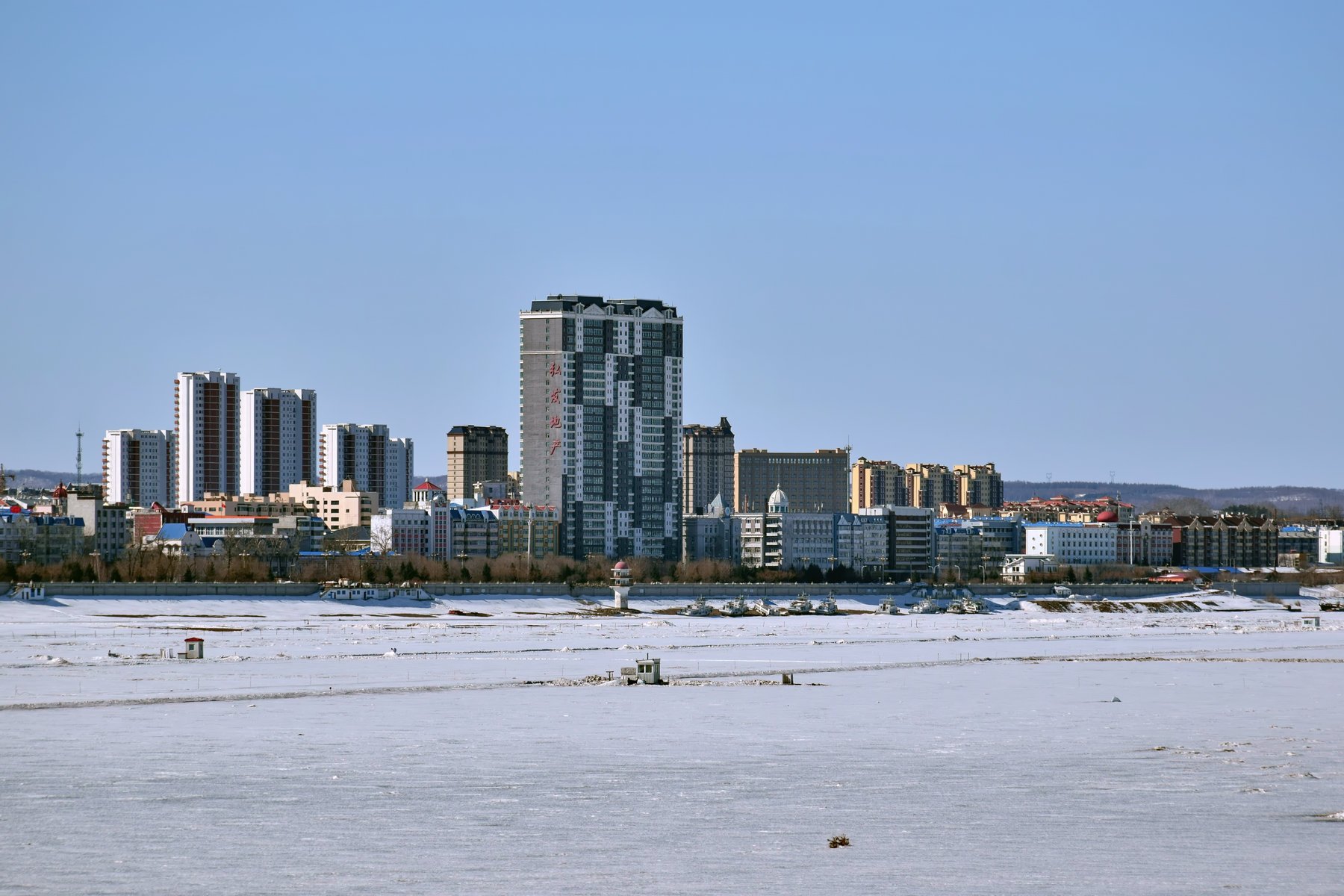
Heihe sits on the Chinese bank of the Amur River — the Heilong Jiang itself — staring directly across at the Russian city of Blagoveshchensk. The two cities are close enough that on a clear day you can read the Cyrillic signs on the opposite shore, and the relationship between them defines everything about Heihe: the town exists, in large part, to sell things to Russians and to let Chinese tourists marvel at the proximity of Russia without needing a visa. In summer, ferries make the crossing in minutes; in winter, when the river freezes solid, buses drive across on the ice.
The border economy is visible everywhere. The main commercial streets are full of shops catering to Russian buyers — furs, electronics, clothing, traditional Chinese medicine — and the staff in hotels and trade centres near the waterfront often speak reasonable Russian. The cross-border trade markets — the Great Island International Trade Centre and the Russian International Trade Centre — are essentially covered markets, and wandering them offers an odd window into how small-scale cross-border commerce actually works in this corner of the world. The free-trade zone designation gives the whole place a slightly transactional energy, but that is also part of what makes it interesting.
History has weight here too. The Aihui History Museum, about 33 kilometres south of the city centre in the old town of Aigun, documents the complicated Sino-Russian territorial negotiations of the 19th century, when China ceded enormous tracts of land under the Treaty of Aigun in 1858. The museum is bilingual, thorough, and notably un-triumphalist by Chinese museum standards. The ancient earthworks of the old Aigun city are still partially visible nearby.
Heihe is most logically visited as part of a journey through northern Heilongjiang rather than as a destination in its own right. The train from Harbin takes around ten hours; flights are faster but infrequent. Summer is the obvious season — the river is open, the days are long, and the town is animated by trade — though there is something genuinely strange and memorable about seeing the ice road to Russia in January.