Nanyang occupies a broad basin in southwestern Henan, hemmed in by mountains on three sides and drained by tributaries of the Han River. It's one of Henan's largest cities by area and one of its most historically layered — humans have been here for perhaps half a million years, the Qin dynasty established it as one of China's eight major cities in the third century BCE, and the Qing dynasty still knew it as a vital trade corridor between north and south, its merchants moving goods by both road and river. Most visitors today come for the Zhuge Liang connection or the jade, but the city rewards anyone willing to move beyond those headliners.
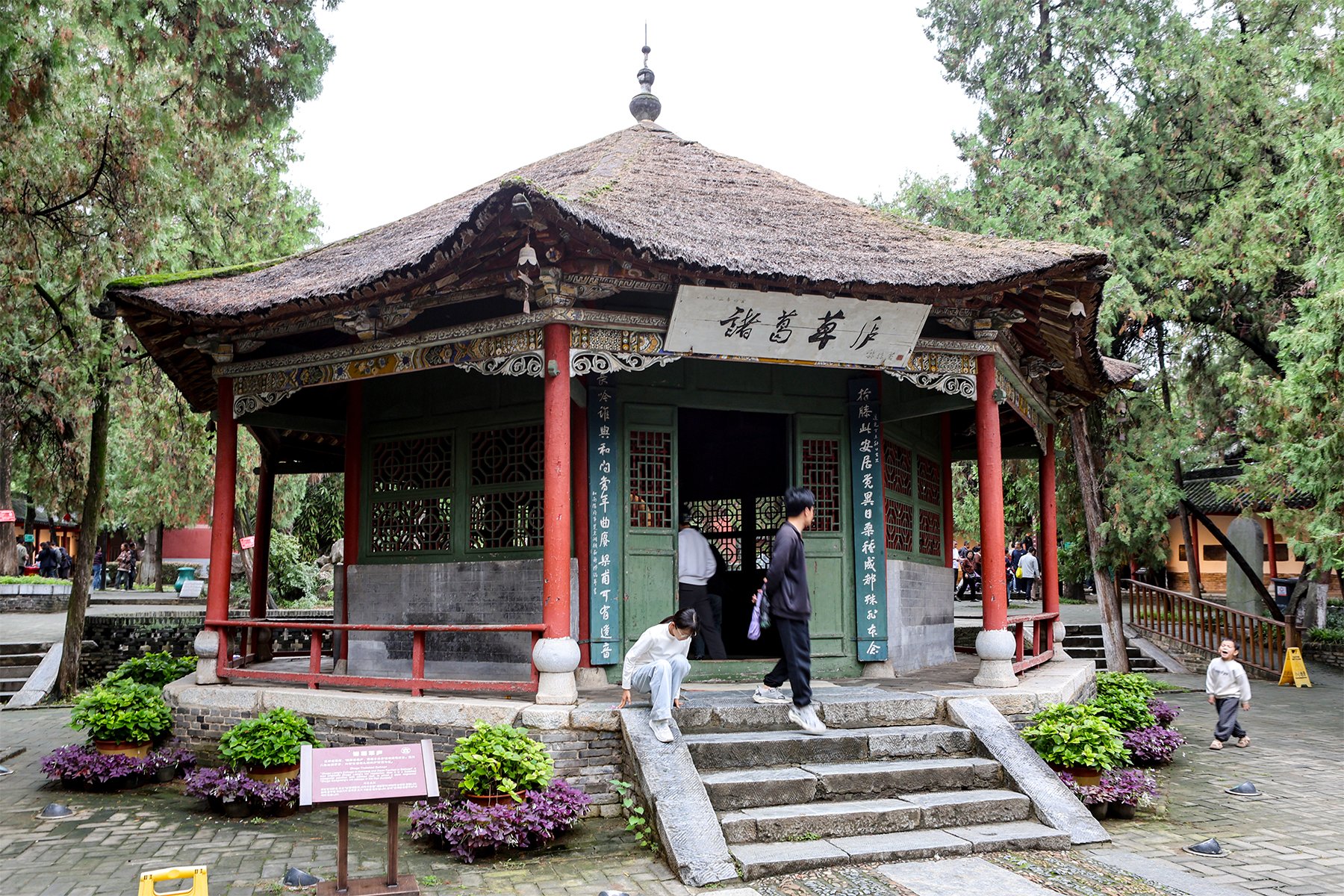
The Nanyang Memorial Temple of Marquis Wu is the main set piece — a large complex dedicated to Zhuge Liang, the strategist of the Three Kingdoms period who is said to have lived here in seclusion before Liu Bei of Shu Han visited three times to persuade him to enter service. The temple is handsomely maintained, with cypress trees several centuries old shading the main halls, and the ¥60 entry includes a good museum explaining the Three Kingdoms wars. A short distance away, the Memorial Temple of the Medical Sage honours Zhang Zhongjing, a Han-dynasty physician whose treatise on cold-damage disorders remains a foundational text in traditional Chinese medicine. Zhang Heng's tomb, free to visit, commemorates the Eastern Han polymath who invented an early seismoscope; the adjacent museum is modest but earnest.
Nanyang is also the centre of China's jade carving tradition. The workshops in the Jade Carving Festival district and the markets around the railway station sell everything from rough stone to highly finished pieces, and prices are dramatically lower than in Beijing or Shanghai. The jade here tends toward pale green and white rather than the deep imperial green associated with Myanmar jade — it's a local style with a local history, and the craftspeople are genuinely skilled. The September Jade Carving Festival turns the whole city into a marketplace for a week.
Getting to Nanyang has become considerably easier with the opening of a high-speed rail line connecting it to Zhengzhou in under two hours. The Nanyang Jiangying Airport handles flights to about twenty cities. The city's scale — it's geographically enormous by Chinese standards — means getting around requires taxis or occasional local buses, but the main attractions cluster reasonably well.