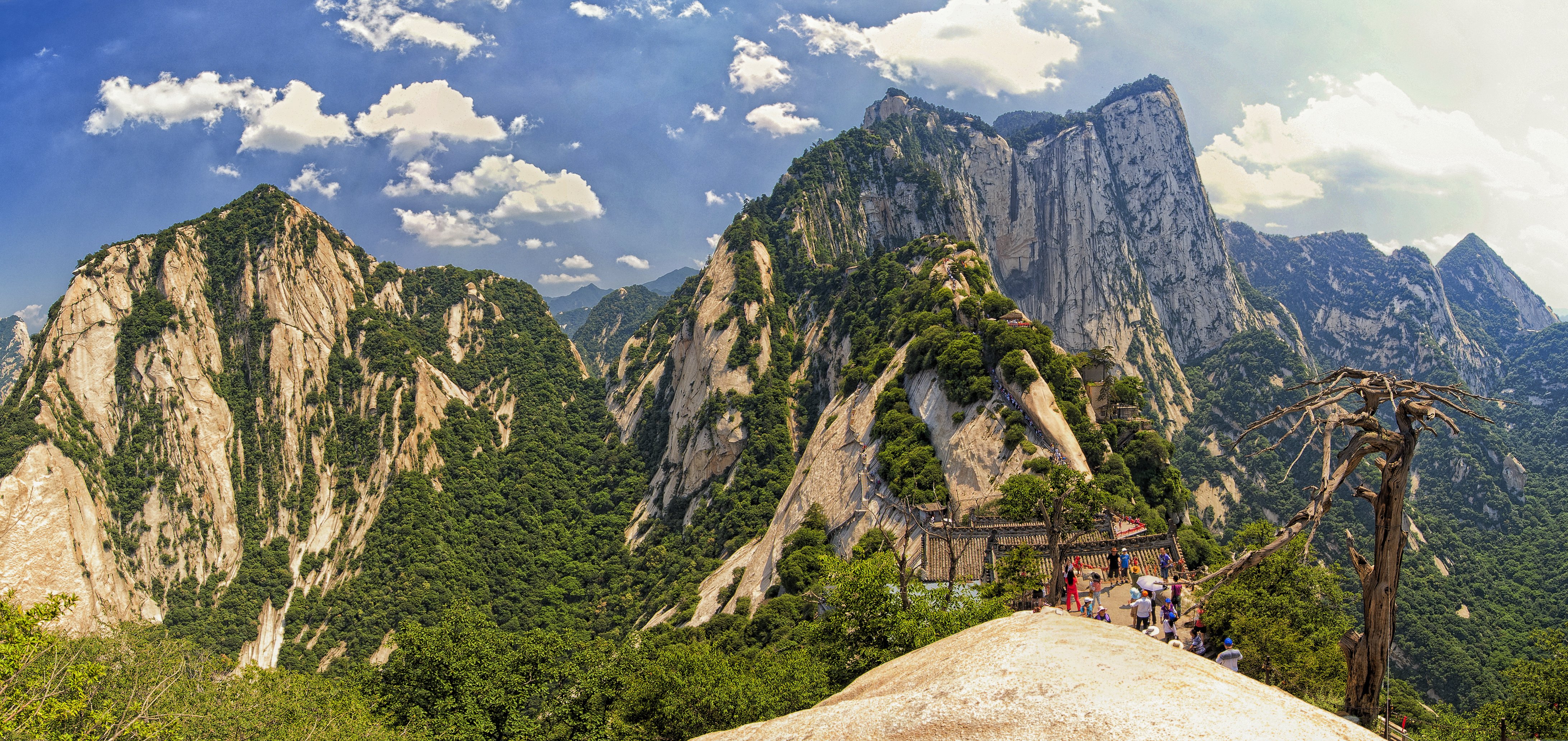
Hua Shan — the West Sacred Mountain, one of China's five Taoist holy peaks — is either the most terrifying or the most exhilarating hike in China, depending on your relationship with heights and your willingness to trust an iron chain bolted into a cliff face. The mountain rises sharply from the North China Plain, its five peaks connected by paths that at several points reduce to narrow notches in near-vertical rock, with chains to hold and exposure on both sides. The Changkong Zhandao — the "Vast Sky Plank Walk," a thirteenth-century wooden pathway mounted on wooden pegs hammered into a sheer rock face — requires a safety harness and inspires real terror in the people crossing it. This is not metaphor; you watch people freeze.
The standard approach is the North Trail on foot (four to six hours up) or the cable car to the North Peak, then a traverse of the mountain visiting East, West, and South peaks. The full loop across all five peaks takes seven to ten hours and is best done over two days, sleeping on the mountain in one of the ridge-top hostels that charge premium prices for their altitude. The classic strategy is a night hike to reach the East Peak before dawn and watch the sunrise from the platform there; half of China seems to have the same plan on summer weekends, but it is spectacular enough to justify the crowds.
Taoism has been here since at least the Tang Dynasty, and the mountain retains several active temples: the Yuquan Courtyard near the North Peak is the largest. The spiritual patina over the dramatic landscape is part of what makes Hua Shan different from a purely recreational climbing destination.
From Xi'an, high-speed trains reach Huashan North Station in thirty-three to forty-five minutes. The mountain is two hours beyond that by bus and then cable car. The park is open year-round; the winter entrance fee drops significantly and the snow-covered ridges are spectacular for those prepared for cold.