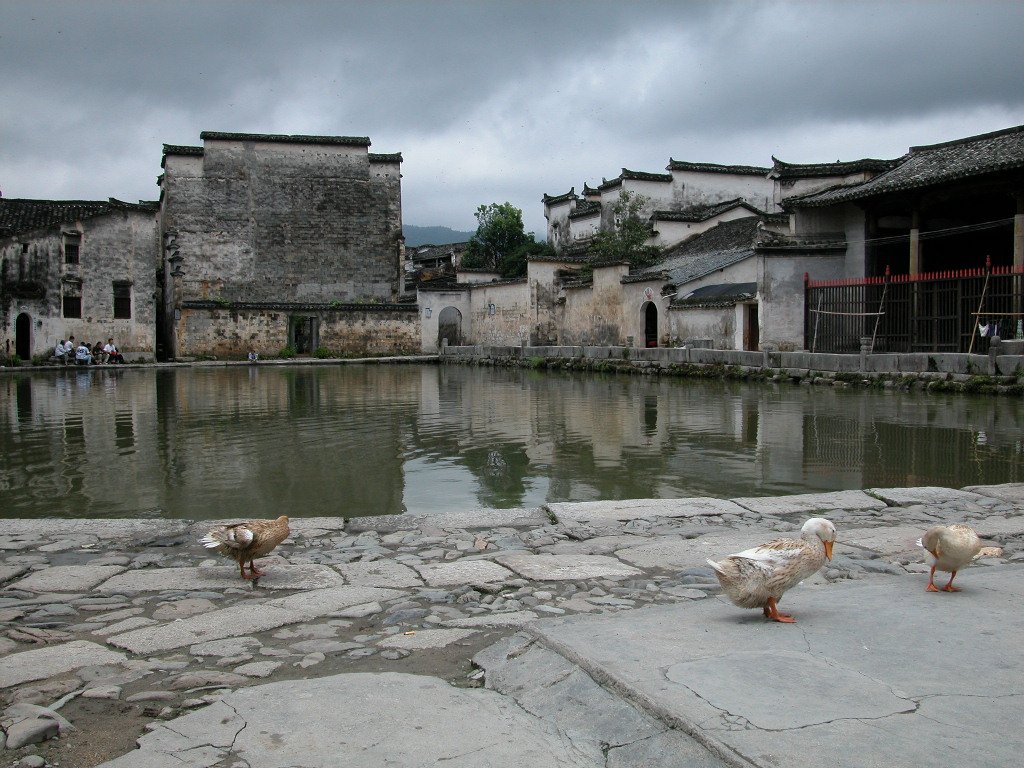
Ancient Anhui village whose whitewashed houses and Moon Pond form a classic Hui landscape.
Hongcun is the more photographed of southern Anhui's two UNESCO-listed ancient villages, and the reason is immediately apparent: the Moon Pond at the village entrance, with its mirror reflection of whitewashed walls and ink-dark roofs, is one of the most composed natural photographs in China. The village appeared in Ang Lee's Crouching Tiger, Hidden Dragon and has been the subject of innumerable landscape paintings by the art students who descend on it in spring and autumn, easels set up along the pond bank.
The layout of the village is historically deliberate. Hongcun was designed in the shape of an ox, with a canal system functioning as a circulatory network: water flows from a spring through channels cut along the lanes, fills the Moon Pond, continues to the larger South Lake, and exits the village. This irrigation and drainage system, conceived in the Ming dynasty, still functions and keeps the village remarkably clean. The lanes are paved with cobblestones and too narrow for anything but foot traffic.
The great building here is Chengzhi Hall, a late Qing mansion built by a wealthy salt merchant. The hall has forty-eight rooms across an elaborate compound, and every surface that can be carved has been: beams, screen panels, window lattices, and column bases display scenes from nature, mythology, and Qing dynasty domestic life. The carving is exceptional by any standard. Several smaller mansions and ancestral halls are included in the entrance fee and warrant exploration.
Hongcun is 85 kilometers from Tunxi (Huang Shan city) and 11 kilometers from Yixian. Tourist buses run from Huangshan North station. Entrance costs around ¥104, and the ticket permits multiple days. The village fills up entirely on weekends and during national holidays; a weekday visit, or arriving before 8am, makes an enormous difference.
Guide
Eating Out
Eating in Hongcun means Huizhou cuisine — the mountain-influenced cooking of southern Anhui, built around preserved ingredients, strong flavors, and braised preparations. The village's restaurants are concentrated near the main entrance and along the lanes leading to the Moon Pond; quality varies, but the cooking is generally honest and the dishes are genuinely regional.
The dish most identified with the area is Huizhou hairy tofu — bean curd that has been deliberately fermented until a white mold develops on the surface, then pan-fried until crisp outside and creamy within. The smell is intense, the taste is remarkable. Stinky mandarin fish (chouxiyu) — river fish salted and fermented for several days — is another Huizhou specialty that provokes strong reactions; it is absolutely worth trying once. Bamboo shoot dishes are excellent in spring when the fresh shoots are at their peak.
Guesthouses inside the village typically include a home-cooked dinner option for staying guests — this is often the best value and most genuinely local meal available.
Guide
When to Go
Hongcun is best visited in spring (March to May) or autumn (September to November). Spring brings misty mornings when low cloud hangs over the hills behind the village, creating the atmospheric conditions that landscape painters prize; autumn offers clear light, cooler temperatures, and the yellow of ginko trees against the whitewashed walls.
Summer (June to August) is hot and humid — southern Anhui in July can be oppressively so — but the tourist crowds are highest and accommodation prices peak. The lotus on South Lake is at its best in July and August if you can tolerate the heat. Winter visits, while cold and grey, offer near-empty lanes and the possibility of snow on the rooftops, which transforms the village into something close to a woodblock print.
The worst time to visit is during Chinese national holidays (Golden Week in early May and early October), when the village becomes genuinely unpleasant. The entrance ticket remains valid for multiple days, which is worth remembering if you happen to arrive during a rush.