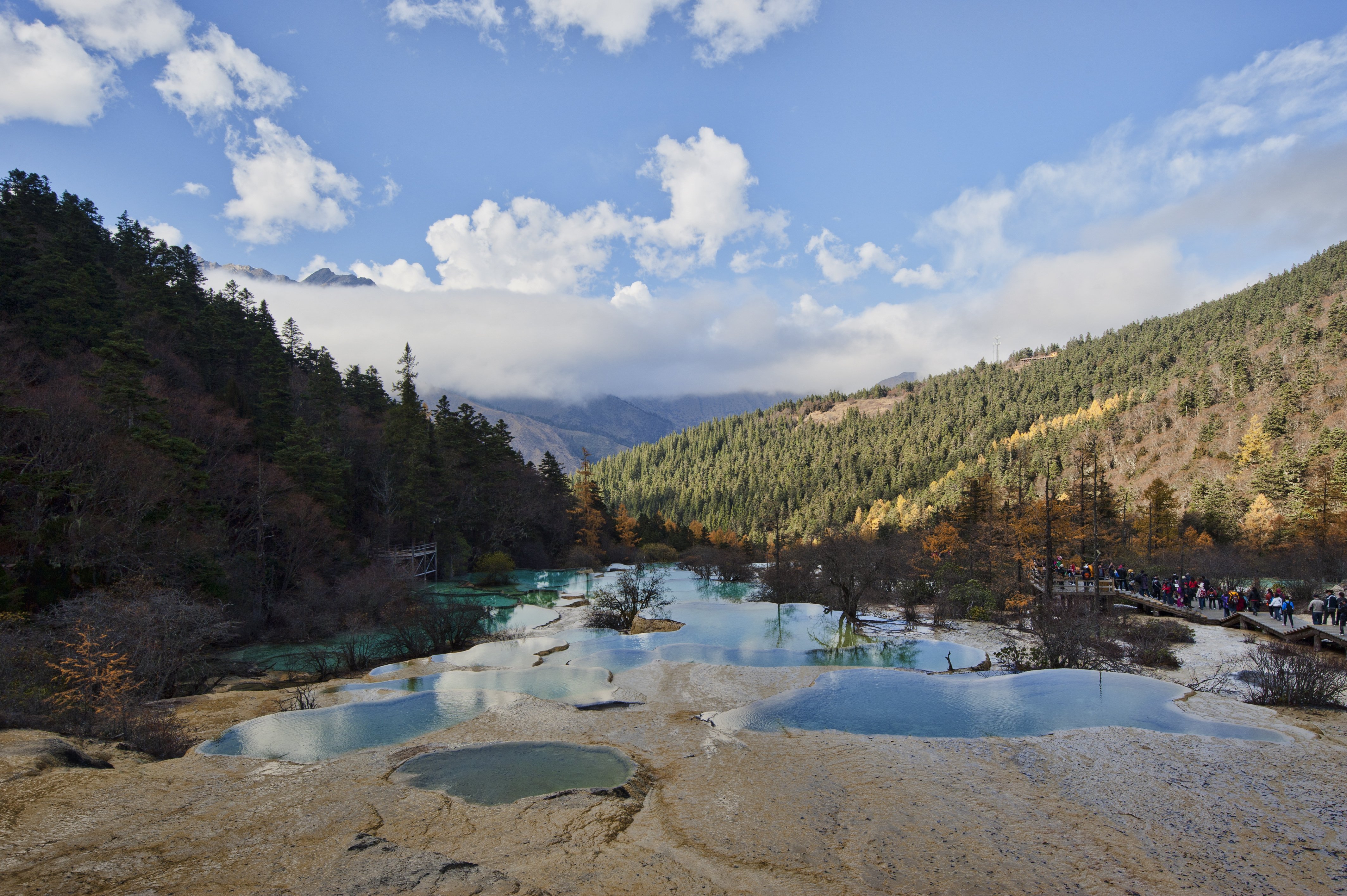
Sichuan mountain valley known for travertine pools, forested slopes, and Tibetan villages.
Huanglong — officially Huanglongsi National Park — is a UNESCO World Heritage Site in northern Sichuan, about 60 kilometres north of Songpan, featuring a valley of travertine mineral pools that descend a limestone mountainside in vivid shades of turquoise, gold, and white. The deposits have accumulated over millennia as calcium-rich water flows down from the snowfields above, leaving behind terraced formations that look, in photographs, almost too saturated to be real. In person the colour is genuine and the scale is larger than images convey.
The park's main feature is a 4.2-kilometre wooden boardwalk that climbs about 700 metres from the entrance at roughly 3,000 metres to the Five Colored Pool near the summit at 3,700 metres. The ascent takes two to three hours and passes pools, a small Buddhist temple, and nearly horizontal waterfalls that are rare enough to be worth stopping for. The cable car, available for ¥80 one-way, covers the upper section and is worthwhile for acclimatisation or on the descent. Budget four to six hours for the full circuit.
The altitude is the principal consideration. The entrance alone is at 3,000 metres and most visitors arrive by bus from Jiuzhaigou or Chengdu having not spent much time at elevation. Altitude sickness is common — headaches and breathlessness are normal, more serious symptoms require descent. The park is a day trip only, with no accommodation available inside, and the last bus back to Jiuzhaigou departs in mid-afternoon.
Entry costs ¥200 between April and November. Outside those months, when the pools take on a different, frost-edged quality and visitor numbers drop sharply, the price falls to ¥60 — a genuinely good deal for one of China's more extraordinary natural sites. Bring food and water from town; prices at the few concessions inside the park are punitive.
Guide
Getting There
Huanglong is most commonly visited as a day trip from Jiuzhaigou — the two parks are approximately 100 kilometres apart and tourist buses connect them directly. The drive takes about two hours and crosses the Xueshanbao Pass at 4,000 metres, which provides its own dramatic views. This is the standard approach for most visitors.
From Chengdu, direct tourist buses reach Huanglong in about eight hours via Songpan. The road north from Chengdu through Maoxian and Songpan is scenic but long. Most people combine Huanglong with Jiuzhaigou over two to three days rather than making a dedicated trip.
There is no accommodation inside the park. The nearest town with substantial accommodation is Songpan, about 60 kilometres to the south on the road to Chengdu. Several hotels and guesthouses also operate at Chuanzhusi, the crossroads town nearer the park entrance.
The park entrance is at about 3,000 metres, and buses from Jiuzhaigou typically arrive by late morning, leaving in the mid-afternoon. Timed your visit accordingly: arriving at 11 a.m. and departing at 3 p.m. gives enough time for the full circuit if you are reasonably fit, but is tight for those who take the cable car both ways and linger at the top pools.
Guide
When to Go
Huanglong is open year-round, but the experience varies considerably by season.
April to November is the standard visiting season, with a ¥200 entrance fee. The pools are at their most colourful between August and November, when autumn light strikes the calcium deposits at better angles and the surrounding trees add seasonal colour. Summer (June–August) is the peak tourist period with the most crowded conditions; the pools are full but the queues at the cable car and the top viewing platforms can be long.
December to March sees entrance fees drop to ¥60 — a significant reduction. Winter visiting has real rewards: far fewer crowds, and the pools take on a frost-edged quality where ice forms at the margins of the formations while the mineral water continues to flow through the centre. Snow on the surrounding peaks and the boardwalk railings adds to the atmosphere. The cold is genuine, however, and the altitude makes it feel more extreme than a ground-level temperature would suggest. Dress in layers regardless of the season.
Altitude sickness is a significant consideration. The park entrance is at 3,000 metres and the Five Colored Pool is at 3,700 metres. Visitors arriving directly from low-altitude cities without acclimatisation should expect headaches and shortness of breath. One night at altitude before visiting — in Songpan (2,850m) or even Jiuzhaigou (2,000m at the base) — reduces the impact.