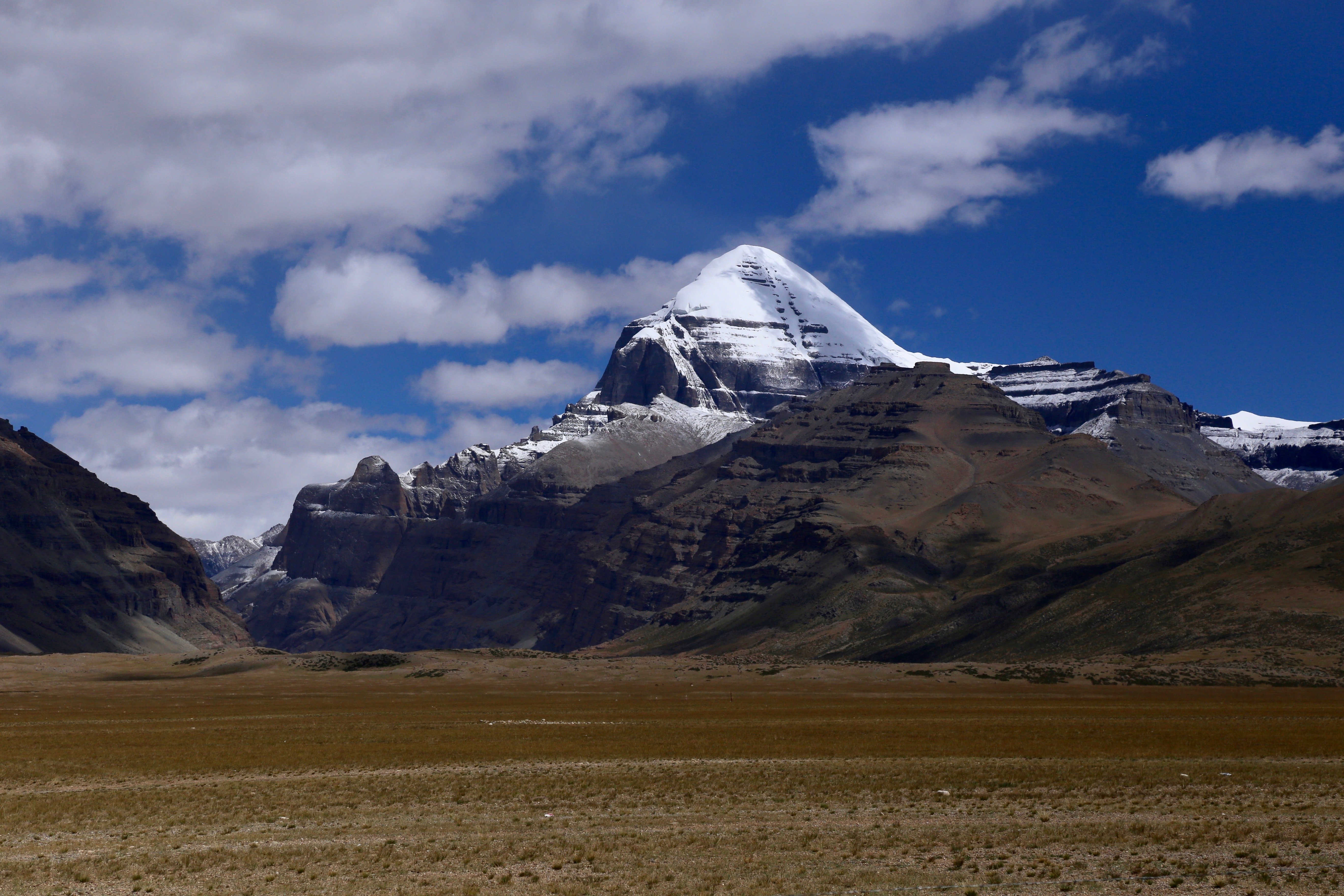
Mount Kailash — known in Tibetan as Kang Rinpoche, "Precious Snow Mountain" — rises to 6,714 metres in the remote far west of Tibet, near the borders of India and Nepal. It has never been climbed and, under the current rules of the Chinese authorities, it never will be: the mountain is considered too sacred for an ascent, and the nearest permitted approach is the base of its flanks. Within a radius of 30 kilometres, four of Asia's great rivers rise: the Indus, the Sutlej, the Brahmaputra, and the Karnali. In Hindu cosmology it is the throne of Shiva; in Tibetan Buddhism it is the most sacred mountain in the world; Jains believe their first prophet attained liberation on its slopes; and the ancient Bon religion regards it as the axis of the universe. Very few mountains have meant so much to so many for so long.
The standard visit involves the kora, a 52-kilometre circumambulation of the mountain at altitudes between 4,600 and 5,630 metres. The route typically takes three days, passing through high valleys and crossing the Drolma La pass at 5,630 metres — one of the highest passes on any popular trekking route in the world. Buddhists and Hindus walk clockwise; Bon pilgrims walk counter-clockwise. The companion pilgrimage, the circuit of Lake Manasarovar (4,588 m), takes a further four or five days and is considered almost as meritorious.
The gateway town is Darchen, a small settlement at the mountain's base where guesthouses, tea shops, and equipment hire have proliferated to serve the growing number of pilgrims and trekkers. Darchen is around 1,200 km from Lhasa, typically reached by hired vehicle in six days via Shigatse and the southern Friendship Highway, or in four days from Shigatse via the G219 highway. Ngari Gunsa Airport at Ali (Shiquanhe) provides a faster option, cutting the overland leg significantly.
This is one of the most permit-heavy destinations in Tibet. In addition to the standard Tibet Travel Permit, visitors need an Aliens' Travel Permit and a Military Permit, all of which must be arranged in Lhasa well in advance. The remoteness and altitude mean altitude sickness is a constant hazard: acclimatise in Lhasa for several days before attempting the kora, and do not rush the Drolma La if you are not feeling strong.