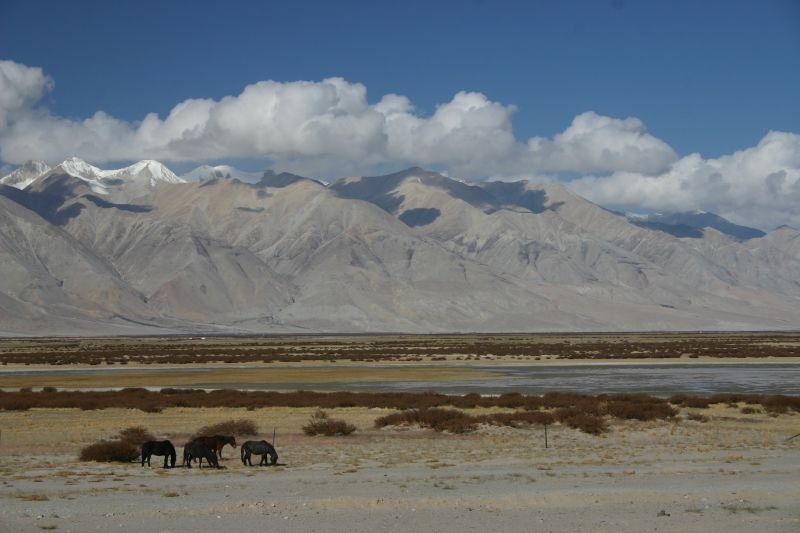
Ngari — its administrative centre known as Ali or Shiquanhe — is the remote western extremity of Tibet, a cold high desert the size of France with a population of barely 100,000. Most of it sits above 4,500 metres; the landscape is stripped bare of almost everything: few trees, few people, little rain (barely 70mm a year in places), and an arid grandeur that some travellers find more compelling than anything in central Tibet. The G219, the Xinjiang-Tibet Highway, is the main road through the region, running from Kashgar in the north to Shigatse in the east — one of the highest and most remote long-distance roads in the world.
The two great draws of Ngari are Mount Kailash and the ruins of the Guge Kingdom. Guge was a powerful Tibetan Buddhist state that flourished in the 10th to 17th centuries; its capital, Tsaparang, survives as one of the most dramatic ruins in all of Asia — a thousand-room fortress built into a cliff above the Sutlej valley, its chapels still bearing intact murals of extraordinary quality. Nearby, Tholing Monastery was founded in 988 AD and became the centre of a great Buddhist translation movement that helped revive the religion after its near-extinction during the dark period. Both sites are genuinely astonishing and receive only a fraction of the visitors they deserve.
Getting to Ngari requires commitment. The nearest airport, Ngari Gunsa at Ali, has direct flights to Lhasa that cut a journey of several days to ninety minutes — but services are infrequent and weather-dependent. Overland from Lhasa takes at least six days by hired vehicle, following the Friendship Highway west through Shigatse and Saga and then north. The alternative approach from Kashgar via the G219 is spectacular but extremely demanding: over 1,000 km of high desert road through the world's most challenging terrain.
Visitors need all the standard Tibet permits plus Aliens' Travel Permits and, for areas near the Indian border including Mount Kailash, a Military Permit. These must be arranged well in advance through a licensed agency. The best time to visit is June to September; winter temperatures are extreme, and the high passes can be closed by snow.