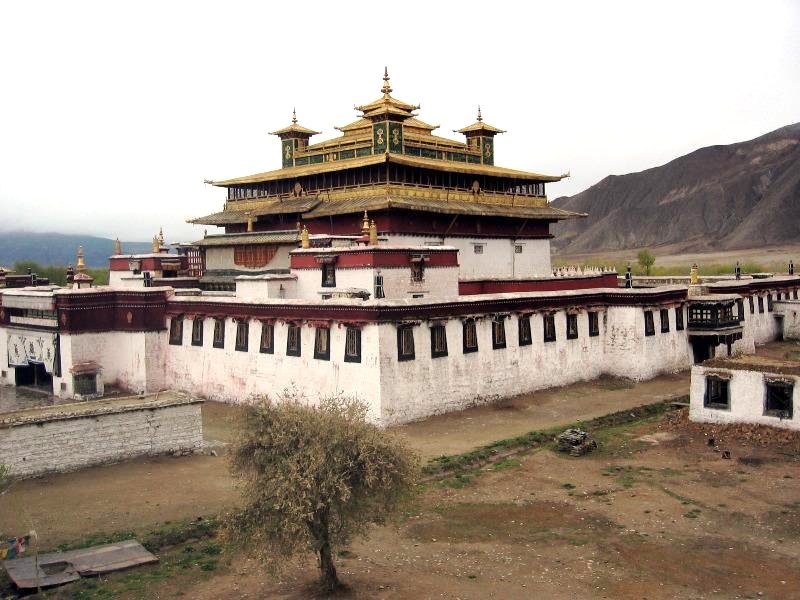
Southern Tibet region along the Yarlung Tsangpo, considered a cradle of Tibetan civilization.
Shannan — known in Tibetan as Lhoka — is considered the cradle of Tibetan civilization. This prefecture-level city in southern Tibet, sitting along the Yarlung Tsangpo River valley at around 3,600 metres, is where the first Tibetan kings ruled, where Tibet's first monastery was built, and where the mythic origins of the Tibetan people are said to lie. It is one of the most historically resonant corners of the plateau.
The Yumbulagang Palace, perched on a narrow rocky ridge above the Yarlung valley, is Tibet's oldest building — a watchtower-turned-palace said to date to the 2nd century BC. The Chonggye Tombs, a short drive away, are the burial mounds of Tibet's early kings, including Songtsen Gampo, the 7th-century emperor who unified Tibet and brought Buddhism from India. Samye Monastery, across the Yarlung Tsangpo to the northwest, was Tibet's first monastery, founded in 779 AD — a mandala-shaped complex that still draws pilgrims and scholars alike. Tradruk Temple, in the lower valley, may predate even Samye — a quiet monastery housing one of Tibet's most treasured devotional artworks.
The valley itself is greener and more temperate than Lhasa, sheltered by mountains and productive enough to be one of Tibet's main agricultural zones. Barley fields line the valley floor; the hills above are austere and treeless.
Getting here from Lhasa involves a drive of around three hours south along the Yarlung Tsangpo valley. Foreign visitors to Tibet require both a Chinese visa and a Tibet Travel Permit, arranged through a licensed tour agency.
Guide
Day Trips
Shannan itself is a region of day trips — Tsetang serves as the base, and the major sites radiate outward from it. But there are worthwhile excursions further afield for those spending more time in the area.
Mindroling Monastery sits about 45 kilometres northwest of Tsetang, in the Dranang valley. One of the largest and most influential Nyingma monasteries in Tibet, it was founded in 1676 and houses excellent thangkas and murals. The drive takes around an hour. It is less visited than Samye and has a quieter atmosphere.
Lhasa is around three to four hours northwest, making it a long day trip or, more sensibly, the next destination rather than a day trip. Most visitors to Shannan have come from Lhasa or are heading there. The road follows the Yarlung Tsangpo valley for much of the journey and the scenery is excellent.
Tsedang Nunnery (Riwo Choling) is a short excursion from Tsetang, up into the hills above the town. The nunnery is modest but the views over the valley are worth the climb. It takes about an hour to walk up from town.
All day trips require travel with your licensed guide and driver. Inform your agency in advance if you want to add sites not originally on your itinerary, as permits for some locations require advance arrangement.
Guide
Getting Around
Most foreign visitors travel with a hired vehicle and guide, arranged through the tour agency that organised their Tibet Travel Permit — independent travel within Tibet is not permitted for foreigners. This works out reasonably well for Shannan: the main sites (Yumbulagang, the Chonggye Tombs, Tradruk Temple) are strung along the Yarlung valley and can be covered in a single long day with a driver, or more comfortably in two days.
Samye Monastery is a more involved trip. It lies on the north bank of the Yarlung Tsangpo, requiring a river crossing either by a local ferry or via a bridge further downstream. The drive from Tsetang takes around two hours each way, so most people treat it as a full-day excursion or spend a night at the monastery guesthouse.
Tsetang town itself is small enough to walk. The central market area, a few temples within town, and most guesthouses are within 15 minutes of each other on foot. Bicycles can sometimes be hired through guesthouses and are useful for exploring the flat valley floor near town.
Roads are generally paved on main routes but can be rough on tracks to smaller sites. Distances are deceptive at altitude — allow more time than maps suggest.
Guide
Getting There
All foreign visitors to Tibet require both a Chinese visa and a Tibet Travel Permit, the latter obtainable only through a licensed tour agency — independent travel within Tibet is not permitted for foreigners. Arranging a permit takes at least a week and usually involves booking a guided tour package, even if you want to travel relatively freely once you arrive.
From Lhasa, Shannan/Tsetang is about 180 kilometres southeast along the Yarlung Tsangpo valley. The drive takes three to four hours. Buses run between Lhasa and Tsetang, but most visitors with permits travel by hired vehicle as part of an organised tour. There is a small airport at Shannan (Lhoka Mainling Airport), with limited flights from Lhasa and Chengdu, but most visitors come overland from Lhasa.
Guide
When to Go
The best time to visit Shannan is between April and October, when the Yarlung valley is at its most accessible and the weather is clear enough to appreciate the landscape. May and June bring mild temperatures and the barley fields are green; September and October offer settled skies and excellent visibility, with the harvest underway in the valley. Summer (July–August) brings monsoon moisture from the south, and while rain is not as heavy as in lower parts of the Himalayas, cloud can obscure views and some tracks become muddy.
Winter (November to March) is cold and very dry. Temperatures in Tsetang drop well below freezing at night, but the days can be brilliantly clear. Some sites reduce their opening hours. Tibet Travel Permits are more difficult to obtain in certain months — typically March, when the government restricts access ahead of the anniversary of the 1959 uprising — so check the current situation before planning.
The altitude throughout Shannan is between 3,500 and 3,700 metres. Budget at least two full days to acclimatise before attempting long drives or hikes.