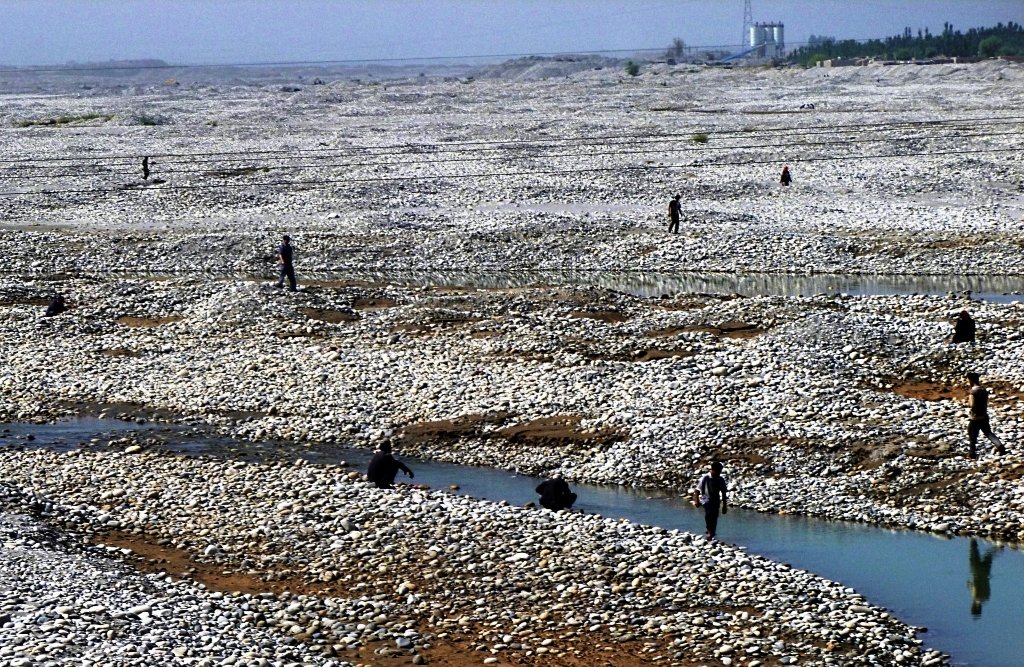
Hotan sits at the southern edge of the Taklamakan Desert, where the rivers flowing down from the Kunlun Mountains bring enough water to sustain an oasis of mulberry trees and vineyards. It was an important city on the southern Silk Road — the main alternative route to the northern one through Turpan and Kuqa — and a place of particular commercial importance because of two things found here and almost nowhere else: jade and fine silk.
The jade comes from the Yurungkash River and Karakash River — the White Jade River and the Black Jade River — which have carried nephrite out of the Kunlun Mountains for thousands of years. The Chinese imperial court considered Hotan jade the finest in existence, and the trade dates back at least 3,000 years. You can still wade into the Yurungkash riverbed outside town and, with luck and a good eye, find raw stone. The Sunday market and the daily jade bazaar are good places to see how the trade operates today — polished pieces, raw chunks, carvings, and a great deal of haggling.
The carpet and silk industries give Hotan a different character from the cities of the northern route. Local workshops still produce traditional Uyghur carpets with geometric patterns and deep reds and blues, and the silk bazaar sells atlas silk — the ikat-woven fabric with its characteristic blurred pattern. Both are significantly cheaper here than anywhere else in China, and the quality at the better workshops is genuinely high. The Hotan Cultural Museum has good displays on the Buddhist kingdoms that preceded the Islamic conversion of the region, including murals and artefacts from the lost cities of Dandan Oilik and Niya buried in the desert. Further out, the Rawak Stupa and Melikawat ruins are among the most evocative desert sites in Central Asia.
Hotan is more conservative than the northern Xinjiang cities and the security presence is visible. Travel here requires the same patience with checkpoints and registration requirements as elsewhere in the region. Flights connect to Ürümqi and Kashgar; trains have reached the city since 2011 and now link it to the broader Xinjiang rail network.